Astreopora Coral
Astreopora, usually sold as star coral or porous star coral, is a small-polyp stony (SPS) coral - a colonial animal (a cnidarian), not a plant.
🗓️ Last reviewed: July 2026
Overview
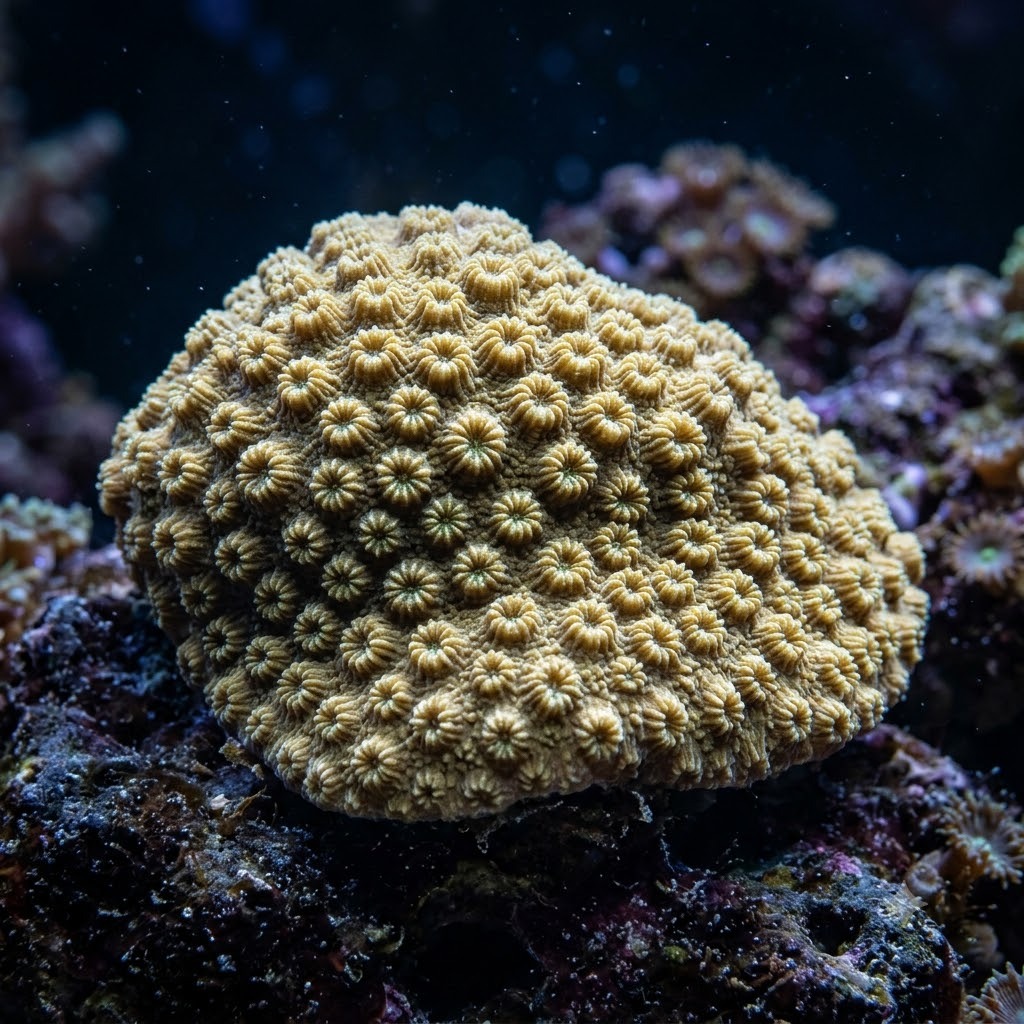
Astreopora, usually sold as star coral or porous star coral, is a small-polyp stony (SPS) coral - a colonial animal (a cnidarian), not a plant. It belongs to the Acroporidae, the same family as Acropora and Montipora, but it grows as a solid encrusting crust or a rounded dome rather than a branching structure. Its corallites are small, evenly spaced and slightly raised, giving the surface a distinct scattering of tiny stars. It is less common in the trade than its famous relatives but it is a real hobby coral and a comparatively steady one.
Origin & Habitat
The genus is Indo-Pacific, ranging from the Red Sea and East Africa through the Indian Ocean to the western Pacific, where it grows on reef slopes, flats and lagoon floors, often in areas with moderate light and steady water movement. It is a slower, more massive builder than the branching Acroporids. Aquacultured frags are the responsible option - wild stony coral collection is regulated and all stony corals (order Scleractinia) are listed under CITES Appendix II - and captive-grown pieces adapt more predictably to tank lighting.
Appearance
Colonies form low mounds or thick crusts with a firm, stony feel. The corallites sit in shallow raised cones spread evenly across the surface, and when the polyps extend the colony takes on a soft, dotted fuzz that softens the outline. Typical colours are cream, tan, pale green, brown and occasionally purple or pink, usually more muted than a designer Acropora morph. The visual appeal is texture and form rather than neon colour.
Placement & Temperament
Astreopora is peaceful. Like other Acroporids it has no long aggressive sweeper tentacles, so it will not sting neighbours across a gap, but as an encrusting and mounding coral it slowly claims the rock it sits on and can eventually contact a neighbour. Leave a few centimetres of clearance. Mount it securely on solid rock in the middle third of the tank where light is decent and flow is unobstructed; it is not a sand-bed coral, since settling detritus on the dome causes patchy tissue loss.
Tank & Water Conditions
Standard reef targets: salinity 1.024-1.026, temperature 24-27 C (75-81 F), alkalinity 8-11 dKH, calcium 400-450 ppm and magnesium 1300-1350 ppm. A mature system with steady chemistry is essential, as with any SPS. Keep nitrate and phosphate low but present rather than stripped to zero. Astreopora is not as knife-edge sensitive as Acropora, but it is still an Acroporid and it dislikes alkalinity swings.
Lighting & Flow
Moderate to bright light, roughly 150-250 PAR, suits it, with gradual acclimation to any increase. It tolerates a slightly lower light level than most Acropora without losing tissue, though colour dulls in dim placements. Flow should be moderate to strong and turbulent so that nothing settles on the upper surface of the mound - a dome shape sheds detritus far less effectively than a branching colony, so current direction matters.
Feeding
Symbiotic zooxanthellae supply most of the energy budget, making light the primary food source. The small polyps also capture fine particulate matter, and occasional broadcast feeding with microplankton or a powdered coral blend supports growth and colour. Target feeding is unnecessary and hard to do well at this polyp size. Clean, stable water contributes far more to a healthy Astreopora than any feeding routine.
Health & Growth
Growth is slow to moderate - this coral thickens and spreads rather than shooting outward, so expect a patient project rather than a fast frag factory. It is reasonably hardy for an SPS, but the usual quarantine rules apply: inspect and dip every new frag. Note that the headline Acroporid pests are host-specific - Acropora-eating flatworms feed on Acropora and Montipora-eating nudibranchs on Montipora, and neither has Astreopora as a known target - so the realistic risk here is hitch-hiking algae, worms and crabs on the plug rather than a dedicated predator. Warning signs include a receding tissue margin exposing white skeleton, browning under weak light, and bleaching after a lighting change made too quickly. Rapid tissue necrosis is less common here than in Acropora but not impossible after a serious parameter swing.
Pros & Cons
Pros
- Peaceful Acroporid with no sweeper tentacles
- Steadier and more forgiving than Acropora while offering similar family texture
- Solid mounding form that adds structure between branching corals
Cons
- Slow-growing, so a frag takes a long time to become a display piece
- Muted colours compared with designer SPS morphs
- Less widely stocked, and dome shape collects detritus if flow is weak
🧠 Test yourself: guess the exotic
Three clues from our quiz bank, each about another of our exotic. Can you name them?
Clue 1.This ambush hunter has a single ear on its underside, tuned to detect the echolocation of hunting bats.
It's the Praying Mantis - read the full profile →
Clue 2.Sold cheaply at beach shops, this pet has one oversized claw used to seal the entrance of its home.
It's the Hermit Crab - read the full profile →
Clue 3.This twig-mimicking insect is a master of camouflage and can sometimes regrow a lost leg when it molts.
It's the Stick Insect (Phasmid) - read the full profile →