Finger Leather Coral
The Finger Leather Coral is a soft coral - a colonial marine animal (a cnidarian), not a plant - commonly sold as species of Sinularia and the related Devils-hand leather (Lobophytum).
Updated: September 2026
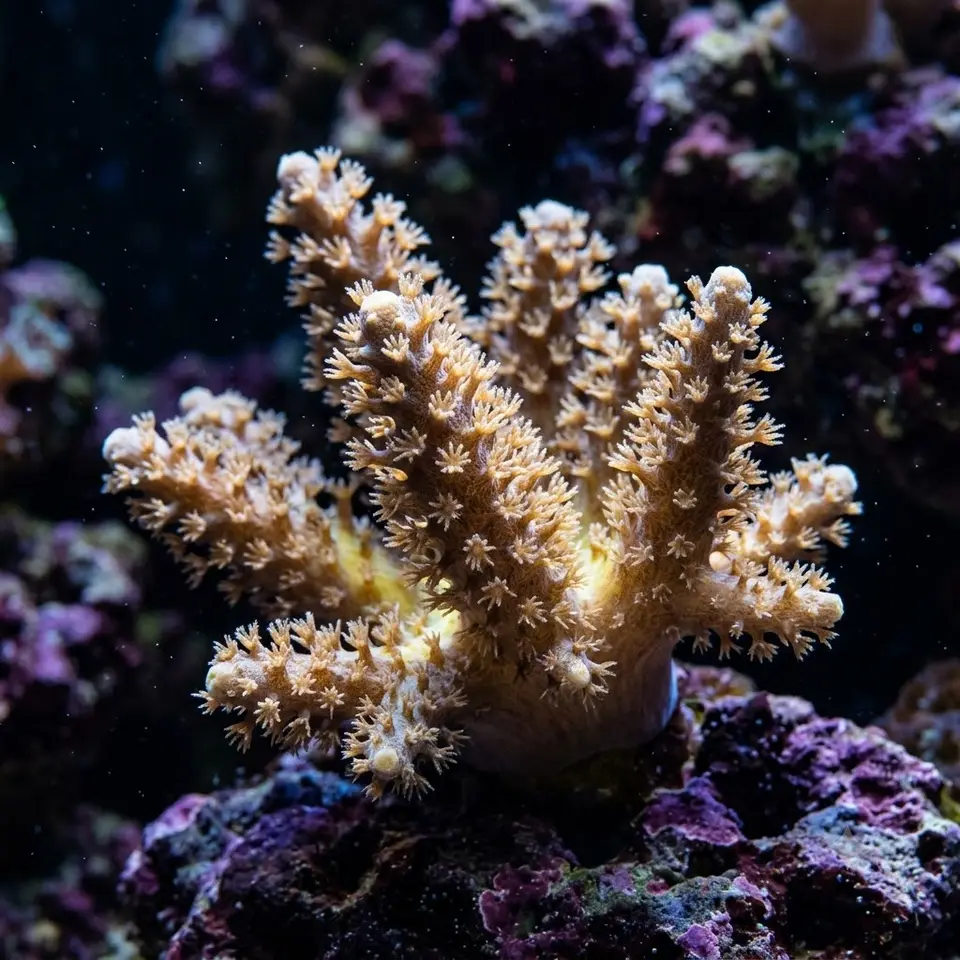 AI illustration
 Overview
The Finger Leather Coral is a soft coral - a colonial marine animal (a cnidarian), not a plant - commonly sold as species of Sinularia and the related Devils-hand leather (Lobophytum). It forms a tough, leathery base topped with finger-like lobes studded with tiny feeding polyps, and it is one of the most forgiving corals for a newer reefkeeper. Its two hallmark behaviours are periodic shedding of a waxy surface film and quiet chemical competition with nearby corals.
Origin & Habitat
Finger leathers are Indo-Pacific corals, ranging across reefs from East Africa and the Red Sea through Indonesia, the Philippines, and out to the western Pacific and the Great Barrier Reef. They are not Caribbean or Atlantic animals. In the wild they thrive on shallow reef flats, lagoon margins, and upper slopes where light is strong and water movement is brisk, often forming large low colonies that dominate patches of rock.
Appearance
The colony has a thick, rubbery trunk that branches into blunt, finger-shaped lobes; Devils-hand forms flatter, hand-like fronds. Colours are usually muted and earthy - cream, tan, olive, brown, or soft green - rather than neon. When the coral is open and healthy, the surface looks fuzzy or velvety from thousands of extended polyps. By night, or when disturbed, the polyps retract and the colony shrinks to a smooth, slightly waxy, leathery mass. From time to time it may go dull and closed for a day or two and slough a thin waxy film; this is normal self-cleaning, not disease.
Placement & Temperament
This coral does not have long stinging sweeper tentacles, so it is not physically aggressive. Its weapon is chemical: it releases terpenoid compounds into the water that can suppress or irritate nearby corals, especially small-polyp stony corals downstream of it. Because of this, give it a clear buffer of several inches from other corals, keep good water flow and running carbon to dilute the chemicals, and place it on the rock in the lower or middle third of the aquascape, or on the sand bed, where it has room to grow without leaning onto neighbours.
Tank & Water Conditions
Keep it in a mature, stable reef tank. Target salinity 1.024-1.026, temperature 24-27 C (75-81 F), and the reef "big three": alkalinity 8-11 dKH, calcium 400-450 ppm, and magnesium 1300-1350 ppm. Soft corals are less demanding of calcium and alkalinity than stony corals, but stability matters more than chasing perfect numbers. It tolerates slightly higher nutrient levels than SPS corals, which is part of why it is so beginner-friendly.
Lighting & Flow
Finger leathers do well under low-to-moderate reef lighting, roughly 40-150 PAR, and adapt to a wide range - too much intense light can bleach or stress them, while too little leaves them limp and pale. Flow should be moderate to strong and, ideally, a bit turbulent: good movement helps the polyps extend, carries away shed film and mucus, and prevents detritus from settling on the lobes.
Feeding
Most of its energy comes from symbiotic zooxanthellae (photosynthetic algae) living in its tissue, so strong lighting is its main food source. It captures very little particulate food and generally does not need target feeding; if you wish, occasional broadcast feeding of fine plankton or coral foods aimed at the whole tank can offer a small supplement, but it is not required for good growth.
Health & Growth
This is a genuinely hardy, fast-growing soft coral - one of the reasons it is recommended to beginners. A healthy colony stands upright with polyps extended most of the day. Warning signs include staying closed and shrunken for more than a few days, a persistent slimy coat that never sheds, tissue turning white or breaking down, or the colony flopping over and not recovering. Remember that a brief closed-and-waxy phase followed by shedding is normal. It propagates readily: a cut lobe can be attached to rock and will grow into a new colony.
Sourcing
Because finger leathers frag and grow so readily, aquacultured and hobbyist-fragged colonies are widely available; choose one of these over a wild-collected import whenever you can, as tank-raised frags ship better, carry fewer hitchhiking pests, and settle in faster. Soft corals such as Sinularia and Lobophytum are generally not listed on CITES (unlike all stony corals, which are CITES-regulated), but buying captive-propagated stock is still the responsible, sustainable choice and easy to find.
Pros & Cons
Pros
- Hardy, forgiving, and fast-growing - excellent for beginners and easy to frag
- Tolerates a range of light and moderate nutrients, and needs no target feeding
Cons
- Releases terpene chemicals that can suppress nearby corals, so it needs space and carbon
- Regular waxy shedding and muted earth-tone colours disappoint keepers wanting bright, always-open corals
Everyday gear for a reef tank
Links go to Amazon or a partner brand's own store and may earn us a commission at no extra cost to you. As an Amazon Associate we earn from qualifying purchases. An Amazon link leads to a type of gear and you choose the exact product; a card that names a store leads to that partner's own shop.