Leptastrea Coral
Leptastrea is a small-polyp stony (SPS) coral - a colonial animal (a cnidarian), not a plant - that grows as a flat encrusting crust or a low, rounded mound.
🗓️ Last reviewed: July 2026
Overview
Leptastrea is a small-polyp stony (SPS) coral - a colonial animal (a cnidarian), not a plant - that grows as a flat encrusting crust or a low, rounded mound. It sits at the boundary of the SPS category: the polyps are small and packed tightly, but they are meatier and more visible than an Acropora's, and hobbyists usually file it with the encrusting SPS group alongside Cyphastrea. It is exceptionally hardy, spreads reliably across rock, and is often sold as a named colour morph rather than by species.
Origin & Habitat
The genus is Indo-Pacific, found from the Red Sea and East Africa across to the Pacific, encrusting hard substrate on reef flats, slopes, lagoon rubble and shaded overhangs. It handles turbid, variable conditions in the wild, which is exactly why it is so tolerant in a tank. Nearly all hobby stock is aquacultured, and that is the right choice - wild collection of stony corals is regulated and all stony corals (order Scleractinia) are listed under CITES Appendix II - and Leptastrea propagates so readily that captive frags are the norm.
Appearance
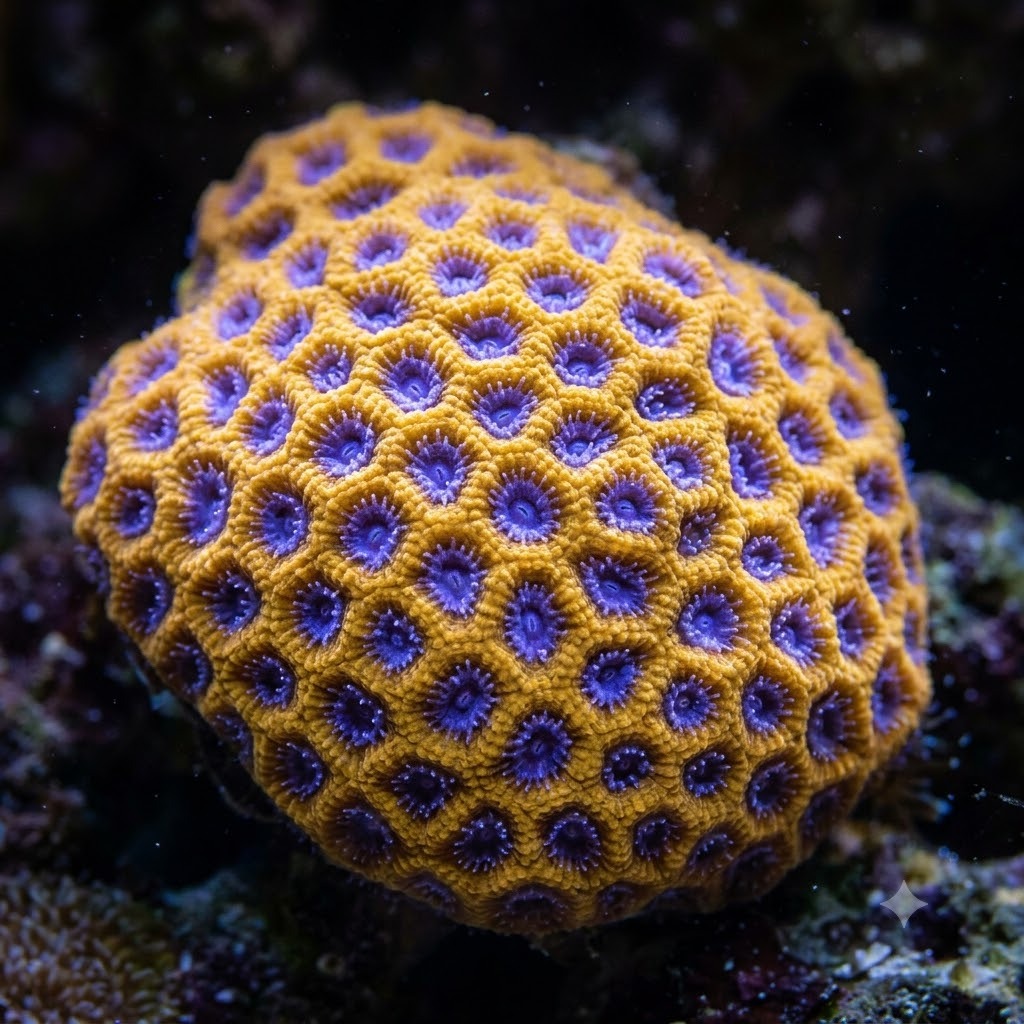
A Leptastrea colony reads as a smooth, tightly tiled mosaic: polygonal corallites packed against each other with little space between, so the surface looks paved rather than dotted. Popular morphs pair a bright polyp colour with a contrasting base - deep purple with green centres, pink with cream, orange with yellow. Feeding tentacles emerge mainly at night and change the look entirely, turning a flat plate into a bristling surface.
Placement & Temperament
Leptastrea is deceptively aggressive at close range. It has no long sweepers, but it fights by contact - the advancing encrusting edge digests and kills tissue it touches, and it reliably wins against slower neighbours. Give it its own patch of rock with a clear margin, or accept that it will annex everything within reach over time. It tolerates a wide range of positions, from bright upper rock to shaded low ledges, so there is rarely a reason to place it tight against another coral.
Tank & Water Conditions
Target salinity 1.024-1.026, temperature 24-27 C (75-81 F), alkalinity 8-11 dKH, calcium 400-450 ppm and magnesium 1300-1350 ppm. This is one of the least demanding stony corals in terms of water quality, tolerating higher nutrients and less-than-perfect stability better than any branching SPS. That said, it is still a calcifying animal, so consistent alkalinity and calcium drive its growth rate, and long neglect shows up as a stalled encrusting front.
Lighting & Flow
Low to moderate light works, roughly 75-200 PAR, and many of the best-coloured colonies sit on shaded ledges rather than up top. Intense light can bleach it or flatten the colour contrast between polyp and base. Flow should be moderate and turbulent so detritus does not settle on the flat surface; heavy direct blasting is unnecessary and can irritate the tissue.
Feeding
Zooxanthellae in its tissue cover most of its energy budget, so light remains the primary food. Beyond that, Leptastrea is a genuinely enthusiastic feeder for a small-polyp coral - its nocturnal feeding tentacles readily take baby brine, finely chopped mysis and powdered coral foods, and regular evening feeding visibly accelerates encrusting growth. That is a real advantage for a coral often kept in dimmer spots.
Health & Growth
Hardy and persistent is the summary. Growth is a steady outward creep, faster with feeding, and a frag will typically cover its plug and start onto surrounding rock within a few months. Problems are usually external rather than internal: algae crowding the leading edge, or a neighbouring coral stinging it back. Watch for a growth front that stops advancing, polyps staying shut in daylight for extended periods, or bleached patches after a lighting upgrade. Fragging is a matter of cutting encrusted rock, and pieces recover quickly.
Pros & Cons
Pros
- Extremely hardy and tolerant of moderate nutrients and lower light
- Feeds enthusiastically, which speeds growth even in dim placements
- Bold two-tone colour morphs and easy propagation
Cons
- Aggressive by contact - kills and overgrows neighbours it reaches
- Encrusting spread needs monitoring or it takes over a rock
- Colour contrast can bleach out under strong lighting
🧠 Test yourself: guess the exotic
Three clues from our quiz bank, each about another of our exotic. Can you name them?
Clue 1.This twig-mimicking insect is a master of camouflage and can sometimes regrow a lost leg when it molts.
It's the Stick Insect (Phasmid) - read the full profile →
Clue 2.This predatory insect, named for its folded, spiked forelegs held as if in prayer, is the only insect that can swivel its head nearly 180 degrees.
It's the Praying Mantis - read the full profile →
Clue 3.This hermaphrodite gastropod has both sexes in one body and can lay over a thousand eggs a year.
It's the Giant African Land Snail - read the full profile →