Porites Coral
Porites, sold as finger coral, jewel coral or most often as "Christmas tree worm rock," is a small-polyp stony (SPS) coral - a colonial animal (a cnidarian), not a plant.
🗓️ Last reviewed: July 2026
Overview
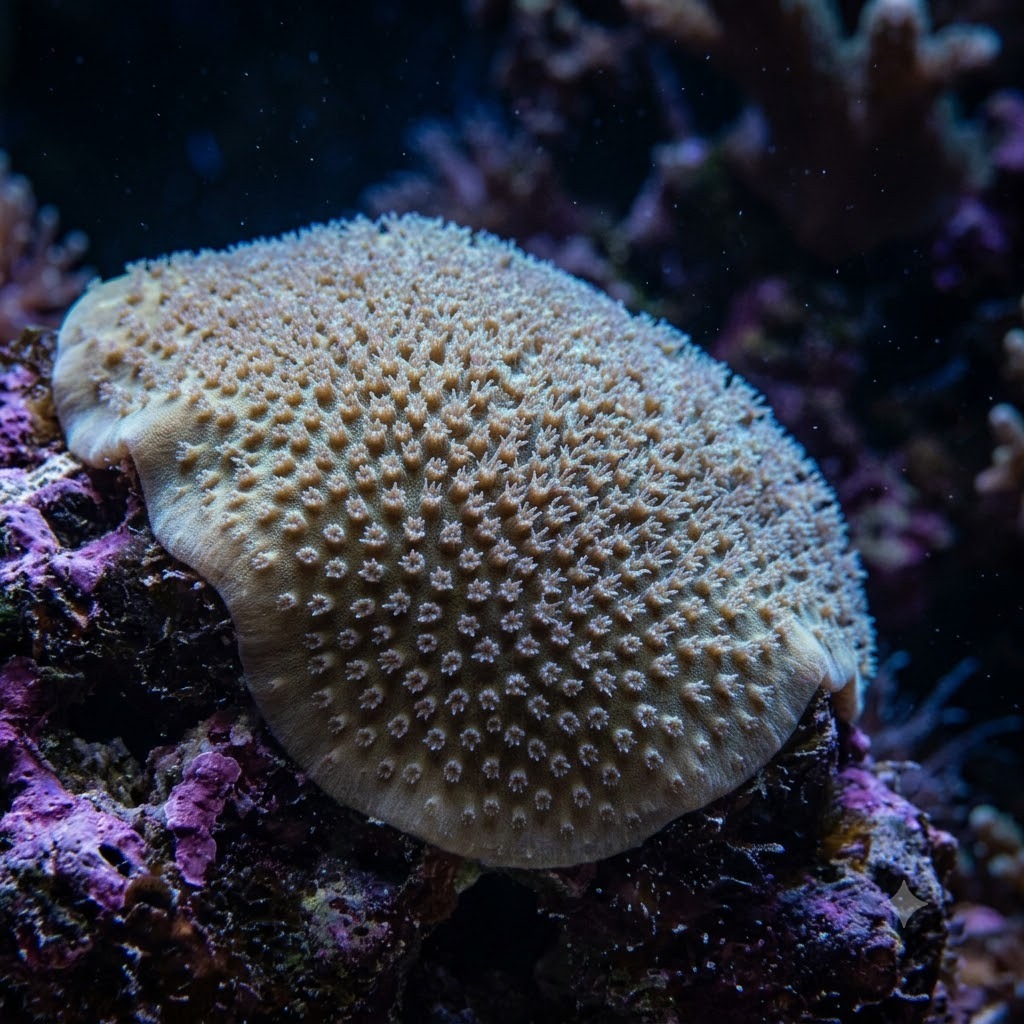
Porites, sold as finger coral, jewel coral or most often as "Christmas tree worm rock," is a small-polyp stony (SPS) coral - a colonial animal (a cnidarian), not a plant. Its corallites are among the tiniest of any reef coral, giving colonies a smooth, almost stone-like surface that fuzzes over when the polyps extend. On the reef it is a major builder of massive boulder colonies; in aquariums it has a reputation as one of the harder SPS corals to keep alive long term, and that reputation is earned.
Origin & Habitat
Porites is found throughout the Indo-Pacific and also in the Caribbean, on reef flats, slopes, lagoons and back reefs, forming everything from encrusting sheets to branching fingers to multi-metre boulders. Wild collection of stony corals is regulated and all stony corals (order Scleractinia) are listed under CITES Appendix II, so aquacultured frags are the responsible choice. This matters more than usual here: much of the Porites in the trade arrives as wild-collected worm rock, and those pieces frequently decline in home tanks, so seek out captive-grown material where you can.
Appearance
Colonies look deceptively simple - smooth domes, lobes or blunt fingers in cream, yellow, purple, pink, green or pale brown. Look closely and the surface is covered in a dense field of pinhole corallites, and when the polyps are out the whole colony takes on a fine velvet nap. The famous version is a Porites head studded with Christmas tree worms (Spirobranchus), which are separate animals living in tubes bored into the living coral, not part of the coral itself.
Placement & Temperament
Porites is peaceful - no sweeper tentacles, no chemical aggression worth planning around. Its needs are about position rather than politics: mount it where flow is brisk and multidirectional so nothing settles on the surface, and where light is bright and consistent. Sand-bed placement is a common mistake, since detritus drifting against the base starts tissue recession that then creeps upward. Give it a clear, well-flushed spot on the rockwork and leave the colony undisturbed once it has attached.
Tank & Water Conditions
Target salinity 1.024-1.026, temperature 24-27 C (75-81 F), alkalinity 8-11 dKH, calcium 400-450 ppm and magnesium 1300-1350 ppm. Porites wants a genuinely mature system with very stable chemistry; it responds badly to swings and to newly cycled tanks. It is not an ultra-low-nutrient coral either - some measurable nitrate and phosphate helps, and stripping the water bare is a frequent cause of slow decline.
Lighting & Flow
Bright light in the 150-300 PAR range suits most hobby species, with gradual acclimation to avoid bleaching. Flow is arguably the more critical variable: strong, turbulent, varied current is what keeps the smooth surface clean. Because the corallites are so small, even a light dusting of detritus or a film of algae can shut down a patch of tissue, and once tissue lifts, the exposed skeleton is quickly colonised by algae that the coral cannot reclaim.
Feeding
Symbiotic zooxanthellae supply the bulk of its energy, so lighting comes first. The polyps are extremely small and can only handle very fine particulate food - microplankton, powdered coral blends, or the general suspended matter of a well-fed tank. Direct target feeding is largely futile at this polyp size. If the colony hosts Christmas tree worms, those filter-feeding worms do benefit from fine suspended foods, which is a separate consideration from feeding the coral.
Health & Growth
Be honest with yourself before buying: Porites is slow-growing and unforgiving, and a great many colonies waste away over months rather than thriving. Success comes from a mature tank, unwavering parameters, strong flow and patience. Warning signs are patchy tissue loss exposing white skeleton, algae taking hold on bare spots, and worms abandoning their tubes on worm rock, which usually indicates the underlying coral is failing. Growth, when it does happen, is a slow thickening and spreading rather than the visible surges of a digitata or Pocillopora.
Pros & Cons
Pros
- Peaceful with no sweeper tentacles, safe to place near other corals
- Distinctive smooth, velvety colonies and the classic Christmas tree worm host
- Long-lived and structurally solid once genuinely established
Cons
- Genuinely difficult - many colonies slowly decline despite decent care
- Slow growth and low tolerance for detritus, weak flow or parameter swings
- Much of the trade stock is wild-collected worm rock with a poor survival record
🧠 Test yourself: guess the exotic
Three clues from our quiz bank, each about another of our exotic. Can you name them?
Clue 1.Used in classrooms and films, this docile, climbing insect cannot fly and grows several inches long.
It's the Madagascar Hissing Cockroach - read the full profile →
Clue 2.Belonging to an order whose name means 'apparition,' this insect includes some of the longest insects on Earth.
It's the Stick Insect (Phasmid) - read the full profile →
Clue 3.Social by nature, these scavengers form lines to swap shells and breathe through gills needing humid air.
It's the Hermit Crab - read the full profile →