Stylophora Coral
Stylophora, often sold as cat's-paw or club-finger coral, is a small-polyp stony (SPS) coral - a colonial animal (a cnidarian), not a plant.
Updated: July 2026
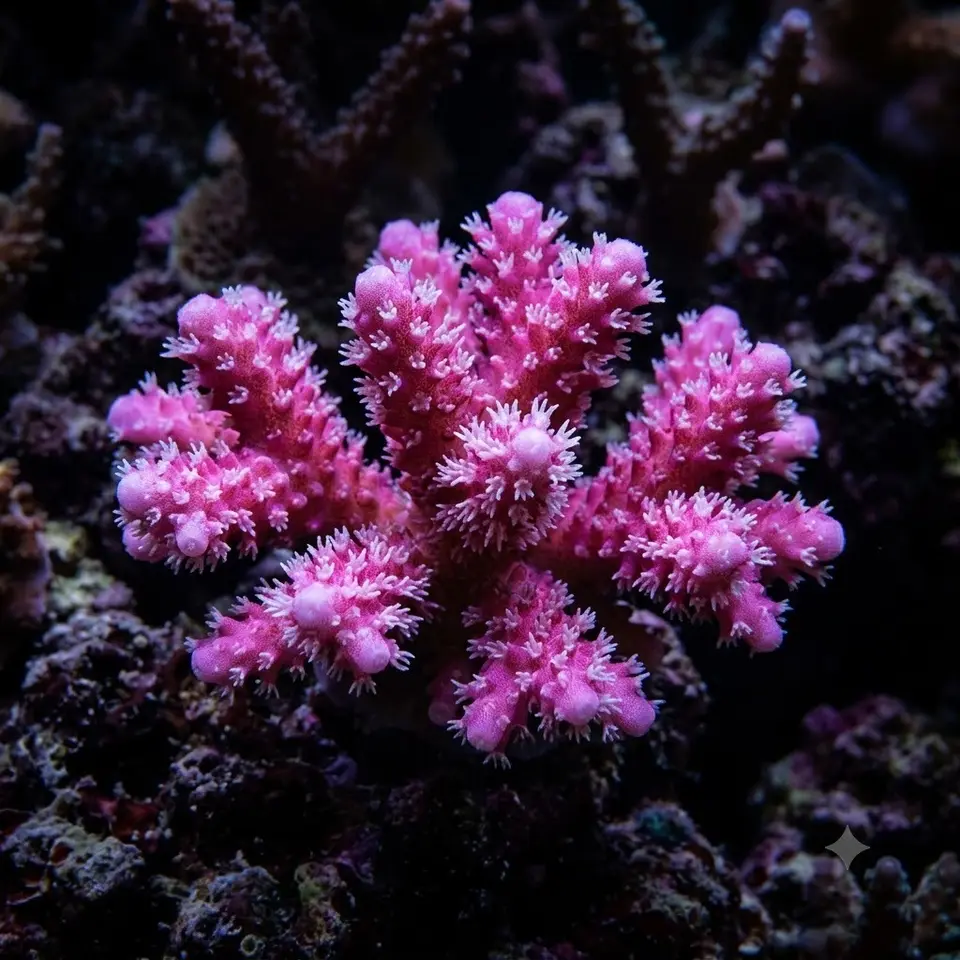 AI illustration
 Overview
Stylophora, often sold as cat's-paw or club-finger coral, is a small-polyp stony (SPS) coral - a colonial animal (a cnidarian), not a plant. It forms sturdy, thick, blunt-tipped branches covered in tiny fuzzy polyps, and is widely considered one of the more forgiving SPS corals. It is a popular "gateway SPS" for aquarists moving up from soft corals and LPS, though it still demands stable reef chemistry.
Origin & Habitat
Stylophora is an Indo-Pacific coral, found across the Red Sea, the Indian Ocean and the western Pacific on shallow reef flats, slopes and lagoons. It thrives in bright, well-lit, high-energy zones where wave action keeps the branches clean. It is not a Caribbean/Atlantic genus. Most aquarium stock is aquacultured; wild stony corals are regulated, and all stony corals (order Scleractinia) are listed under CITES Appendix II, so aquacultured frags are the responsible choice.
Appearance
Colonies grow as clusters of stout, rounded branches with characteristic blunt, club-like tips. When the polyps extend, the surface takes on a soft, fuzzy or hairy look; when retracted, the underlying skeleton and its neat pinhole corallites show through. Colours range widely - pink, salmon, green, cream, purple and brown - often with contrasting polyp colour. Polyps commonly extend during the day under stable conditions and can retract at night or when the coral is stressed or disturbed.
Placement & Temperament
Stylophora is a relatively peaceful SPS. It does not deploy the long, aggressive sweeper tentacles that some LPS corals use, so it is a good neighbour by SPS standards. Even so, it grows fast and can shade or crowd out slower corals, so leave a few centimetres of open space around the colony. Place it on the rockwork in the upper-to-middle third of the tank where light and flow are strongest - not on the sand bed, where detritus and lower flow can smother the base.
Tank & Water Conditions
Give Stylophora a mature, stable reef aquarium; sudden swings are the usual killer of SPS. Target salinity 1.024-1.026, temperature 24-27 C (75-81 F), and hold the reef "big three" steady: alkalinity 8-11 dKH, calcium 400-450 ppm, and magnesium 1300-1350 ppm. Keep nitrate and phosphate low but not zero, as ultra-low nutrients can bleach or pale the colony. Consistency matters more than chasing perfect numbers - stable alkalinity in particular is critical.
Lighting & Flow
As an SPS, Stylophora wants bright light: roughly 150-300 PAR is a sensible range, landing in the middle of the SPS band. Acclimate it gradually to strong lighting to avoid bleaching. Pair that with moderate-to-strong, turbulent flow that shifts direction so no detritus settles on the branches; too little flow leads to algae and tissue recession, while flow that is strong but not blasting keeps the polyps healthy and well-fed.
Feeding
Stylophora gets most of its energy from its symbiotic zooxanthellae (photosynthetic algae in its tissue), so good lighting is its primary "food." The tiny polyps will also capture particulate food, and occasional feeding of very fine reef foods (such as microplankton or reef-blend suspensions) can support colour and growth. Target feeding is optional rather than essential - clean water and stable chemistry matter far more.
Health & Growth
This is one of the hardier SPS corals and a good confidence-builder, but "hardy for an SPS" still means less forgiving than most soft corals or LPS. Growth is fast once settled, with encrusting bases and branching tips. Watch for warning signs: tissue recession from the base, sudden polyp retraction, browning (often too few nutrients or weak light), or bleaching (light shock or unstable parameters). Rapid tissue loss - "STN" (slow tissue necrosis) or "RTN" (rapid tissue necrosis) - can strip a colony in hours to days and is usually triggered by parameter swings, especially unstable alkalinity. Catching problems early and stabilising the water is key.
Pros & Cons
Pros
- One of the easiest SPS corals to keep - a solid first step into the group
- Fast, rewarding growth and vivid colours under good light
- Peaceful, with no long aggressive sweeper tentacles
Cons
- Still an SPS: needs a mature tank and rock-stable alkalinity, calcium and magnesium
- Vulnerable to rapid tissue necrosis (RTN/STN) when parameters swing
- Fast growth can crowd or shade slower neighbours if not given space
Everyday gear for a reef tank
Links go to Amazon or a partner brand's own store and may earn us a commission at no extra cost to you. As an Amazon Associate we earn from qualifying purchases. An Amazon link leads to a type of gear and you choose the exact product; a card that names a store leads to that partner's own shop.