Clove Polyps
Clove polyps (genus Clavularia) are a hardy soft coral, not a plant - each is a colony of small cnidarian animals.
Updated: September 2026
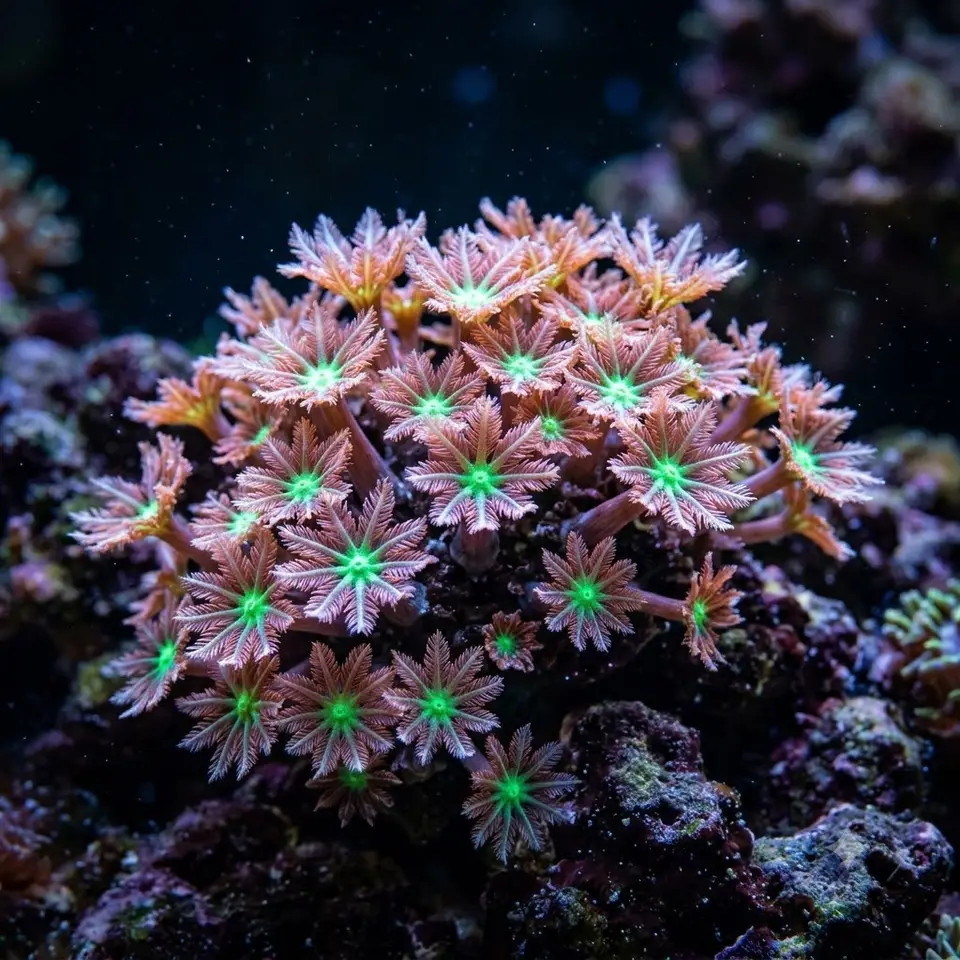 AI illustration
 Overview
Clove polyps (genus Clavularia) are a hardy soft coral, not a plant - each is a colony of small cnidarian animals. They form a spreading mat of stalks topped by delicate, star- or feather-shaped polyps, making them one of the easiest and most rewarding corals for a new reef keeper.
Origin & Habitat
Clove polyps come from tropical Indo-Pacific reefs, including waters around Indonesia, the Philippines, Fiji, and Australia. In the wild they grow on rubble, rock, and reef slopes in shallow to moderate depths, often in areas with steady water movement and bright light.
Appearance
Colonies grow as an encrusting mat of tube-like stalks, each opening into a single polyp ringed by eight feathery tentacles that give a distinctive star or snowflake look. Colours range from cream, tan, and green to bright fluorescent green, gold, or pink, and many clove and daisy varieties glow under actinic light. Polyps extend and sway during the day and often retract into their stalks at night or when disturbed.
Placement & Temperament
Clove polyps do not have stinging sweeper tentacles and are peaceful toward their neighbours - the real concern is the opposite direction. They spread aggressively across rock and can overgrow and smother slower corals, so place them on an isolated rock, an island, or a low ledge with a clear gap or bare-rock buffer around them. Keeping a colony on its own frag rock or an "island" in the sand makes it easy to control their spread.
Tank & Water Conditions
Keep them in a mature, stable tank: salinity 1.024-1.026, temperature 24-27 C (75-81 F). Aim for the reef "big three" of alkalinity 8-11 dKH, calcium 400-450 ppm, and magnesium 1300-1350 ppm. As a soft coral they are forgiving of minor swings, but steady parameters and low nutrients still give the best colour and polyp extension.
Lighting & Flow
Clove polyps are adaptable and do well under low to moderate light, roughly 40-150 PAR; brighter light within that range can boost fluorescent colour, while very intense light offers no benefit. Give them low to moderate, somewhat random flow - enough to let the polyps sway and shed debris, but not so strong that the polyps cannot open.
Feeding
They carry symbiotic zooxanthellae and get most of their energy from light through photosynthesis. They are not heavy feeders, but occasional broadcast feeding of very fine foods such as phytoplankton or coral-food suspensions can support growth. Healthy water and good light matter more than target feeding.
Health & Growth
Clove polyps are genuinely hardy and grow quickly, readily encrusting across rock and even glass. Warning signs to watch for are polyps that stay closed for days, browning-out from too little light, or a receding, patchy mat. Their main "risk" is success - they can become a fast-spreading nuisance over prized corals, so trim or scrape back the edges before they crowd neighbours.
Buying & Sourcing
Clove polyps are one of the easiest corals to frag and propagate, so aquacultured or tank-raised colonies are widely available and inexpensive - choose these over wild-collected pieces whenever you can, as they adapt faster to aquarium life and ease pressure on wild reefs. As a soft coral, Clavularia is generally not listed under CITES the way stony corals are, but buying captive-propagated frags from a reputable seller is still the responsible choice.
Pros & Cons
Pros
- Very hardy and forgiving, ideal for beginners
- Fast-growing with bright, fluorescent star-shaped polyps
- Peaceful with no stinging sweeper tentacles
- Adapts to a wide range of light and flow
Cons
- Spreads aggressively and can overgrow slower corals
- Hard to fully remove once established on rock
- Polyps may sulk and stay closed after being disturbed
- Needs isolation or regular trimming to control
Everyday gear for a reef tank
Links go to Amazon or a partner brand's own store and may earn us a commission at no extra cost to you. As an Amazon Associate we earn from qualifying purchases. An Amazon link leads to a type of gear and you choose the exact product; a card that names a store leads to that partner's own shop.