Duncan Coral
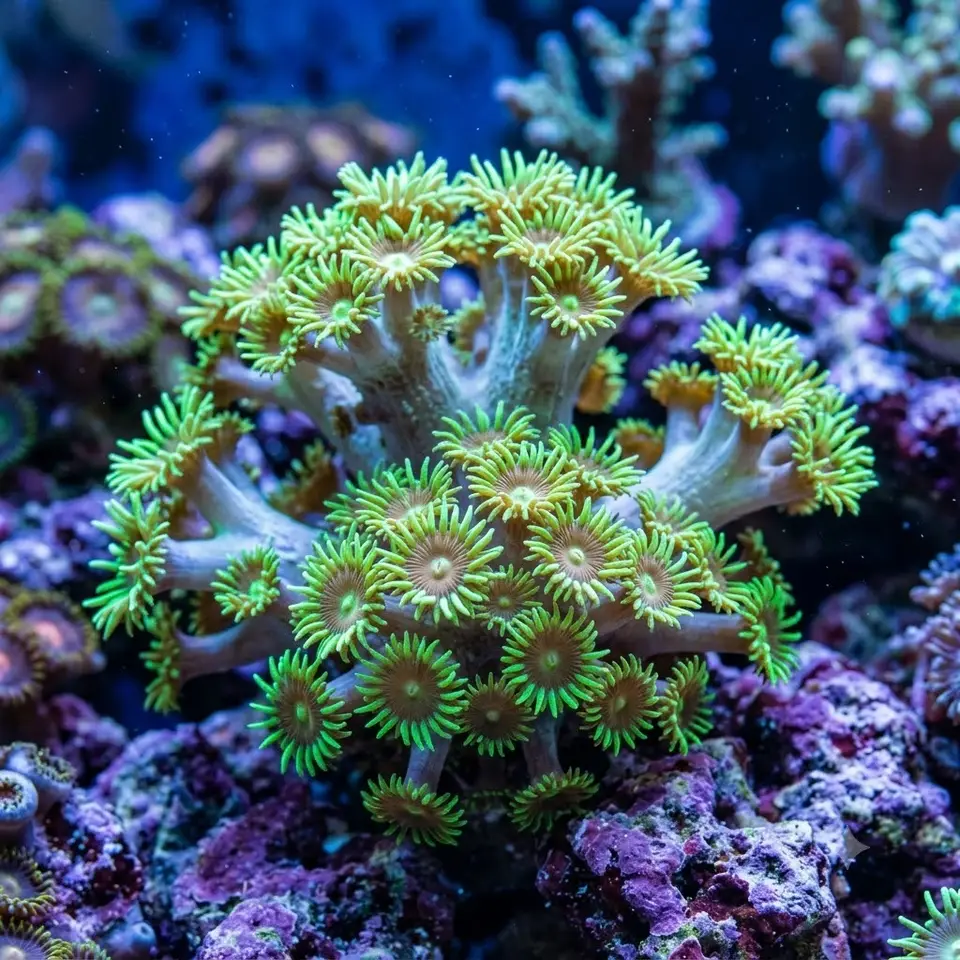
The Duncan coral is a friendly, fast, beginner LPS - clusters of daisy-like polyps with green centres and tan tentacles on branching stalks, famous for being one of the easiest corals to feed and quickest to multiply.
Last reviewed: October 2026
 AI illustration
 Overview
The Duncan coral is a friendly, fast, beginner LPS - clusters of daisy-like polyps with green centres and tan tentacles on branching stalks, famous for being one of the easiest corals to feed and quickest to multiply. (Duncanopsammia axifuga.)
Origin & Habitat
Subtropical waters off Australia and the South China Sea, on rock and rubble.
Appearance
Round polyps with a green mouth ringed by tan or green tentacles, on branching skeletons; the polyps extend widely and reach for food.
Placement & Temperament
Peaceful - one of the more community-friendly corals. Give it space to branch as the colony expands.
Tank & Water Conditions
Salinity 1.024-1.026, 24-27°C, stable alkalinity 8-11 dKH, calcium 400-450, magnesium 1300-1350.
Lighting & Flow
Low to moderate light (about 50-130 PAR) and gentle to moderate flow.
Feeding
Loves to eat - target-feed small meaty foods and it grows fast, adding new heads quickly. Very responsive feeder.
Health & Growth
Hardy, peaceful and fast-growing - an ideal starter LPS. Polyps that stay closed usually mean flow that is too strong or a fish pestering them.
Pros & Cons
Pros
- Easy, peaceful, fast-growing LPS
- Loves feeding - very rewarding
- Multiplies into a big colony
Cons
- Needs feeding to reach potential
- Closes up in strong flow
- Not the boldest colours
Everyday gear for a reef tank
Links go to Amazon or a partner brand's own store and may earn us a commission at no extra cost to you. As an Amazon Associate we earn from qualifying purchases. An Amazon link leads to a type of gear and you choose the exact product; a card that names a store leads to that partner's own shop.
Duncan Coral - frequently asked questions
Do I need to feed my Duncan coral?
It photosynthesises, but Duncans are eager feeders and grow far faster when target-fed small meaty foods a few times a week.
Why are my Duncan polyps staying closed?
Usually flow that is too strong pointed right at them, or a fish nipping the polyps. Redirect flow and watch for pests.