Favia Brain Coral
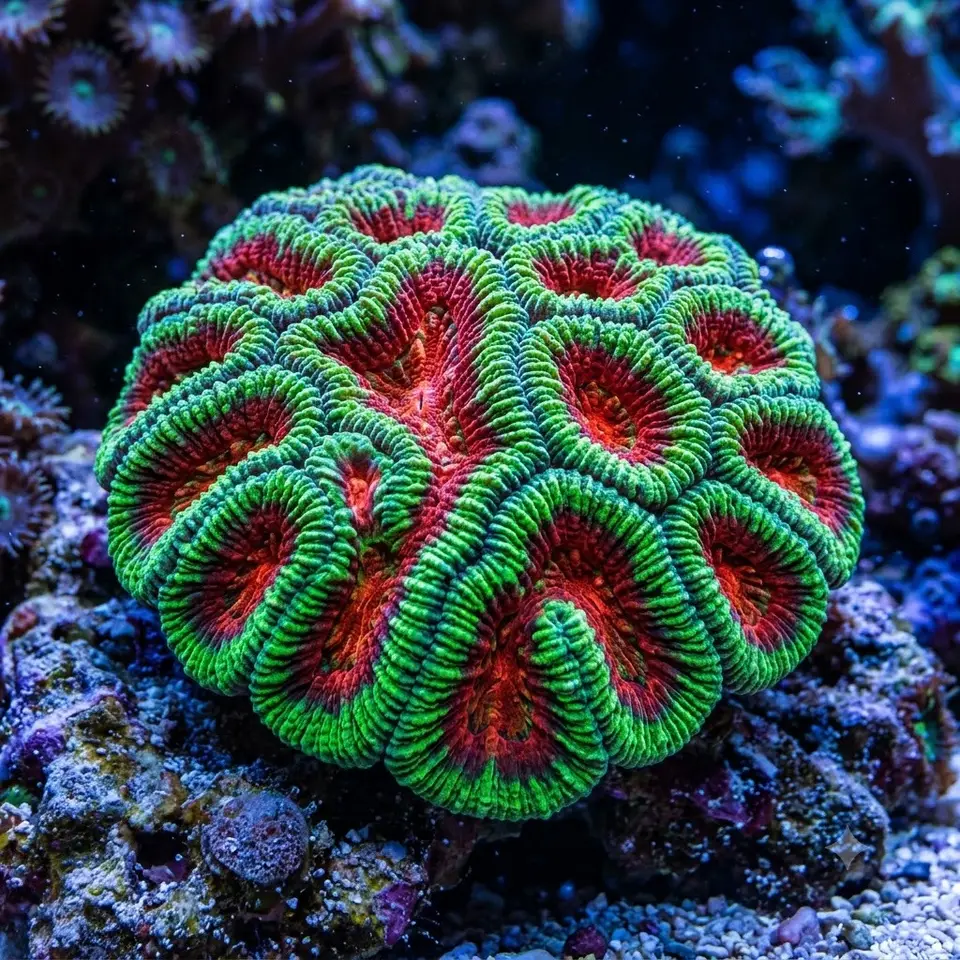
Favia (and its maze-patterned cousin Platygyra) are the encrusting 'brain' corals - hardy stony domes and plates with a surface of ridged, closely-packed corallites that glow under actinic light and grow slowly into boulders.
Last reviewed: July 2026
 AI illustration
 Overview
Favia (and its maze-patterned cousin Platygyra) are the encrusting 'brain' corals - hardy stony domes and plates with a surface of ridged, closely-packed corallites that glow under actinic light and grow slowly into boulders. Tough, colourful and long-lived. (Favia and Platygyra species.)
Origin & Habitat
Indo-Pacific reefs, across a range of depths and light levels.
Appearance
An encrusting or domed stony surface patterned with round cups (Favia) or winding mazes (Platygyra), often green, red or two-tone with strong fluorescence.
Placement & Temperament
Has strong stinging sweeper tentacles at night - give it 10-15 cm of space from other corals despite its slow growth.
Tank & Water Conditions
Salinity 1.024-1.026, 24-27°C, stable alkalinity 8-11 dKH, calcium 400-450, magnesium 1300-1350.
Lighting & Flow
Low to moderate light (about 60-150 PAR) and gentle to moderate flow.
Feeding
Photosynthetic; extends feeder tentacles at night and grows faster with occasional target feeding.
Health & Growth
Very hardy and long-lived. Slow growing, so it needs space kept clear around it because it cannot outrun neighbours.
Pros & Cons
Pros
- Hardy, long-lived stony coral
- Strong fluorescent colours
- Adapts to a range of light
Cons
- Strong night sweeper tentacles
- Slow growing
- Needs cleared space it cannot defend by speed
Everyday gear for a reef tank
Links go to Amazon or a partner brand's own store and may earn us a commission at no extra cost to you. As an Amazon Associate we earn from qualifying purchases. An Amazon link leads to a type of gear and you choose the exact product; a card that names a store leads to that partner's own shop.
Favia Brain Coral - frequently asked questions
Are brain corals aggressive?
Favia and Platygyra look passive by day but extend long stinging sweeper tentacles at night. Give them 10-15 cm of clear space from other corals.
Why does my favia glow under blue light?
Favias are full of fluorescent pigments that pop under actinic/blue LEDs - one of the reasons they are so prized.