Green Star Polyps
Green star polyps (GSP) are the classic starter coral - a purple mat that erupts in a lawn of bright green, star-shaped polyps and grows over almost anything.
Last reviewed: October 2026
 AI illustration
 Overview
Green star polyps (GSP) are the classic starter coral - a purple mat that erupts in a lawn of bright green, star-shaped polyps and grows over almost anything. They are an animal, not a plant, and they are so vigorous they are best kept on their own island of rock. (Pachyclavularia violacea.)
Origin & Habitat
Indo-Pacific reefs, growing as encrusting mats over rock and rubble in bright, moving water.
Appearance
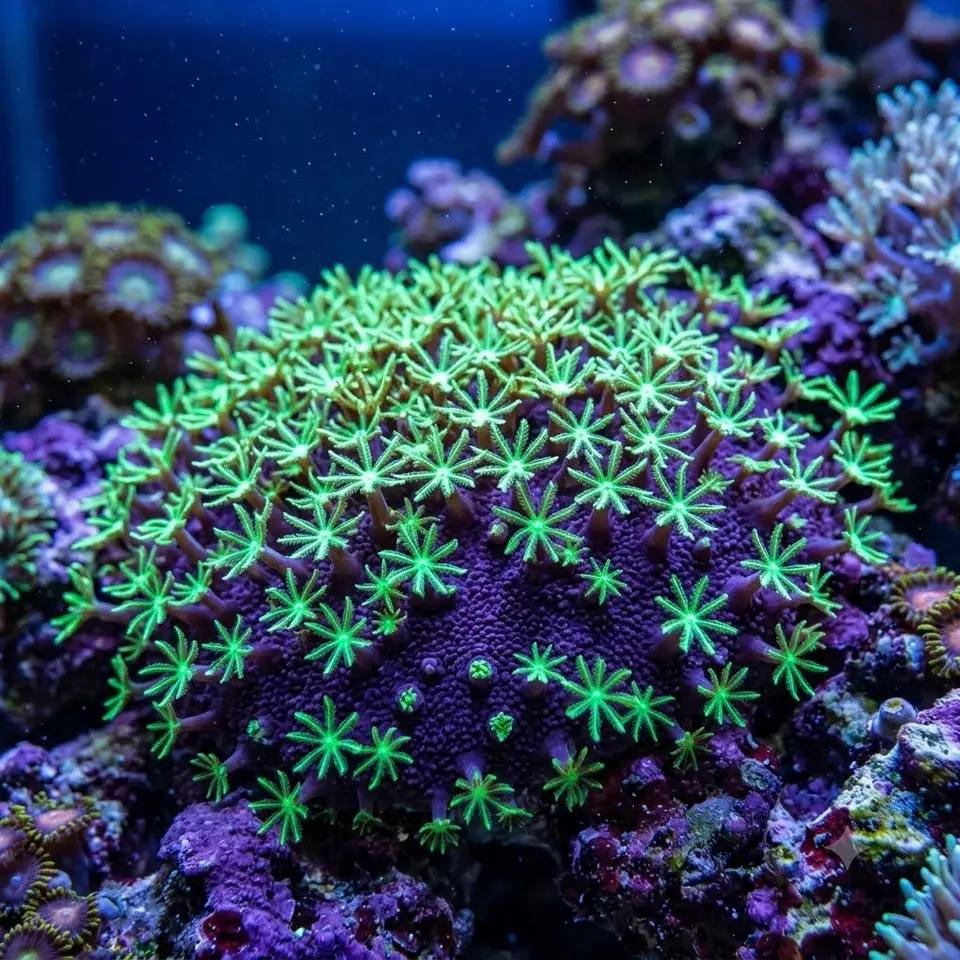
A rubbery purple base membrane studded with fuzzy green polyps that open into eight-armed stars; closes to a flat mat when disturbed.
Placement & Temperament
Peaceful to its neighbours but aggressively fast-spreading - it will encrust over other corals' bases. Keep it on an isolated rock or ledge with a moat of bare sand around it.
Tank & Water Conditions
Salinity 1.024-1.026, 24-27°C (75-81°F), stable alkalinity 8-11 dKH, calcium 400-450 ppm, magnesium 1300-1350 ppm. A cycled, stable tank.
Lighting & Flow
Low to moderate light (roughly 50-120 PAR) and moderate flow; tolerant of a wide range.
Feeding
Mostly powered by its symbiotic zooxanthellae (algae in its tissue) via light; little or no target feeding needed.
Health & Growth
Extremely hardy - one of the first corals most reefers keep. A sulking mat that stays closed for days usually signals water instability or being freshly moved.
Pros & Cons
Pros
- Bright, fast, forgiving beginner coral
- Thrives across a wide light range
- Cheap and endlessly fragged
Cons
- Weedy: encrusts and overtakes rock
- Hard to fully remove once established
- Best isolated from other corals
Everyday gear for a reef tank
Links go to Amazon or a partner brand's own store and may earn us a commission at no extra cost to you. As an Amazon Associate we earn from qualifying purchases. An Amazon link leads to a type of gear and you choose the exact product; a card that names a store leads to that partner's own shop.
Green Star Polyps - frequently asked questions
Is green star polyps good for beginners?
Yes - it is one of the hardiest corals in the hobby. The only catch is its speed: keep it on its own rock so it cannot overgrow slower corals.
Why won't my GSP open?
Usually recent handling, a swing in water parameters, or too little flow to keep it clean. Give it stable water and a few days.