Pavona Coral
Pavona, sold in the hobby as cactus coral, lettuce coral or potato-chip coral, is a small-polyp stony (SPS) coral - a colonial animal (a cnidarian), not a plant.
🗓️ Last reviewed: July 2026
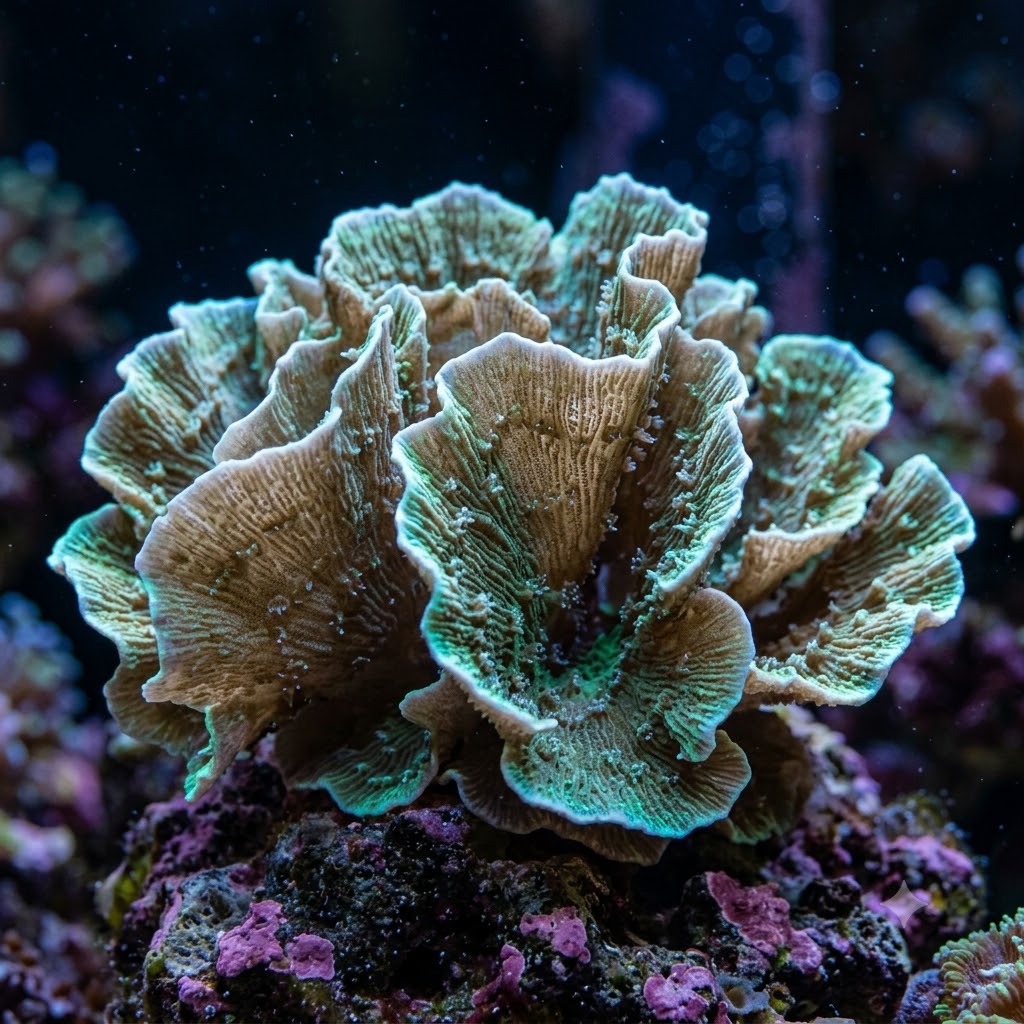
Overview
Pavona, sold in the hobby as cactus coral, lettuce coral or potato-chip coral, is a small-polyp stony (SPS) coral - a colonial animal (a cnidarian), not a plant. Its polyps are among the smallest of any hobby coral, set in shallow valleys that give the skeleton a fine, ridged texture. Common aquarium species include Pavona cactus, Pavona decussata and Pavona maldivensis, which grow as thin upright plates, contorted folds or low encrusting crusts depending on species and conditions.
Origin & Habitat
Pavona is an Indo-Pacific genus, found from the Red Sea and East Africa through the Indian Ocean to the Pacific, with some species reaching the eastern Pacific. It occupies a wide depth range, from bright shallow reef flats to shaded slopes and lagoon walls, which explains its tolerance of moderate light in aquaria. Choose aquacultured frags rather than wild-collected colonies: stony coral collection is regulated and all stony corals (order Scleractinia) are listed under CITES Appendix II, and tank-raised pieces settle in far more readily.
Appearance
The classic look is a cluster of thin, vertical plates or ruffled fronds that fold over each other like leaves, with a matte, slightly velvety surface. Colours are usually understated compared with Acropora - forest and neon green, tan, brown, cream, pink and grey-blue - and the polyps are so small that the colony often reads as a solid textured sheet rather than a mass of individual mouths. Encrusting species instead spread as a flat, patterned crust over rock before lifting into plates.
Placement & Temperament
Treat Pavona as semi-aggressive. Its main weapon is overgrowth - plates encrust across rock and lift into blades that shade and smother slower corals in contact with them - but it is also capable of developing sweeper tentacles, and P. cactus in particular is reported to extend them at night well beyond the colony edge to sting neighbours. Leave clear rock around the colony, allow extra clearance for corals sitting downstream in the flow, and prune when it reaches a neighbour. It accepts a wide range of positions, from mid-rock to the lower third, which makes it useful for filling shaded gaps where fussier SPS will not colour up.
Tank & Water Conditions
A mature, stable reef system is still the baseline. Target salinity 1.024-1.026, temperature 24-27 C (75-81 F), alkalinity 8-11 dKH, calcium 400-450 ppm and magnesium 1300-1350 ppm. Pavona tolerates slightly higher nutrients than most SPS and can look better in a modestly fed tank than in an ultra-lean one, but it dislikes swings, especially in alkalinity. Consistency is the real requirement.
Lighting & Flow
This is one of the more light-flexible SPS corals, doing well anywhere from roughly 100 to 250 PAR. Bright light drives faster, more compact growth; moderate light gives looser, thinner plates and often deeper colour. Flow should be moderate and turbulent - enough to sweep detritus out of the folds between plates, which is where problems start, but not so strong that the thin blades are damaged. Stagnant pockets inside a dense colony are the most common cause of tissue loss.
Feeding
Symbiotic zooxanthellae supply most of its energy, so lighting is the main food source. The polyps are tiny and take only very fine particles; occasional broadcast feeding of microplankton or a fine reef blend supports growth but is not essential. Target feeding is impractical given the polyp size, and a clean, stable tank does more for a Pavona than any feeding routine.
Health & Growth
Pavona is genuinely one of the easier SPS corals and a good confidence-builder, but "easier SPS" is not the same as easy - it still needs mature water and stable chemistry. Growth is moderate to fast, and encrusting bases lock the colony to the rock quickly. Watch for algae or detritus building up in the crevices between plates, which leads to tissue recession from the inside out, and check flow if the interior of a colony starts to brown or die back. Bleaching usually follows a lighting change made too fast; browning usually means too little light.
Pros & Cons
Pros
- Tolerant of moderate light and slightly higher nutrients than most SPS
- Useful for filling mid- and lower-rock gaps where fussier SPS will not colour up
- Distinctive plate and frond texture unlike any branching stony coral
Cons
- Encrusts and overgrows slower neighbours in contact with it
- Can develop sweeper tentacles at night, so downstream neighbours need clearance too
- Detritus trapped between plates causes recession if flow is too gentle
- Colours are subtler than the bright morphs of branching SPS
🧠 Test yourself: guess the exotic
Three clues from our quiz bank, each about another of our exotic. Can you name them?
Clue 1.Used in classrooms and films, this docile, climbing insect cannot fly and grows several inches long.
It's the Madagascar Hissing Cockroach - read the full profile →
Clue 2.With triangular head, swiveling neck, and grasping front limbs, this stick-mimicking insect strikes prey in a fraction of a second.
It's the Praying Mantis - read the full profile →
Clue 3.This hermaphrodite gastropod has both sexes in one body and can lay over a thousand eggs a year.
It's the Giant African Land Snail - read the full profile →