Rhodactis Mushroom Coral
Rhodactis mushroom coral is a soft coral - a colonial invertebrate animal (a cnidarian in the corallimorph group), not a plant.
Updated: August 2026
Group guide: Mushroom Coral · All soft corals
 AI illustration
 Overview
Rhodactis mushroom coral is a soft coral - a colonial invertebrate animal (a cnidarian in the corallimorph group), not a plant. It is one of the hardiest reef animals a beginner can keep: it tolerates a wide range of conditions, spreads quickly, and asks for very little light or flow. Despite the "mushroom" nickname, each polyp is a living animal that hosts symbiotic algae and can also feed. For how it compares with the other two mushrooms sold in the hobby, see the mushroom coral overview.
Origin & Habitat
Rhodactis is found across the tropical Indo-Pacific, from the Red Sea and East Africa through Southeast Asia to the reefs of the Pacific. In the wild it settles on rubble, rock faces, and shaded lagoon zones, often in slightly turbid, nutrient-rich water with lower light - which is exactly why it adapts so well to home aquariums.
Appearance
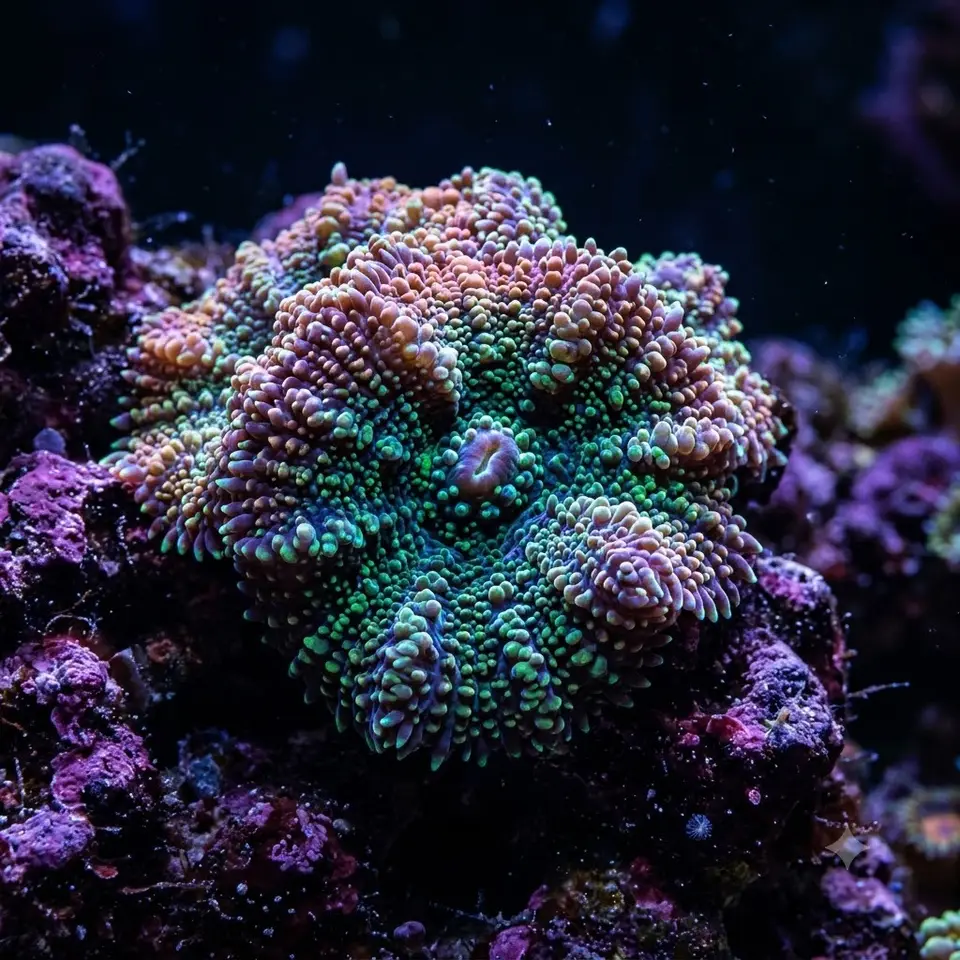
Each polyp is a rounded, disc-shaped body attached to the rock by a short foot. The surface is covered in tiny bumps or short, fuzzy tentacle-like projections that give it a textured, sometimes hairy or bubbly look. Colours range from green, brown, and teal to blue, red, and metallic mixes, often with contrasting mouths and speckling. There is little day-versus-night difference beyond mild expansion and contraction; a polyp that stays tightly puckered for long periods is usually reacting to stress or poor conditions.
Placement & Temperament
Rhodactis is mostly peaceful and does not throw long sweeper tentacles the way some stony corals do. However, larger Rhodactis (sometimes called elephant-ear or hairy mushrooms) can be mildly aggressive: big specimens may fold over and capture small fish, shrimp, or snails, and dense mats can crowd out slower neighbours. Give each colony a few centimetres of clear space, place it on the lower rock or the sand-to-rock transition, and keep it away from small motile livestock and prized slow-growing corals.
Tank & Water Conditions
Keep a mature, stable tank: salinity 1.024-1.026, temperature 24-27 C (75-81 F), alkalinity 8-11 dKH, calcium 400-450 ppm, and magnesium 1300-1350 ppm. Being a soft coral, Rhodactis does not build a heavy stony skeleton, so it is forgiving of the "big three" swinging a little - but stability still matters more than chasing perfect numbers. It actually tolerates modestly higher nutrients better than many corals, which suits newer systems.
Lighting & Flow
Low to moderate light suits this coral best: roughly 40-100 PAR. Under intense lighting it will often shrink, bleach, or detach and move to a shadier spot. Flow should be low and indirect - strong direct current keeps polyps from opening fully and can blow them off the rock. Gentle, varied flow that lets the discs expand is ideal.
Feeding
Rhodactis gets most of its energy from symbiotic zooxanthellae (photosynthetic algae) in its tissue, so good light plus stable water often keeps it fat and spreading with no direct feeding. It will also capture and digest small meaty foods; occasional target feeding of finely chopped seafood or a fine coral/plankton food can boost growth and colour, especially for large hairy specimens. Feed sparingly to avoid fouling the water.
Health & Growth
This is one of the toughest and most beginner-proof corals available. Growth is fast: healthy polyps enlarge and split, and colonies can carpet a rock over months, so plan for spread. Warning signs include a polyp staying shrivelled or "puckered" for days, thinning or peeling tissue, a gaping mouth, or detaching and drifting - usually caused by too much light or flow, or unstable water. A wandering or shrinking mushroom is often just relocating to better conditions; move it to lower light and gentler flow and it typically recovers.
Sourcing
Because Rhodactis multiplies so readily, it is one of the easiest corals to find as aquacultured, captive-propagated frags - choose those over wild-collected specimens. Corallimorphs like this are not listed under CITES the way stony corals are, but buying tank-raised frags is still the responsible choice and usually gives you hardier, better-adapted animals.
Pros & Cons
Pros
- Extremely hardy and forgiving - ideal first coral
- Thrives in low light and gentle flow, so it fits simple setups
- Fast-spreading and easy to propagate, tolerant of higher nutrients
Cons
- Can spread aggressively and crowd or shade neighbours
- Large specimens may eat small shrimp, snails, or fish
- May detach and wander around the tank until conditions suit it
Everyday gear for a reef tank
Links go to Amazon or a partner brand's own store and may earn us a commission at no extra cost to you. As an Amazon Associate we earn from qualifying purchases. An Amazon link leads to a type of gear and you choose the exact product; a card that names a store leads to that partner's own shop.