Blastomussa Coral
The Blastomussa Coral (often shortened to "blasto") is a large-polyp stony (LPS) coral, an animal in the cnidarian family rather than a plant.
Updated: July 2026
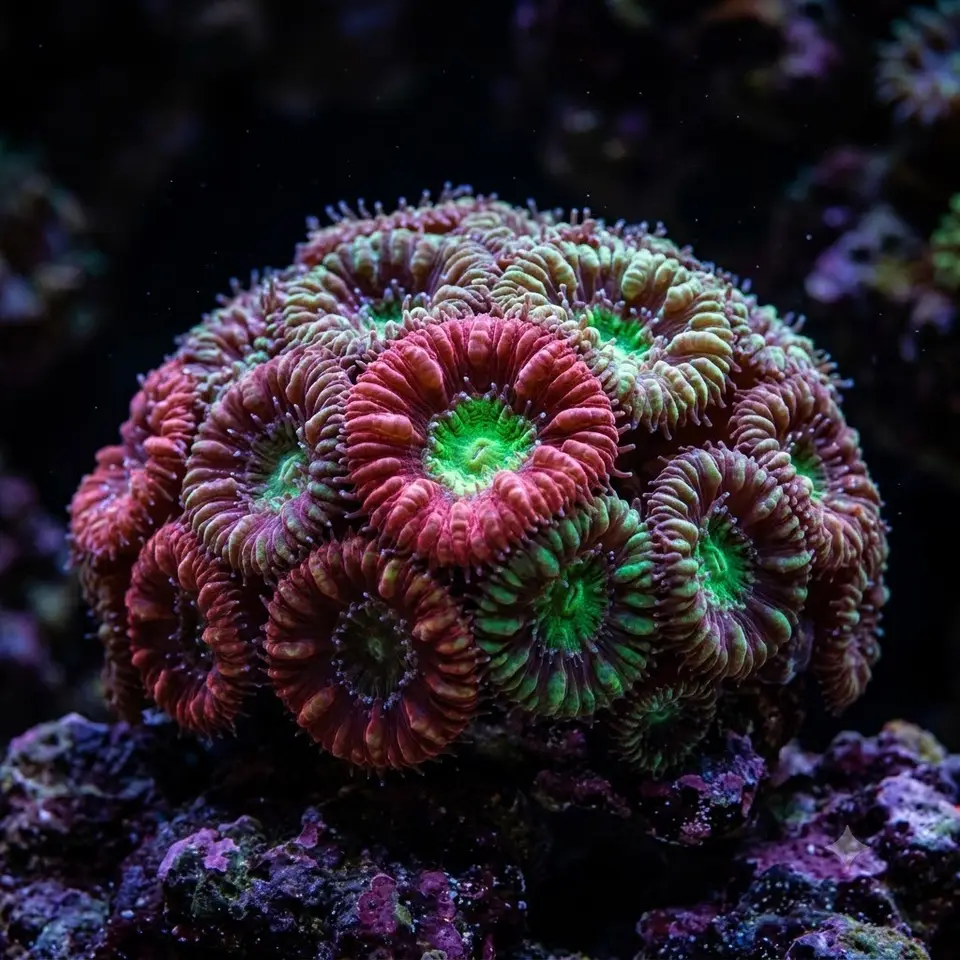 AI illustration
 Overview
The Blastomussa Coral (often shortened to "blasto") is a large-polyp stony (LPS) coral, an animal in the cnidarian family rather than a plant. It forms clusters of large, rounded, fleshy polyps in rich reds, oranges, greens, and blues that make it a standout centrepiece. Its calm temperament and tolerance of modest light and flow make it one of the more forgiving LPS corals for newer reefkeepers.
Origin & Habitat
Blastomussa is an Indo-Pacific coral, found across reefs from the Red Sea and East Africa through Southeast Asia and out to the western Pacific and Australia. It typically grows on deeper or shaded reef slopes and lagoon environments where light is softer and water movement is gentle, which is why it adapts so well to lower-light spots in an aquarium.
Appearance
Each polyp is a large, fleshy, dome-like disc, and colonies form tight clusters of these rounded heads on a shared skeleton. Colours are often vivid and multi-toned, with contrasting centres and rims - deep red with green centres, orange, and blue-grey being common. By day the polyps inflate and puff out over the skeleton; at night, or when disturbed, they deflate and may extend fine feeding tentacles.
Placement & Temperament
Blastomussa is a peaceful coral with only short sweeper tentacles, so it poses little threat to neighbours. Even so, give it a few inches of space, since its own soft flesh can be stung or overgrown by more aggressive corals nearby. Place it low to mid on the rockwork or on the sand bed in a shaded, low-flow area; too much light or current keeps the polyps from inflating fully.
Tank & Water Conditions
House Blastomussa in a mature, stable reef tank. Target salinity 1.024-1.026, temperature 24-27 C (75-81 F), and hold the reef "big three" steady: alkalinity 8-11 dKH, calcium 400-450 ppm, and magnesium 1300-1350 ppm. As a stony coral it draws on calcium and alkalinity to build skeleton, so stable, consistent parameters matter more than chasing any single number.
Lighting & Flow
This is a low-to-moderate light coral. Aim for roughly 50-100 PAR; it will tolerate up to about 120-150 but often shows its best colour and fullest polyp inflation on the lower end. Keep flow gentle and indirect - strong, direct current prevents the fleshy polyps from expanding and can tear tissue over time.
Feeding
Blastomussa hosts symbiotic zooxanthellae and gets much of its energy from light. It also benefits from occasional target feeding of small meaty foods such as finely chopped mysis or micro-pellets dropped onto the polyps after dark when tentacles emerge. Feeding is optional but supports faster growth and richer colour; once or twice a week is plenty.
Health & Growth
Blastomussa is genuinely hardy and one of the more beginner-friendly LPS corals, with a slow but steady growth rate as new polyps bud off the colony. Watch for warning signs of trouble: polyps that stay deflated for days, receding flesh exposing white skeleton, or a brown-jelly film, which usually point to too much flow or light, unstable parameters, or irritation. Move it to a calmer, shadier spot and stabilise water chemistry, and it typically recovers well.
Pros & Cons
Pros
- Peaceful with only short sweepers, easy to place among other calm corals
- Hardy and tolerant of lower light and gentle flow, forgiving for beginners
- Vivid, multi-toned fleshy polyps make an eye-catching centrepiece
Cons
- Slow-growing, so a colony takes time to fill out
- Fleshy polyps can be damaged by strong flow, aggressive neighbours, or nipping fish
- Needs stable alkalinity, calcium, and magnesium in a mature tank to thrive
Everyday gear for a reef tank
Links go to Amazon or a partner brand's own store and may earn us a commission at no extra cost to you. As an Amazon Associate we earn from qualifying purchases. An Amazon link leads to a type of gear and you choose the exact product; a card that names a store leads to that partner's own shop.