Bubble Coral
Bubble Coral (genus *Plerogyra*) is a large-polyp stony (LPS) coral, and like all corals it is an animal, a reef-building cnidarian rather than a plant.
Updated: July 2026
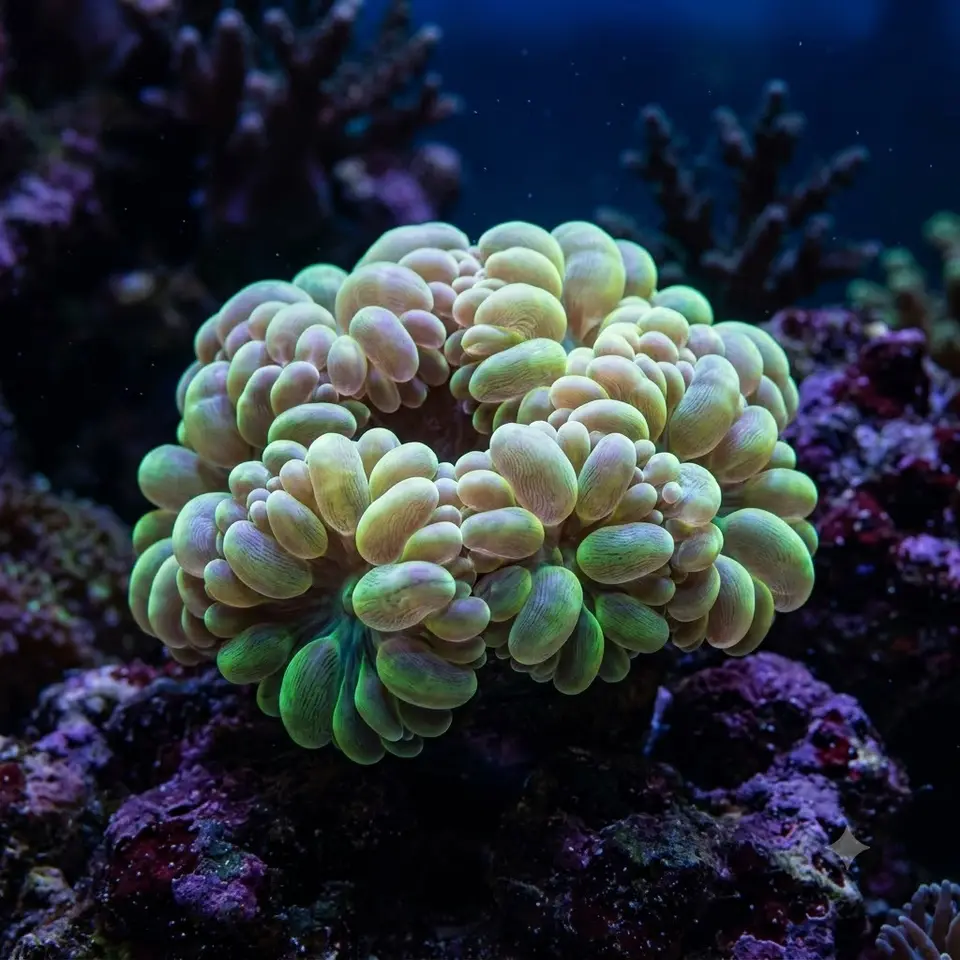 AI illustration
 Overview
Bubble Coral (genus Plerogyra) is a large-polyp stony (LPS) coral, and like all corals it is an animal, a reef-building cnidarian rather than a plant. It is famous for the cluster of rounded, grape-like vesicles that inflate over its skeleton during the day. It is a rewarding but intermediate-level coral because its tissue is fragile and it turns surprisingly aggressive after dark.
Origin & Habitat
Bubble Coral is native to the Indo-Pacific, found across reefs from the Red Sea and East Africa through Southeast Asia to the western Pacific. It typically grows on lower reef slopes and in shaded overhangs where light is moderate and water movement is gentle, rather than on high-energy reef crests.
Appearance
By day the coral inflates soft, translucent vesicles that look like a cluster of grapes, pearls, or bubbles, usually in pearly white, cream, greenish, or pale gold tones. These bubbles swell with water and zooxanthellae to catch light and can shrink or partly deflate when the animal is disturbed or the lights go out. At night the vesicles retreat and the coral extends thin feeding and sweeper tentacles from between them, giving it a completely different, wispy look.
Placement & Temperament
Do not let the calm daytime appearance fool you: this is an aggressive coral. After dark it deploys long sweeper tentacles that can reach several centimetres and pack a potent sting, so give it wide spacing, ideally 10-15 cm (4-6 inches) or more of clear space from any neighbour on all sides. Place it low on the rockwork or on the sand bed in a gentle-flow, moderate-light zone. The vesicle tissue tears very easily, so never let it rest against sharp rock and handle it as little as possible.
Tank & Water Conditions
Keep it in a mature, stable reef system. Target salinity 1.024-1.026, temperature 24-27 C (75-81 F), and hold the reef "big three" steady: alkalinity 8-11 dKH, calcium 400-450 ppm, and magnesium 1300-1350 ppm. As an LPS coral it is sensitive to swings, so stability matters more than chasing any single number.
Lighting & Flow
Bubble Coral prefers low to moderate light in the range of about PAR 50-120. Under harsh, high-intensity lighting the vesicles may bleach or stay shrunken. Flow should be gentle and indirect; strong or direct flow prevents the bubbles from inflating fully and can tear the delicate tissue.
Feeding
Most of its energy comes from photosynthesis by the symbiotic zooxanthellae living in its tissue. You can supplement with occasional target feeding of small meaty foods such as mysis or finely chopped seafood, offered at night when the feeding tentacles are extended. Feed sparingly and place food gently near the tentacles rather than blasting it at the fragile vesicles.
Health & Growth
Bubble Coral is reasonably hardy once settled and given calm conditions, growing at a slow to moderate pace. The most common problems are physical: torn vesicle tissue from rough handling or excess flow, which can lead to infection and recession. Warning signs include vesicles that stay deflated for days, browning or bleaching, receding tissue, or exposed white skeleton. Because it stings, watch for damage to neighbouring corals as an early sign that spacing is too tight.
Pros & Cons
Pros
- Striking, unusual bubble form that stands out in any reef display
- Moderate light and flow needs make it forgiving on equipment
- Slow, manageable growth that will not quickly overrun a tank
Cons
- Long night-time sweeper tentacles sting neighbours and demand wide spacing
- Fragile tissue tears easily from rough handling or strong flow
- Not a beginner coral; needs a mature, stable system to thrive
Everyday gear for a reef tank
Links go to Amazon or a partner brand's own store and may earn us a commission at no extra cost to you. As an Amazon Associate we earn from qualifying purchases. An Amazon link leads to a type of gear and you choose the exact product; a card that names a store leads to that partner's own shop.