Discosoma Mushroom Coral
The Discosoma mushroom coral is a soft coral - an animal, not a plant, and specifically a colonial cnidarian in the corallimorph group (close relatives of true anemones).
Updated: September 2026
Group guide: Mushroom Coral · All soft corals
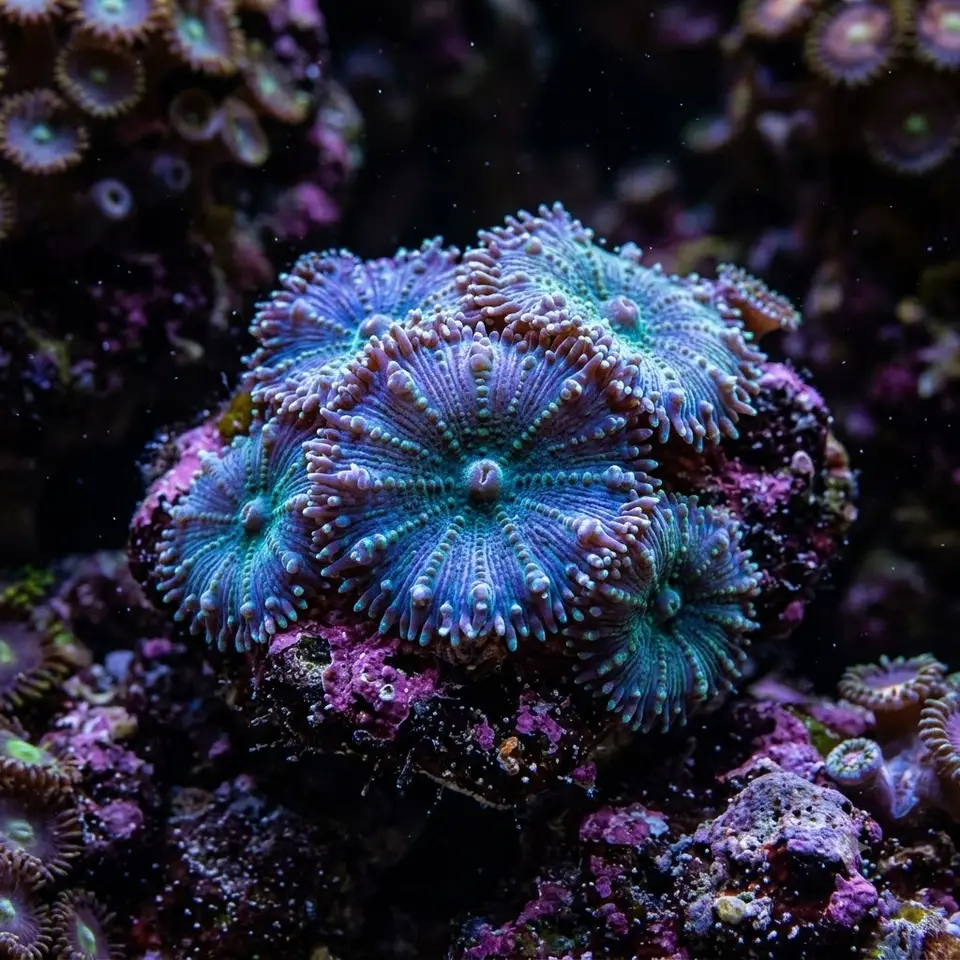 AI illustration
 Overview
The Discosoma mushroom coral is a soft coral - an animal, not a plant, and specifically a colonial cnidarian in the corallimorph group (close relatives of true anemones). It is one of the hardiest and most forgiving corals in the hobby, tolerating a wide range of conditions and spreading readily on its own. This combination makes it a classic beginner-proof first coral. For how it compares with the other two mushrooms sold in the hobby, see the mushroom coral overview.
Origin & Habitat
Discosoma species are found on tropical Indo-Pacific reefs, with related mushroom corals also occurring in the wider tropics. In the wild they carpet shaded ledges, rubble zones, lagoon walls, and lower reef slopes where light is diffuse and water movement is gentle - exactly the sheltered, nutrient-tolerant niches that make them so adaptable in aquariums.
Appearance
Each polyp is a flat, rounded disc that sits low against the rock like a small mushroom cap, typically 2-8 cm across. Colours span red, blue, green, brown, purple, and speckled or striped combinations, often with a smooth or only lightly textured surface. Discosoma generally lack a raised central mouth cone and have a fairly smooth disc. Day and night appearance changes little compared with many corals - the discs may curl or fold their edges when unhappy, when light is too strong, or to catch food, and can shrink at night.
Placement & Temperament
This is a peaceful coral with no stinging sweeper tentacles, so it will not reach out and burn neighbours. That said, it can spread aggressively by budding and detaching daughter polyps, gradually carpeting rock and crowding slower corals, so give it a defined patch of rock and leave a couple of centimetres of open space around nearby corals. Place it on the lower or middle rockwork or on the sand bed in a shaded, low-flow spot; keep it off high, brightly lit peaks where it may bleach colour or detach.
Tank & Water Conditions
Keep salinity at 1.024-1.026, temperature 24-27 C (75-81 F), and stable "big three" chemistry: alkalinity 8-11 dKH, calcium 400-450 ppm, and magnesium 1300-1350 ppm. A mature, biologically stable tank is best, though Discosoma is unusually tolerant of slightly higher nutrients and less-than-perfect parameters. Stability matters far more than chasing exact numbers - avoid swings.
Lighting & Flow
Low to moderate light suits this coral well, roughly 40-100 PAR; it often shows its best colour under gentler lighting and can bleach or shrink under intense reef lights. Provide low, indirect flow. Strong direct current keeps the discs from opening fully and can dislodge polyps, so aim for a soft, random drift across the colony.
Feeding
Discosoma hosts symbiotic zooxanthellae and derives most of its energy from light through photosynthesis, so no target feeding is required. It will absorb dissolved nutrients from the water and can occasionally capture fine particulate food; small amounts of finely chopped meaty food or coral foods may modestly boost growth, but overfeeding is unnecessary and just fouls water.
Health & Growth
This is among the hardiest corals available - very difficult to kill and quick to propagate, often multiplying to cover rockwork within months. Growth is by budding and splitting rather than skeletal build-up (it has no hard skeleton). Warning signs to watch for: polyps that stay tightly curled or "pinched" for days, thinning or bleaching from too much light, a shrinking or slimy disc, or detachment and drifting. Most problems trace back to excessive light or flow, or a sudden parameter swing, and usually reverse once conditions are corrected.
Sourcing
Mushrooms are among the easiest corals to propagate, so tank-raised frags are widely available and inexpensive - choose aquacultured or hobbyist-fragged stock over wild-collected colonies. Corallimorphs like Discosoma are generally not covered by the CITES coral rules that apply to hard stony corals, but buying propagated frags is still the responsible and most reliable choice, and gives you a piece already adjusted to aquarium life.
Pros & Cons
Pros
- Extremely hardy and forgiving - an ideal first coral
- Thrives under low light and gentle flow, so cheap, simple setups work
- Spreads readily on its own and is easy to frag and share
- Peaceful, with no aggressive sweeper tentacles
Cons
- Can spread aggressively and crowd out slower neighbours over time
- Individual polyps may detach and drift into pumps or overflows
- Colours can fade or bleach if the light is too strong
- Less structural "wow" than branching or plating stony corals
Everyday gear for a reef tank
Links go to Amazon or a partner brand's own store and may earn us a commission at no extra cost to you. As an Amazon Associate we earn from qualifying purchases. An Amazon link leads to a type of gear and you choose the exact product; a card that names a store leads to that partner's own shop.