Lobophyllia Coral
Lobophyllia (frequently grouped with the closely related Symphyllia and sold as "lobo" or "brain" coral) is a large-polyp stony (LPS) coral - a reef-building animal, not a plant.
Updated: July 2026
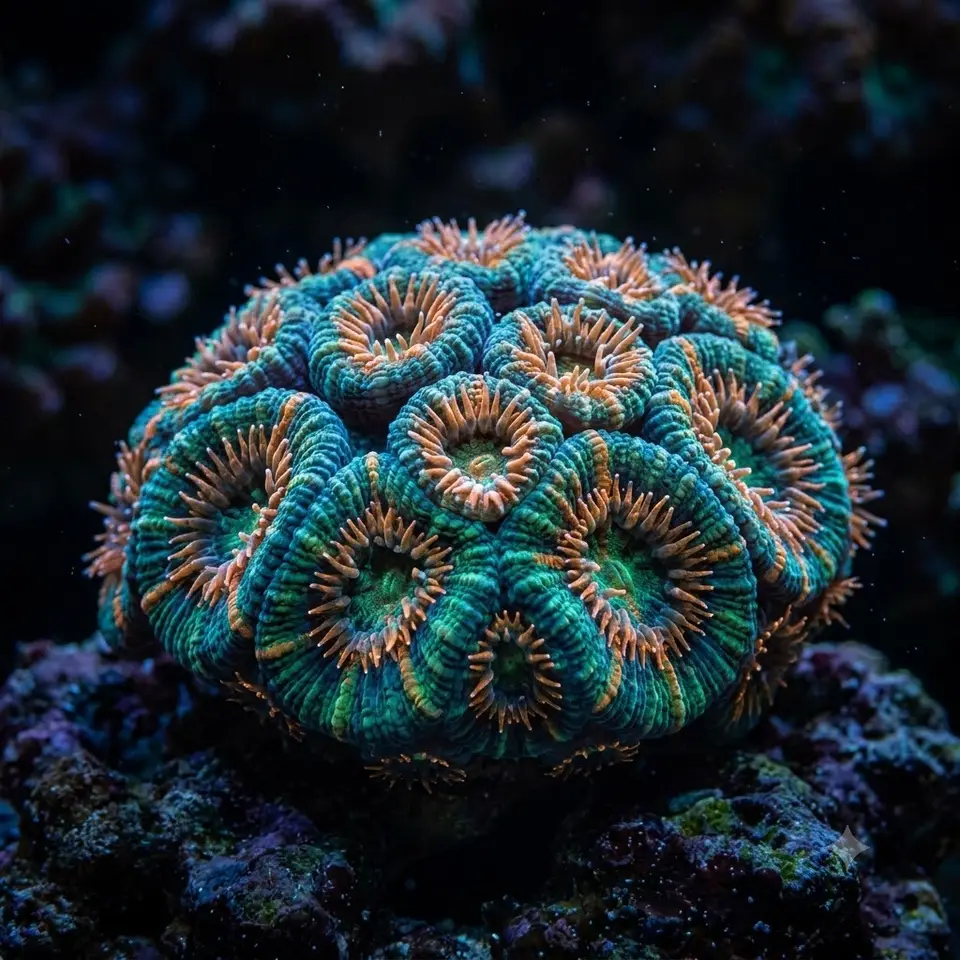 AI illustration
 Overview
Lobophyllia (frequently grouped with the closely related Symphyllia and sold as "lobo" or "brain" coral) is a large-polyp stony (LPS) coral - a reef-building animal, not a plant. It belongs to the cnidarians, the same group as anemones and jellyfish, and forms a thick, fleshy tissue mantle over a heavy stony skeleton. It is popular for its intense colours, forgiving nature, and appetite for meaty food.
Origin & Habitat
Lobophyllia is an Indo-Pacific coral, ranging across reefs from the Red Sea and East Africa through Southeast Asia and out to the Great Barrier Reef and the wider western Pacific. It typically grows on lower reef slopes and in calmer, sediment-tolerant zones rather than in high-energy surf. Because it is a wild-reef stony coral (and stony corals fall under CITES Appendix II trade controls), aquacultured or maricultured frags are the responsible choice over wild-collected colonies.
Appearance
This coral forms rounded, dome-like colonies with deep valleys and fleshy, meandering ridges that can look brain-like or, in some forms, like separated fat cones. The inflated daytime flesh comes in striking colours - reds, greens, oranges, teals, purples, and rainbow mixes, often with contrasting rims and centres. By day the polyps swell with water and hide the skeleton; at night the tissue deflates and the coral extends feeding tentacles, revealing a very different, spidery profile.
Placement & Temperament
Lobophyllia is moderately aggressive. It looks docile by day, but after dark it deploys sweeper tentacles that reach out and sting neighbouring corals, so treat it as a coral that needs a buffer. Give it several inches (roughly 4 to 6 in / 10 to 15 cm) of clear space on all sides. Place it on the sand bed or on low, stable rock in a lower-light, gentler-flow spot; it is heavy and fleshy, so it can be damaged if it tumbles or if flow is strong enough to tear the tissue.
Tank & Water Conditions
House Lobophyllia only in a mature, stable reef. Target salinity 1.024 to 1.026, temperature 24 to 27 C (75 to 81 F), and hold the reef "big three" steady: alkalinity 8 to 11 dKH, calcium 400 to 450 ppm, and magnesium 1300 to 1350 ppm. As a stony coral it draws on calcium and alkalinity to build skeleton, so consistency matters more than chasing peak numbers - swings stress the tissue faster than any single value.
Lighting & Flow
Give it moderate LPS lighting, roughly PAR 50 to 120; it colours up well without being blasted, and too much light can bleach or brown the flesh. Keep flow low to moderate and, ideally, indirect. Gentle, varied flow keeps detritus from settling in the valleys, while strong direct flow can prevent the polyp from fully inflating or abrade the tissue.
Feeding
Lobophyllia hosts symbiotic zooxanthellae and gets much of its energy from light, but it is a genuinely feedable coral that responds well to target feeding. In the evening, when tentacles are out, offer small meaty foods such as mysis, finely chopped seafood, or a coral pellet placed on the flesh. A feeding once or twice a week supports colour, tissue thickness, and growth; avoid overfeeding, which fouls water.
Health & Growth
This is one of the hardier LPS corals and a reasonable intermediate choice, but growth is slow, so patience is required. Watch for warning signs: receding flesh exposing bare white skeleton, a persistently deflated polyp, brown jelly infection, or "bleaching" to pale/white from light or temperature shock. Most problems trace back to unstable parameters, pest flatworms or picking fish, or physical injury. Handle gently, never let flesh rest on sharp rock, and correct any parameter swings promptly.
Pros & Cons
Pros
- Hardy and forgiving for an LPS, with spectacular colour and texture
- Feedable, which lets you actively support its growth and colouring
Cons
- Night-time sweeper tentacles sting neighbours, so it needs open spacing
- Slow-growing, and its fleshy tissue is easily torn by strong flow or sharp rock
Everyday gear for a reef tank
Links go to Amazon or a partner brand's own store and may earn us a commission at no extra cost to you. As an Amazon Associate we earn from qualifying purchases. An Amazon link leads to a type of gear and you choose the exact product; a card that names a store leads to that partner's own shop.