Montipora Digitata
Montipora digitata, usually just called digitata or finger Montipora, is a small-polyp stony (SPS) coral - a colonial animal (a cnidarian), not a plant.
🗓️ Last reviewed: July 2026
Overview
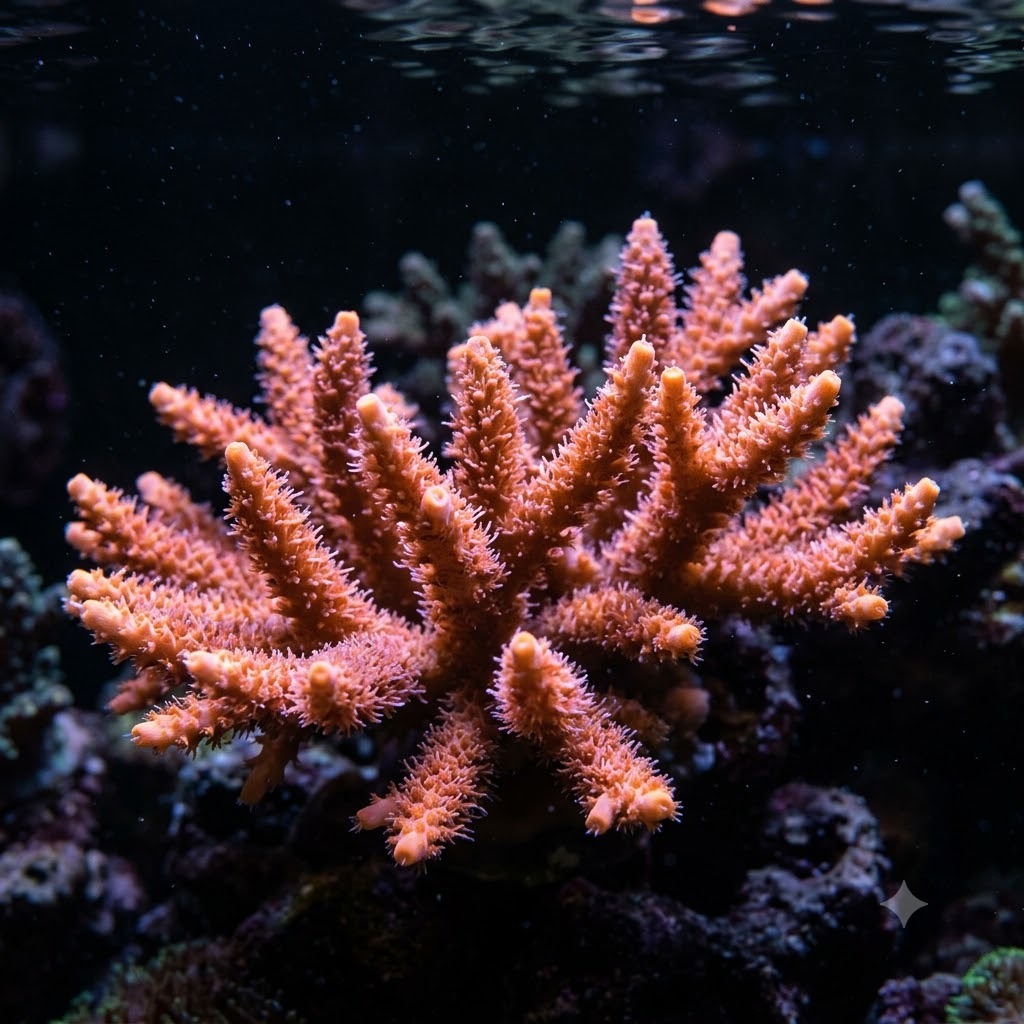
Montipora digitata, usually just called digitata or finger Montipora, is a small-polyp stony (SPS) coral - a colonial animal (a cnidarian), not a plant. Unlike the flat, whorled plating Montiporas most reefers picture, digitata grows as clusters of upright, finger-like branches. It is widely regarded as one of the easiest true SPS corals, forgiving of imperfect light and flow, and it is a sensible first branching stony for someone stepping up from soft corals and LPS.
Origin & Habitat
The species is Indo-Pacific, occurring from the Red Sea and East Africa across the Indian Ocean to the western and central Pacific. It favours shallow lagoons, reef flats and protected slopes with bright light and steady water movement, and it tolerates a wider range of conditions than most of its Acroporid relatives. Nearly all hobby stock is aquacultured, and that is the responsible choice - wild collection of stony corals is regulated and all stony corals (order Scleractinia) are listed under CITES Appendix II, so frags grown in captivity carry no collection pressure and adapt faster to tank life.
Appearance
Colonies form clumps of slender, rounded branches, sometimes forking, sometimes staying as simple fingers. The surface is finely textured rather than fuzzy, because the polyps sit in very small pinhole corallites; when extended they give the branches a soft, hazy edge. Common colour morphs include orange, forest green, pink, purple and cream, often with lighter growth tips that show where the colony is actively extending. Colour is strongly light-dependent, so the same frag can look quite different in two tanks.
Placement & Temperament
Digitata is peaceful. It has no sweeper tentacles and will not sting neighbours, but it competes the way most branching SPS do - by growing fast and shading whatever sits below it. Give it several centimetres of clear space and expect to trim it. Mount it on solid rock in the middle to upper third of the tank; the sand bed is a poor choice because settling detritus and weak flow encourage tissue loss at the base.
Tank & Water Conditions
A mature, stable reef tank is the requirement, not a nice-to-have. Target salinity 1.024-1.026, temperature 24-27 C (75-81 F), alkalinity 8-11 dKH, calcium 400-450 ppm and magnesium 1300-1350 ppm. Keep nitrate and phosphate low but measurable - stripped, near-zero nutrients tend to pale digitata rather than brighten it. Steady numbers beat perfect numbers, and alkalinity is the one to watch most closely.
Lighting & Flow
Bright reef light suits it best, roughly 150-300 PAR, though digitata will hold on at the lower end where fussier SPS sulk. Acclimate new frags gradually to strong lighting to avoid bleaching. Flow should be moderate to strong and turbulent so that no detritus settles between the branches; too little movement leads to algae film and recession, while varied, non-blasting current keeps polyps out and feeding.
Feeding
Most of its energy comes from symbiotic zooxanthellae, the photosynthetic algae living in its tissue, so light is the primary food source. The tiny polyps also capture particles, and occasional fine reef foods such as microplankton or powdered coral blends can support growth and colour. Target feeding is optional here; water stability does far more for a digitata than any feeding regime.
Health & Growth
Growth is fast once the frag has encrusted its base - branches lengthen visibly over a few months and the colony can be pruned for new frags. The main species-specific worry is the Montipora-eating nudibranch, a tiny white pest that hides between branches and strips tissue; inspect and dip every new Montipora before it goes in the display. Otherwise watch for browning (usually too little light or excess nutrients), bleaching after a lighting change, and tissue receding from the base, which almost always traces back to unstable alkalinity or trapped detritus.
Pros & Cons
Pros
- One of the most forgiving branching SPS corals - a realistic first stony coral
- Fast, easily fragged growth with strong colour morphs
- Peaceful, with no sweeper tentacles
Cons
- Still an SPS: needs a mature tank and stable alkalinity, calcium and magnesium
- Prone to Montipora-eating nudibranchs, so dipping and inspection are essential
- Rapid growth shades and crowds slower neighbours without regular pruning
🧠 Test yourself: guess the exotic
Three clues from our quiz bank, each about another of our exotic. Can you name them?
Clue 1.With triangular head, swiveling neck, and grasping front limbs, this stick-mimicking insect strikes prey in a fraction of a second.
It's the Praying Mantis - read the full profile →
Clue 2.A heavy-bodied arachnid kept as a pet, the females of which can live for decades, far longer than the short-lived males.
It's the Tarantula - read the full profile →
Clue 3.A slow-moving herbivore whose elongated body resembles a branch; it may sway gently to imitate a twig in the breeze.
It's the Stick Insect (Phasmid) - read the full profile →