Ricordea Mushroom Coral
Ricordea is a soft coral mushroom (order Corallimorpharia), and like all corals it is an animal - a colonial cnidarian, not a plant.
Updated: August 2026
Group guide: Mushroom Coral · All soft corals
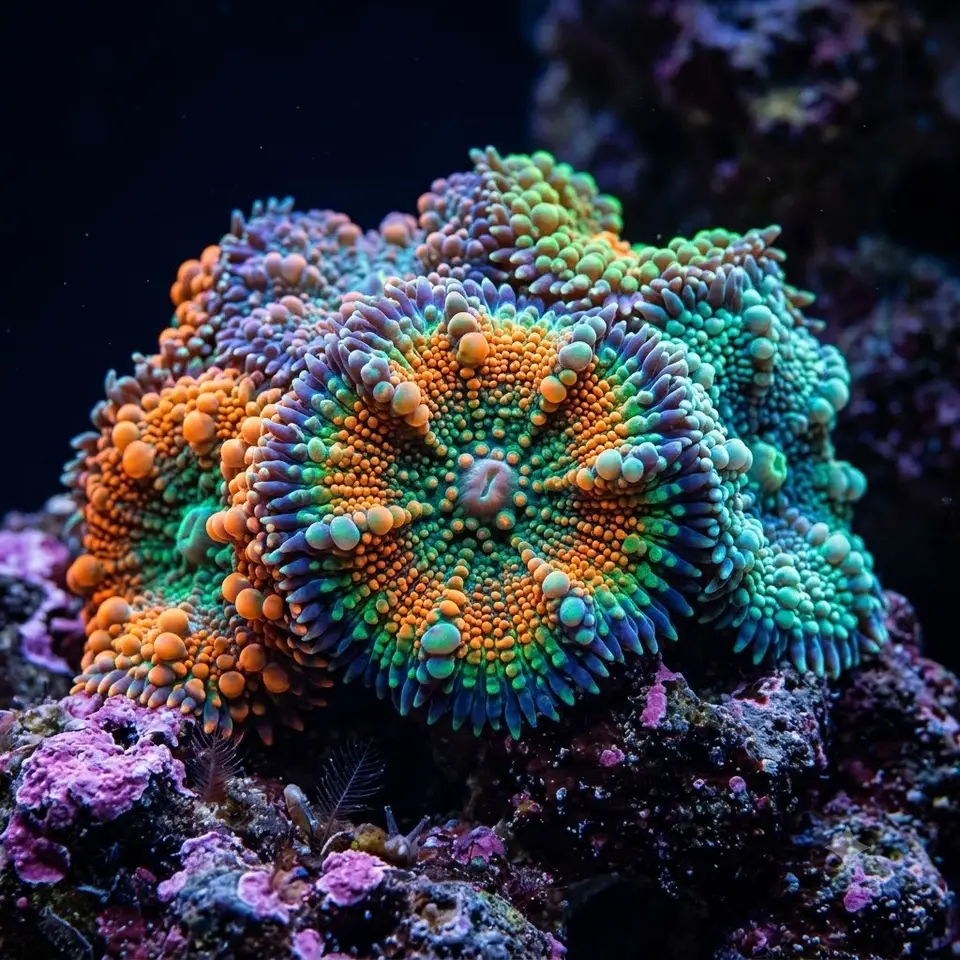 AI illustration
 Overview
Ricordea is a soft coral mushroom (order Corallimorpharia), and like all corals it is an animal - a colonial cnidarian, not a plant. It is one of the most colourful and forgiving mushrooms in the hobby, sold mainly as two types: Ricordea yuma (Indo-Pacific) and Ricordea florida (Caribbean). Hardy, peaceful, and undemanding, it is a classic first coral. For how it compares with the other two mushrooms sold in the hobby, see the mushroom coral overview.
Origin & Habitat
Ricordea florida comes from the shallow reefs and lagoons of the Caribbean and western Atlantic, while Ricordea yuma is found across the tropical Indo-Pacific. In the wild both settle on rubble, rock, and reef flats in relatively shallow, well-lit water, often in slightly sheltered pockets rather than high-flow reef crests. Choose aquacultured frags where possible, since wild collection is regulated.
Appearance
Ricordea forms a rounded, disc-shaped polyp covered in tight clusters of small bubble-like vesicles, giving it a beaded or bubbly texture quite unlike the smooth discs of other mushrooms. Colours are vivid and often fluorescent - orange, green, blue, purple, rainbow, and metallic blends, frequently with a contrasting mouth and radiating pattern. The polyp inflates and shows its best colour under light during the day and can deflate or partly close at night or when disturbed. Yuma tends to be larger with a pronounced central mouth; florida is usually smaller and forms tighter clusters.
Placement & Temperament
Ricordea is peaceful and does not deploy the aggressive sweeper tentacles seen in many stony corals, so it will not sting distant neighbours. It can, however, slowly spread and overgrow a rock, so give it a little room - a few centimetres of open space from other soft corals and mushrooms. It does best low to mid on the rockwork or on the sand bed in gentle flow; secure a loose frag in a rubble crevice until it attaches. Keep it away from known stingers such as large-polyp Euphyllia or leather corals that can chemically crowd it.
Tank & Water Conditions
Ricordea needs a mature, stable reef tank - avoid adding it to a system less than a couple of months old. Target salinity 1.024-1.026, temperature 24-27 C (75-81 F), and steady reef parameters: alkalinity 8-11 dKH, calcium 400-450 ppm, and magnesium 1300-1350 ppm. As a soft coral it is not a heavy calcifier, so stability matters far more than pushing the "big three" high; sudden swings stress it more than any single number.
Lighting & Flow
Moderate lighting suits it best - roughly 50-120 PAR. Too little light dulls the colour, while too much can bleach or brown it, so acclimate gradually to bright fixtures and expect the strongest colours under mid-range, somewhat actinic-rich light. Provide low to moderate, indirect flow: enough to keep detritus from settling on the disc, but not so strong that the polyp cannot fully inflate.
Feeding
Ricordea gets most of its energy from symbiotic zooxanthellae (photosynthetic algae in its tissue), so good lighting is its main food source. It will also capture fine particulate foods, and occasional target feeding of small meaty items or coral food near the mouth can boost growth and colour. Feeding is optional rather than essential - a well-lit, stable tank keeps it thriving on light alone.
Health & Growth
This is a genuinely hardy, beginner-friendly coral with no palytoxin concern (that risk belongs to zoanthids and Palythoa, not Ricordea). Growth is slow to moderate: healthy polyps enlarge and occasionally split or bud off new mushrooms over time. Warning signs include a chronically deflated or shrinking disc, loss of colour (too much or too little light), a curling or "yawning" mouth that stays open, or detachment and drifting - usually pointing to unstable parameters, poor water quality, aggression from a neighbour, or excessive flow. Watch for pest flatworms and nuisance algae smothering the disc.
Pros & Cons
Pros
- Very hardy and forgiving, one of the best first corals
- Brilliant, often fluorescent colours in many varieties
- Peaceful with no aggressive sweeper tentacles, and no palytoxin concern
- Tolerates moderate light and gentle flow, so it is easy to place
Cons
- Slow growing compared with many soft corals
- Can gradually spread and overgrow nearby rock space
- Colours fade under the wrong light intensity and it dislikes strong flow
- Still needs a mature, stable tank - not for brand-new setups
Everyday gear for a reef tank
Links go to Amazon or a partner brand's own store and may earn us a commission at no extra cost to you. As an Amazon Associate we earn from qualifying purchases. An Amazon link leads to a type of gear and you choose the exact product; a card that names a store leads to that partner's own shop.