Turbinaria Scroll Coral
Turbinaria, sold as scroll coral, cup coral or pagoda coral, is a stony coral - a colonial animal (a cnidarian), not a plant - that grows in sweeping plates, vases and tiered scrolls rather than branches.
🗓️ Last reviewed: July 2026
Overview
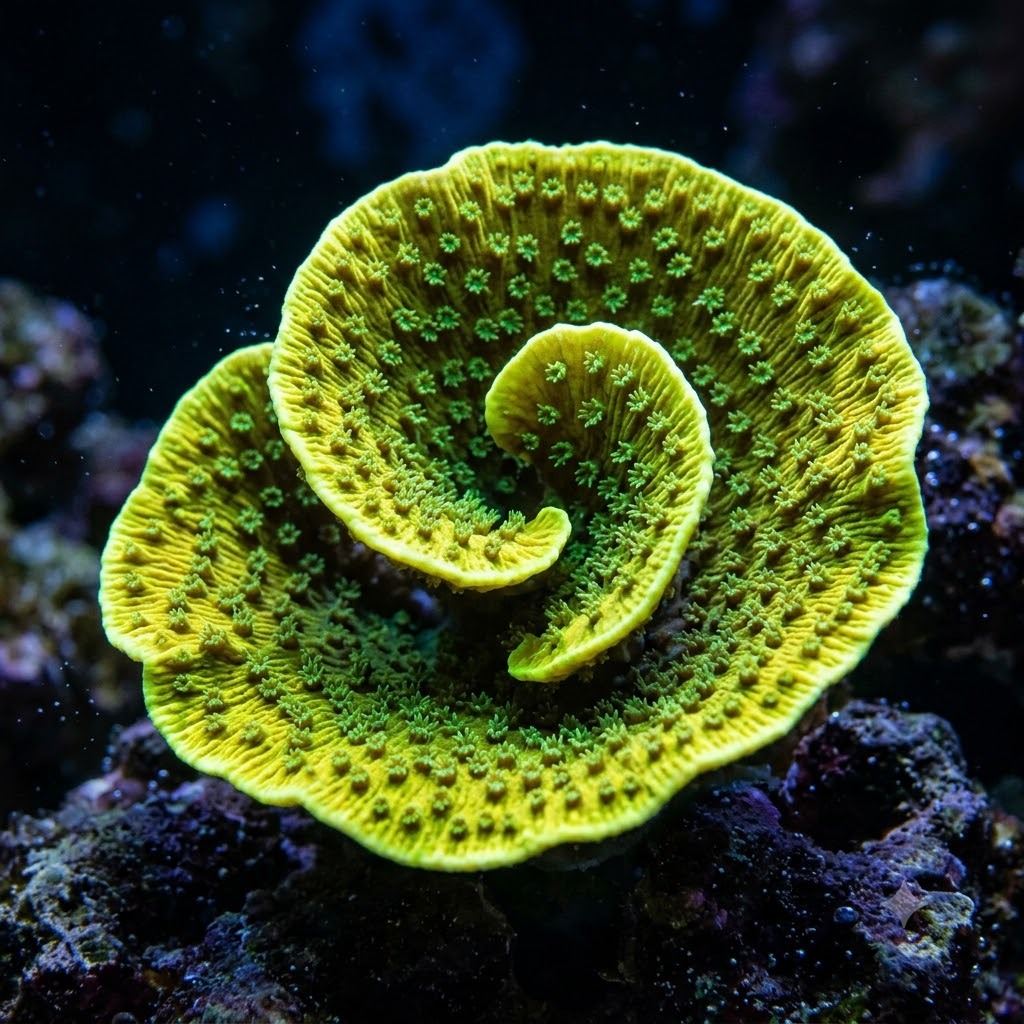
Turbinaria, sold as scroll coral, cup coral or pagoda coral, is a stony coral - a colonial animal (a cnidarian), not a plant - that grows in sweeping plates, vases and tiered scrolls rather than branches. Classification is worth getting straight first: Turbinaria belongs to the family Dendrophylliidae, and most care guides file it with the LPS corals rather than the SPS group, because the cup and pagoda species such as Turbinaria peltata carry visibly fleshy polyps. The thin plating scroll species like Turbinaria reniformis have much smaller polyps and are the ones occasionally grouped with plating SPS corals, so treat any SPS label on a scroll coral as a loose one. Whatever the label, it behaves like a forgiving stony coral: tolerant of moderate light, moderate nutrients and a beginner's imperfect stability.
Origin & Habitat
Turbinaria is Indo-Pacific, occurring from the Red Sea and East Africa across the Indian Ocean to the western Pacific on reef slopes, lagoon margins and turbid inshore reefs. Several species are notably tolerant of murky, nutrient-rich water, which is why they cope with conditions that would kill an Acropora. Choose aquacultured frags where possible - wild collection of stony corals is regulated and all stony corals (order Scleractinia) are listed under CITES Appendix II - and captive-grown plates settle in and encrust more readily.
Appearance
The signature form is a thin, ruffled plate that curls upward into a scroll or vase, sometimes stacking into tiers as it grows. The surface carries evenly spaced, slightly raised corallites, and in the popular yellow scroll morph the polyps and plate contrast beautifully with a green or greenish-yellow tone. Other species form flatter cups or lumpier pagoda shapes in cream, green, brown or grey. Polyps extend mostly at night, giving the plate a fuzzy outline it lacks by day.
Placement & Temperament
Turbinaria is largely peaceful and does not deploy the long sweeper tentacles of a Euphyllia, though vendors often label it semi-aggressive as a precaution. Its shape creates a placement problem the coral itself does not cause: a mature plate can grow wide enough to shade everything beneath it. Plan for the adult size, not the frag. Mount it on rock at an angle where light hits the plate face and where flow can reach the underside, and leave the area below it free of light-hungry corals. Sand-bed placement is workable for larger cup forms but risks detritus collecting in the bowl.
Tank & Water Conditions
Target salinity 1.024-1.026, temperature 24-27 C (75-81 F), alkalinity 8-11 dKH, calcium 400-450 ppm and magnesium 1300-1350 ppm. Turbinaria is one of the more relaxed stony corals about nutrients and will often look better in a moderately fed tank than in a stripped one. Stability still matters, and calcification slows noticeably if alkalinity and calcium are allowed to drift.
Lighting & Flow
Moderate light is enough, roughly 100-200 PAR, and this coral will bleach or lose its yellow tone if pushed too hard too fast. Acclimate carefully after any lighting change. Flow is the more critical factor: the scroll shape naturally catches detritus, so moderate to strong turbulent current is needed to keep the plate and its folds clean. If sediment settles in the bowl of a cup-shaped colony, tissue loss usually follows.
Feeding
Zooxanthellae in its tissue provide most of its energy, so lighting still comes first, but Turbinaria is a more active feeder than most SPS-class corals. The relatively large polyps take finely chopped mysis, baby brine and coral pellets, and evening feeding when the polyps are extended produces a visible response. Regular feeding supports faster plate growth, which is worth remembering when planning how much room to leave around it.
Health & Growth
This is one of the most forgiving stony corals in the trade and a good stepping stone before harder SPS. Growth is moderate and outward, with the plate margin thickening and extending; large specimens become the centrepiece of a rockscape. Watch for detritus accumulation on horizontal surfaces, brown film algae on shaded undersides, and tissue receding from the plate edge, which is often a flow or sediment problem rather than a chemistry one. Bleaching almost always traces to a light increase made too quickly.
Pros & Cons
Pros
- Very tolerant of moderate light and higher nutrients for a stony coral
- Largely peaceful with no long sweeper tentacles, and feeds readily
- Dramatic plate and scroll shapes that anchor a reefscape
Cons
- Mature plates shade everything beneath them, so placement must plan ahead
- Scroll and cup shapes trap detritus without strong turbulent flow
- Usually classed as LPS rather than true SPS, so care advice varies between sources
🧠 Test yourself: guess the exotic
Three clues from our quiz bank, each about another of our exotic. Can you name them?
Clue 1.With triangular head, swiveling neck, and grasping front limbs, this stick-mimicking insect strikes prey in a fraction of a second.
It's the Praying Mantis - read the full profile →
Clue 2.Kept as a low-maintenance pet abroad, this slow nocturnal animal needs calcium to build its huge spiral shell.
It's the Giant African Land Snail - read the full profile →
Clue 3.This large wingless insect, popular as a hardy pet, forces air through breathing holes to make a loud hiss.
It's the Madagascar Hissing Cockroach - read the full profile →