Cyphastrea Coral
Cyphastrea is a small-polyp stony (SPS) coral - a colonial animal (a cnidarian), not a plant - that grows as a low encrusting sheet or a rounded dome rather than a branching colony.
🗓️ Last reviewed: July 2026
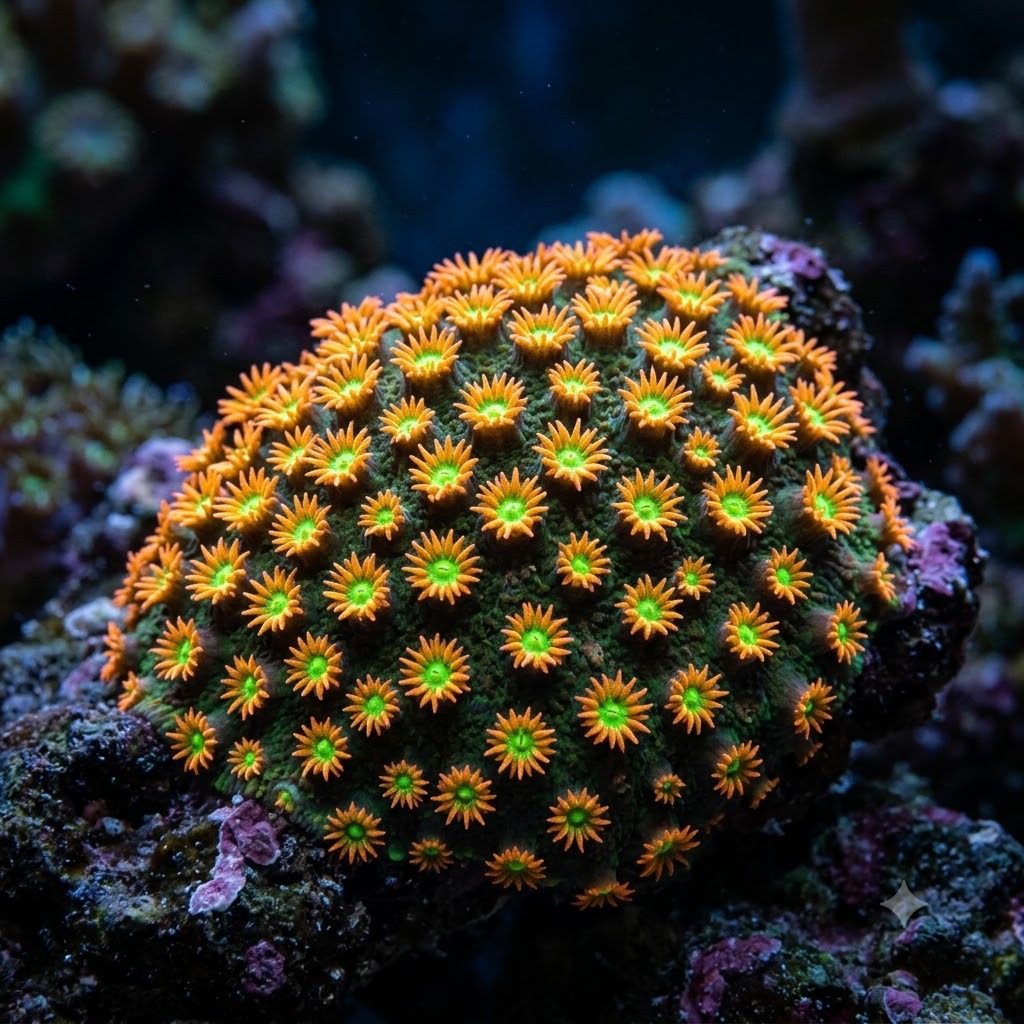
Overview
Cyphastrea is a small-polyp stony (SPS) coral - a colonial animal (a cnidarian), not a plant - that grows as a low encrusting sheet or a rounded dome rather than a branching colony. In the hobby it is best known through named morphs such as the "meteor shower" type, where bright polyps scatter across a contrasting base like sparks. It is one of the most forgiving stony corals available, tolerating light and nutrient levels that would ruin an Acropora, which makes it a common recommendation for a first SPS.
Origin & Habitat
The genus is widespread across the Indo-Pacific, from the Red Sea and East Africa through the Indian Ocean to the western Pacific, encrusting rock on reef slopes, lagoon floors, overhangs and shaded walls. That habitat range explains its flexibility in captivity. Aquacultured frags dominate the trade and are the responsible choice - wild stony coral collection is regulated and all stony corals (order Scleractinia) are listed under CITES Appendix II - and encrusting corals like this one frag and grow out easily, so tank-raised material is easy to find.
Appearance
Colonies start as a thin crust that hugs the rock, later thickening into a low mound. The surface carries small, well-separated corallites that look like tiny raised stars; when the polyps extend the whole colony takes on a soft, dotted texture. Colour morphs are the main draw: green polyps on a purple or maroon base, orange on brown, red on green, and various pastel combinations. The contrast between the polyps and the base tissue between them is what gives the popular morphs their look.
Placement & Temperament
Cyphastrea is calmer than most merulinid corals but it is not entirely passive - it can extend short sweeper tentacles at night, and it encrusts steadily across whatever rock it touches. Treat it as semi-aggressive: leave a few centimetres of clearance, and do not place it directly beside a slow, delicate coral it can grow over. It is happy low or mid-rock, and it is a good candidate for shaded ledges and vertical faces where light-hungry SPS will not colour up.
Tank & Water Conditions
Target salinity 1.024-1.026, temperature 24-27 C (75-81 F), alkalinity 8-11 dKH, calcium 400-450 ppm and magnesium 1300-1350 ppm. Cyphastrea is more tolerant of moderate nutrients than most SPS and often shows better colour in a fed tank than in an ultra-lean one, but it still prefers stability over perfection. Alkalinity swings remain the most common cause of stalled growth and patchy tissue loss.
Lighting & Flow
This is a low-to-moderate light coral by SPS standards, comfortable in roughly 75-200 PAR. Too much light bleaches it or washes out the colour contrast that makes the morphs worth keeping, so many reefers deliberately place it lower in the tank. Flow should be moderate and varied, enough to keep detritus from settling on the flat encrusting surface but not so strong that it scours the tissue.
Feeding
Symbiotic zooxanthellae provide most of its energy, so lighting still does the heavy lifting. The polyps are small but genuinely capable feeders and will accept fine meaty foods - baby brine, finely minced mysis, powdered coral blends - usually extending best in the evening. Because Cyphastrea sits at lower light, supplemental feeding has a more noticeable effect on growth here than it does on a high-light branching SPS.
Health & Growth
Growth is a steady lateral creep rather than a dramatic surge; a frag will encrust its plug and then spread outward across rock over months. It is genuinely hardy, but two problems recur: algae overtaking the leading edge in a tank with poor cleanup, and neighbouring corals stinging the advancing margin. Watch for the encrusting front stalling or receding, for polyps staying closed for days, and for colour washing out under light that is too strong. Frag it by snapping off encrusted rock or cutting a plug, which is straightforward with a band saw or cutters.
Pros & Cons
Pros
- One of the easiest SPS corals, tolerant of lower light and moderate nutrients
- Striking colour morphs with high polyp-to-base contrast
- Useful for shaded ledges and vertical rock faces other SPS refuse
Cons
- Encrusts across rock and can grow into slower neighbours
- Can extend short sweeper tentacles at night, so it still needs clearance
- Colour fades or bleaches under light that is too intense
🧠 Test yourself: guess the exotic
Three clues from our quiz bank, each about another of our exotic. Can you name them?
Clue 1.This ambush hunter has a single ear on its underside, tuned to detect the echolocation of hunting bats.
It's the Praying Mantis - read the full profile →
Clue 2.Belonging to an order whose name means 'apparition,' this insect includes some of the longest insects on Earth.
It's the Stick Insect (Phasmid) - read the full profile →
Clue 3.This crustacean has a soft, spiraled abdomen and must borrow an empty snail shell to protect its body.
It's the Hermit Crab - read the full profile →