Goniopora Coral
Goniopora, commonly called flowerpot coral, is a large-polyp stony (LPS) coral - an animal (a colonial cnidarian), not a plant.
Updated: July 2026
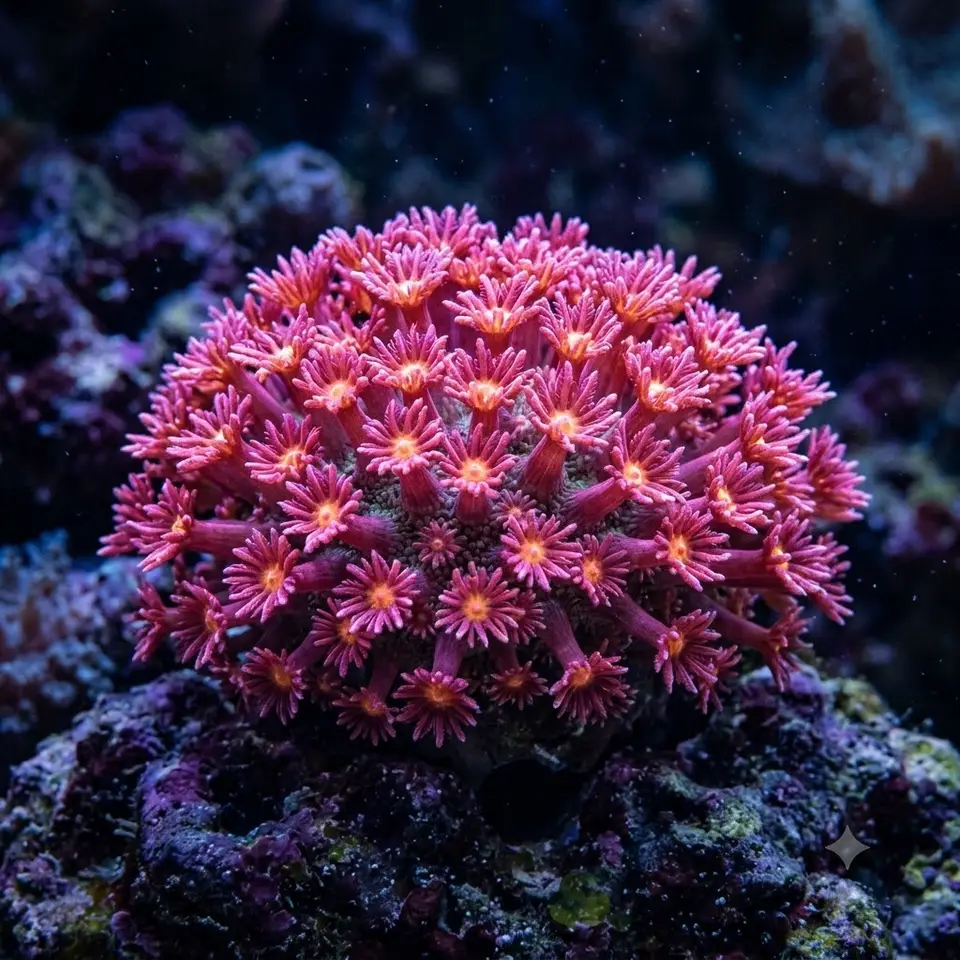 AI illustration
 Overview
Goniopora, commonly called flowerpot coral, is a large-polyp stony (LPS) coral - an animal (a colonial cnidarian), not a plant. It is prized for a shimmering ball of long, flowing polyps, each tipped with 24 tentacles, that sway constantly in the current. It also carries one of the worst survival records in the hobby, so it belongs only with advanced keepers.
Origin & Habitat
Goniopora is found across the Indo-Pacific, from the Red Sea and East Africa through Southeast Asia to the western Pacific and Great Barrier Reef. It grows on lagoon floors, turbid inshore reefs, and reef slopes, often on softer or sediment-rich substrate where water is nutrient-loaded and light is moderate rather than intense.
Appearance
The colony forms a rounded or encrusting stony base from which hundreds of long, slender polyps extend. Each polyp ends in a flower-like crown of tentacles, giving a soft, grassy, waving appearance quite unlike hard-looking SPS corals. Colours range from cream, tan, and green to pink, purple, and neon shades, sometimes with a contrasting mouth. By day the polyps stretch out and flow; when disturbed or at night they retract into the skeleton, shrinking the colony to a bumpy stony mass.
Placement & Temperament
Goniopora is largely peaceful and does not deploy long sweeper tentacles the way aggressive LPS such as bubble or torch corals do. Even so, its extended polyps can touch and irritate close neighbours, so leave at least 10 to 15 cm (4 to 6 in) of open space around the colony. Place it on the sand bed or low on the rock in a spot with gentle, indirect flow where the polyps can fully extend without being blasted.
Tank & Water Conditions
Keep a mature, stable reef: salinity 1.024 to 1.026, temperature 24 to 27 C (75 to 81 F). Hold the reef "big three" steady - alkalinity 8 to 11 dKH, calcium 400 to 450 ppm, and magnesium 1300 to 1350 ppm. Goniopora is sensitive to swings and generally does best in an established tank with light nutrient loading rather than an ultra-clean, stripped-down system.
Lighting & Flow
Moderate LPS lighting suits it, roughly 50 to 175 PAR; low to moderate is safer than intense light. Provide gentle, indirect, and somewhat variable flow so the polyps extend fully and food can reach them, while avoiding a direct high-velocity stream that keeps them retracted.
Feeding
Like most reef corals it hosts symbiotic zooxanthellae that supply energy from light, but light alone rarely sustains Goniopora long-term. It benefits from regular target feeding of fine foods - phytoplankton, rotifers, and tiny meaty particles or coral-specific foods - a few times per week onto the extended polyps. Consistent feeding and stable, slightly nutrient-rich water are widely considered central to survival.
Health & Growth
This is where honesty matters: Goniopora is one of the hardest corals to keep. Historically the majority of wild-collected colonies slowly decline and starve over weeks to months even when water quality looks good, a phenomenon still not fully understood. Growth is slow. Warning signs include polyps that stay retracted, progressive tissue recession exposing bare skeleton, and shrinking day by day - often the start of a decline that is hard to reverse. Aquacultured and captive-grown "dwarf" Goniopora adapt far better and are the honest recommendation; many long-term successes trace back to hardy cultured stock plus a mature tank and diligent feeding. As a stony coral, Goniopora is listed on CITES Appendix II, so choose captive-propagated or aquacultured frags from reputable suppliers over wild-harvested colonies - better for both survival odds and wild reefs.
Pros & Cons
Pros
- Mesmerising flowing, daisy-like polyps and vivid colours
- Largely peaceful with no aggressive sweeper tentacles
- Aquacultured and dwarf types are far hardier than wild colonies
Cons
- Notoriously difficult - many colonies slowly starve or decline over months
- Needs regular target feeding and a mature, stable tank
- Slow growing and unforgiving of parameter swings; not for beginners
Everyday gear for a reef tank
Links go to Amazon or a partner brand's own store and may earn us a commission at no extra cost to you. As an Amazon Associate we earn from qualifying purchases. An Amazon link leads to a type of gear and you choose the exact product; a card that names a store leads to that partner's own shop.