Hydnophora Coral
Hydnophora, known in the hobby as horn coral or velvet horn coral, is a small-polyp stony (SPS) coral - a colonial animal (a cnidarian), not a plant.
🗓️ Last reviewed: July 2026
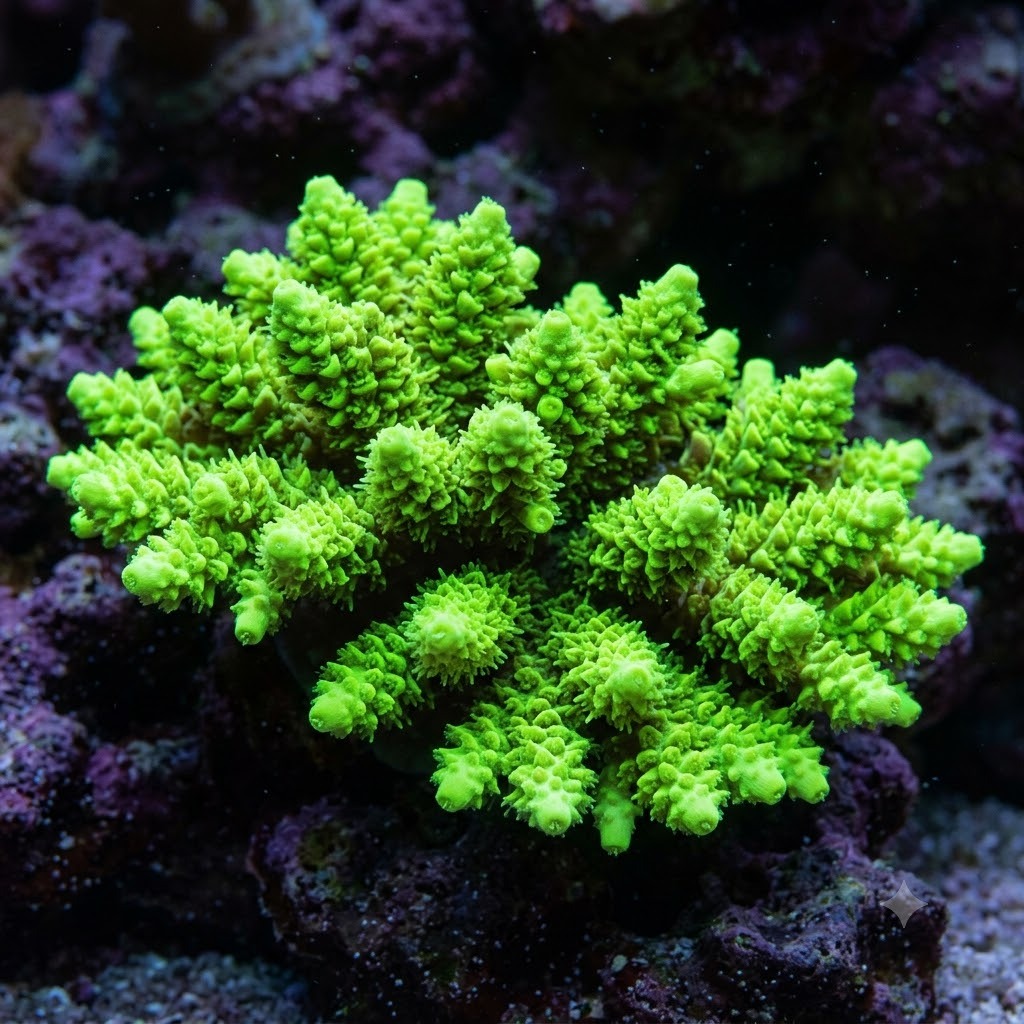
Overview
Hydnophora, known in the hobby as horn coral or velvet horn coral, is a small-polyp stony (SPS) coral - a colonial animal (a cnidarian), not a plant. Its skeleton is unmistakable: instead of cup-shaped corallites it carries dozens of small cone-shaped mounds called hydnophores, with the polyps sitting in the grooves between them. The branching Hydnophora rigida and the encrusting Hydnophora exesa are the two forms usually offered. It is hardy and fast-growing, and it is also one of the most aggressive corals commonly sold for reef tanks.
Origin & Habitat
Hydnophora is Indo-Pacific, ranging from the Red Sea and East Africa across the Indian Ocean to the western Pacific, on reef slopes, lagoons and protected back-reef areas. It handles a broad depth and light range in the wild, which is part of why it adapts so readily to aquariums. Aquacultured frags are the responsible option and are widely available - wild stony coral collection is regulated, and all stony corals (order Scleractinia) are listed under CITES Appendix II.
Appearance
Branching Hydnophora forms antler-like arms with blunt tips; encrusting forms spread as a bumpy sheet across rock and then lift into short knobs. The surface texture is the giveaway - a field of small pointed cones that looks velvety when the polyps are out and distinctly spiky when they are retracted. Bright neon green is the dominant hobby colour, with cream, tan and pale brown morphs also traded, usually with lighter tips on actively growing branches.
Placement & Temperament
This is the honest headline: Hydnophora is very aggressive. It extends long sweeper tentacles, chiefly at night, and it will burn and kill neighbouring corals well beyond its visible outline. It also encrusts aggressively along rock and can creep onto anything it touches. Give it a solid margin of open space - a good 10 to 15 cm in every direction is not excessive - and ideally isolate it on its own rock or bommie. Do not place it upstream of prized corals, since sweepers and stinging cells drift downcurrent, and be prepared to prune it back on a schedule rather than waiting for it to reach something.
Tank & Water Conditions
Standard reef targets apply: salinity 1.024-1.026, temperature 24-27 C (75-81 F), alkalinity 8-11 dKH, calcium 400-450 ppm and magnesium 1300-1350 ppm. Hydnophora is less fragile than most SPS and tolerates moderate nutrient levels, but it still wants a mature system and stable chemistry, especially alkalinity. Sudden swings show up as bleached patches and stalled growth.
Lighting & Flow
Moderate to bright light, roughly 150-250 PAR, keeps the green morphs vivid; under weak light they fade toward brown, and under a sudden jump in intensity they bleach. Acclimate gradually. Flow should be moderate to strong and turbulent so detritus does not settle in the grooves between the hydnophores, which is where tissue problems tend to begin. Steady water movement also helps the colony shed slime and stay clean.
Feeding
Photosynthesis via symbiotic zooxanthellae covers most of its energy needs, so lighting is the primary food. The polyps are small but genuinely predatory and will take fine meaty foods - baby brine, finely chopped mysis, powdered coral blends - and the colony responds to feeding with faster growth. That growth is a double-edged reward given how quickly it encroaches on neighbours, so feed with the pruning schedule in mind.
Health & Growth
Hydnophora is hardy by SPS standards and grows quickly, both outward along rock and upward into branches. Common problems are mechanical rather than chemical: shaded lower branches dying back, detritus accumulating in a dense colony, or the coral itself being stung by a neighbour it grew into. Watch for tissue recession from the base and for white patches where sweeper wars have taken place. Fragging is straightforward with bone cutters, and regular trimming is part of keeping it, not an emergency measure.
Pros & Cons
Pros
- Hardy and fast-growing, tolerant of a broad light and nutrient range
- Striking cone-textured skeleton and vivid green morphs
- Easy to frag and propagate
Cons
- Very aggressive - long sweeper tentacles will kill neighbouring corals
- Needs generous isolation and routine pruning to stay contained
- Encrusting growth spreads across rock and onto anything it touches
🧠 Test yourself: guess the exotic
Three clues from our quiz bank, each about another of our exotic. Can you name them?
Clue 1.One of the world's largest land mollusks, this shelled creature can grow as long as an adult's hand and is a serious invasive pest.
It's the Giant African Land Snail - read the full profile →
Clue 2.Belonging to an order whose name means 'apparition,' this insect includes some of the longest insects on Earth.
It's the Stick Insect (Phasmid) - read the full profile →
Clue 3.Sold cheaply at beach shops, this pet has one oversized claw used to seal the entrance of its home.
It's the Hermit Crab - read the full profile →