Pulsing Xenia
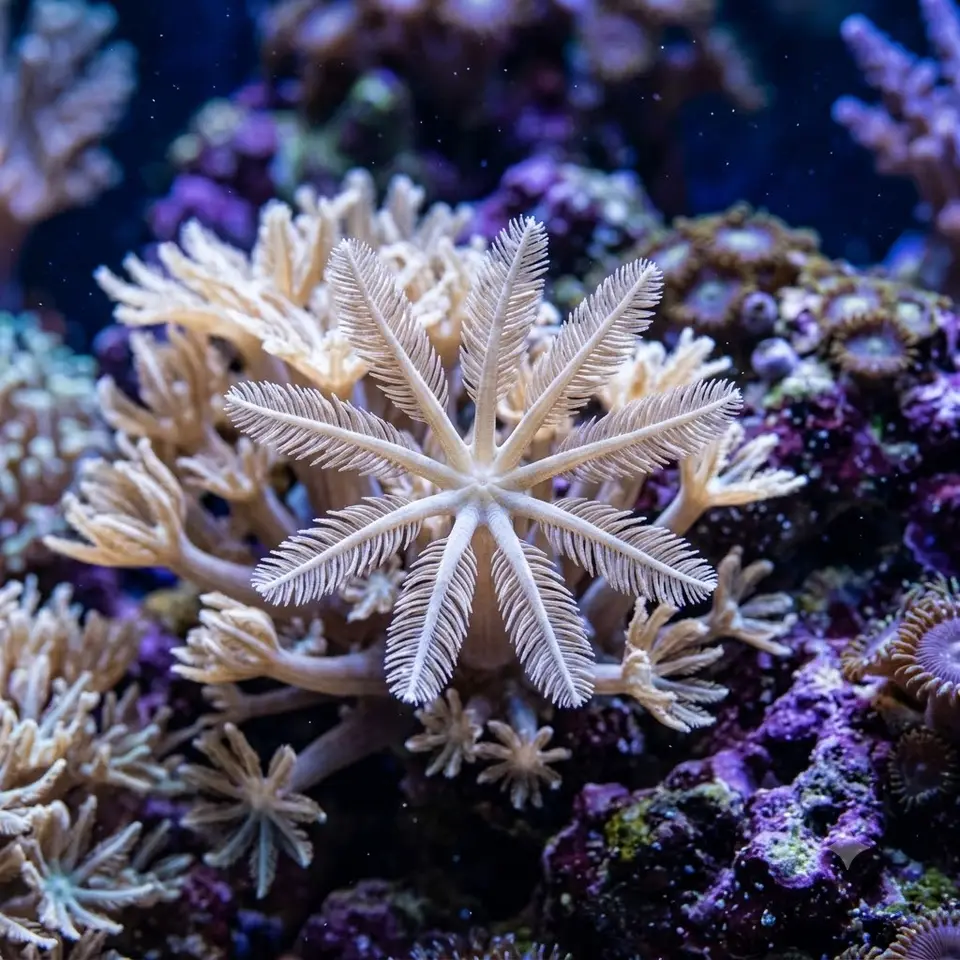
Pulsing xenia has feathery polyps that rhythmically open and close like tiny grasping hands, so the coral seems to breathe.
Last reviewed: October 2026
 AI illustration
 Overview
Pulsing xenia has feathery polyps that rhythmically open and close like tiny grasping hands, so the coral seems to breathe. It is easy to grow; the difficulty is that it grows too well and can carpet a tank overnight. (Xenia and Heteroxenia species.)
Origin & Habitat
Indo-Pacific reefs, in nutrient-rich, well-lit, moving water.
Appearance
Clusters of stalks tipped with eight-fingered polyps that pulse open and shut; usually cream, tan or pale pink.
Placement & Temperament
Peaceful but notoriously invasive - it spreads by 'walking' and dropping tips, and can overrun rock and even glass. Many keepers isolate it on a rock island in a corner.
Tank & Water Conditions
Salinity 1.024-1.026, 24-27°C, stable alkalinity 8-11 dKH, calcium 400-450, magnesium 1300-1350; oddly, it often does best in slightly nutrient-rich water.
Lighting & Flow
Moderate light (about 75-150 PAR) and moderate flow encourage strong pulsing.
Feeding
Photosynthetic; absorbs nutrients from the water. No feeding needed.
Health & Growth
Hardy but unpredictable - it can boom, then mysteriously crash and vanish for no clear reason. Keep a frag isolated as insurance.
Pros & Cons
Pros
- Mesmerising pulsing motion
- Fast, cheap, hardy
- Great nutrient exporter
Cons
- Highly invasive - can take over
- Sometimes crashes for no reason
- Hard to remove from a rock once rooted
Everyday gear for a reef tank
Links go to Amazon or a partner brand's own store and may earn us a commission at no extra cost to you. As an Amazon Associate we earn from qualifying purchases. An Amazon link leads to a type of gear and you choose the exact product; a card that names a store leads to that partner's own shop.
Pulsing Xenia - frequently asked questions
Why does xenia pulse?
No one is fully sure - leading ideas are gas exchange and boosting photosynthesis. Strong, healthy colonies in good light and flow pulse the most.
Should I be careful adding xenia?
Yes - it is one of the most invasive corals in the hobby. Keep it on an isolated rock island, well away from corals you do not want it to smother.