Psammocora Coral
Psammocora, known in the hobby as sandpaper coral or cat's-paw coral, is a small-polyp stony (SPS) coral - a colonial animal (a cnidarian), not a plant.
🗓️ Last reviewed: July 2026
Overview
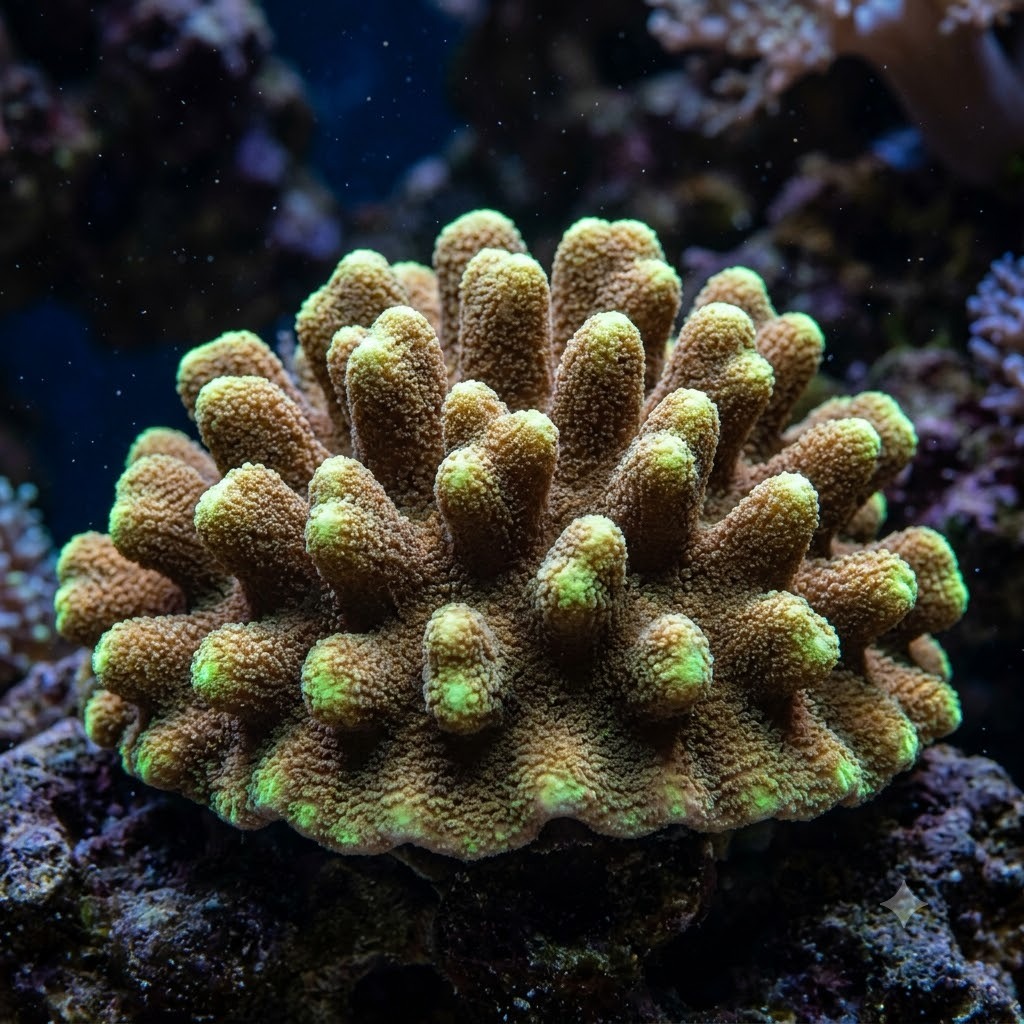
Psammocora, known in the hobby as sandpaper coral or cat's-paw coral, is a small-polyp stony (SPS) coral - a colonial animal (a cnidarian), not a plant. Its polyps are minute and set in shallow, petal-like corallites, so the surface feels and looks finely granular rather than knobbly, hence the sandpaper name. Depending on species and conditions it encrusts, forms thick columns, or throws up short blunt branches. It is uncommon compared with the big-name SPS genera but genuinely available, and it is one of the more forgiving stony corals to keep.
Origin & Habitat
Psammocora occurs widely across the Indo-Pacific, from the Red Sea and East Africa through the Indian Ocean to the Pacific, and it turns up on reef slopes, lagoon floors and rubble zones from shallow water down into dimmer depths. That broad natural range is why it copes with a wide light window in aquariums. Aquacultured frags are the responsible choice - wild collection of stony corals is regulated and all stony corals (order Scleractinia) are listed under CITES Appendix II - and encrusting corals of this type propagate easily in captivity.
Appearance
The defining feature is texture: a matte, velvety, almost suede-like surface with no obvious individual polyps at a glance. Colonies commonly appear as low crusts that thicken into rounded columns or stubby fingers with paw-like blunt tips. Colours in the trade run to greens, tans, salmon, pinkish-brown, purple and grey, often with lighter tips or margins where growth is active. Under actinic-heavy lighting the green morphs can fluoresce strongly, which is a large part of the appeal.
Placement & Temperament
Psammocora is peaceful. It has no long sweeper tentacles and does not chemically bully its neighbours, though like any encrusting stony coral it will slowly spread over adjacent rock and eventually meet whatever is next to it. A few centimetres of clearance is enough. It is flexible about position: mid-rock is the safe default, and it will hold colour lower in the tank better than most branching SPS, which makes it useful for filling the middle band of a reefscape.
Tank & Water Conditions
Standard reef parameters apply: salinity 1.024-1.026, temperature 24-27 C (75-81 F), alkalinity 8-11 dKH, calcium 400-450 ppm and magnesium 1300-1350 ppm. A mature tank with stable chemistry is the requirement, as with any SPS, but Psammocora tolerates moderate nutrient levels better than Acropora and does not demand ultra-lean water. Steady alkalinity is still the single most important number to hold.
Lighting & Flow
Moderate to bright light, roughly 100-250 PAR, covers most hobby species, and it adapts to the lower end better than most stony corals. Acclimate gradually after any change in lighting. Flow should be moderate and turbulent - enough to sweep detritus off the velvety surface and out of the spaces between columns, since trapped sediment is the usual trigger for tissue loss on a coral with such fine surface texture.
Feeding
Symbiotic zooxanthellae supply most of the energy, so lighting is the main food source. The polyps are extremely small and can only take very fine particles; broadcast feeding of microplankton or a powdered reef blend a couple of times a week supports growth, but target feeding is not practical at this polyp size. As with most SPS, water stability contributes more to long-term health than any feeding schedule.
Health & Growth
Psammocora is hardy for an SPS and grows at a moderate pace, encrusting its plug first and then building outward and upward. Its main vulnerability is detritus and algae settling on the fine surface, which shuts down patches of tissue that are then colonised by turf algae. Watch for dull or receding margins, persistent film on the colony, and browning under insufficient light. It is less prone to the sudden rapid tissue necrosis events that plague Acropora, but a serious alkalinity swing will still stall or damage it. Fragging is done by cutting encrusted rock or snapping off a column.
Pros & Cons
Pros
- Hardy for an SPS and tolerant of a wide light range, including dimmer spots
- Peaceful, with no sweeper tentacles
- Unusual velvety texture and strong fluorescence in green morphs
Cons
- Less widely stocked than mainstream SPS genera, so morphs can be hard to find
- Fine surface traps detritus if flow is too gentle, leading to tissue loss
- Growth is slower and less dramatic than branching SPS like digitata
🧠 Test yourself: guess the exotic
Three clues from our quiz bank, each about another of our exotic. Can you name them?
Clue 1.New World species of this arachnid defend themselves by kicking urticating hairs, while Old World species rely on faster, more potent bites.
It's the Tarantula - read the full profile →
Clue 2.This hermaphrodite gastropod has both sexes in one body and can lay over a thousand eggs a year.
It's the Giant African Land Snail - read the full profile →
Clue 3.This crustacean has a soft, spiraled abdomen and must borrow an empty snail shell to protect its body.
It's the Hermit Crab - read the full profile →