Echinopora Coral
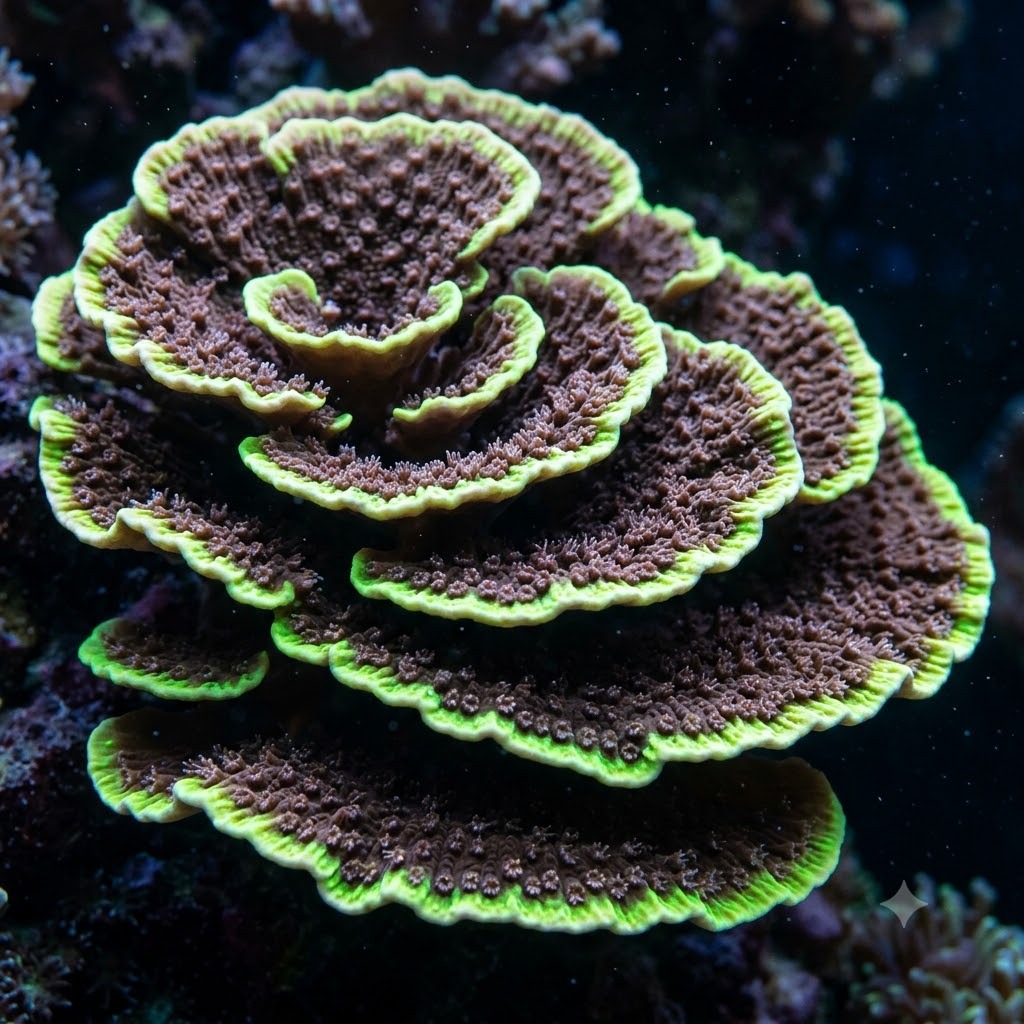
Echinopora, sold as hedgehog coral or (for the plating species) tiered or lettuce-like plate coral, is a stony coral - a colonial animal (a cnidarian), not a plant - that the hobby generally groups with the encrusting and plating SPS corals.
🗓️ Last reviewed: July 2026
Overview
Echinopora, sold as hedgehog coral or (for the plating species) tiered or lettuce-like plate coral, is a stony coral - a colonial animal (a cnidarian), not a plant - that the hobby generally groups with the encrusting and plating SPS corals. Echinopora lamellosa builds thin, overlapping tiers like a stack of shelves; Echinopora horrida grows short, spiky branches from an encrusting base. Both are hardy, grow quickly, and are among the easier stony corals to establish, which is why they turn up so often in named colour morphs.
Origin & Habitat
The genus is Indo-Pacific, found from the Red Sea and East Africa across the Indian Ocean to the western Pacific on protected reef slopes, lagoons and turbid inshore reefs. Plating species in particular favour sheltered water with moderate light, which explains their tolerance of mid-tank placement in aquariums. Aquacultured frags are the responsible choice and are easy to find - wild stony coral collection is regulated and all stony corals (order Scleractinia) are listed under CITES Appendix II - and this genus propagates so readily that captive material dominates the trade.
Appearance
Plating Echinopora forms thin, gently ruffled shelves that stack outward in tiers, each layer edged by a brighter growth margin. Branching forms carry stubby, rough-textured arms studded with small raised corallites, the source of the hedgehog name. Colour morphs are a big part of the appeal - neon green, teal, orange, purple base with contrasting polyps - and the growth edge often glows a different shade from the older tissue. Polyps are small and extend mainly at night, giving the plate a bristled edge in the dark.
Placement & Temperament
Do not treat this one as harmless. Echinopora belongs to the Merulinidae, and like others in that family it can extend sweeper tentacles at night that sting corals within reach. On top of that, plating species grow fast and shade everything under the expanding shelf, while encrusting bases creep across rock. Give it real clearance - several centimetres at minimum, more for a plating colony you intend to grow out - and plan the space below it. Mid-rock placement on a solid, angled surface works well; avoid tucking it beside a slow, delicate coral.
Tank & Water Conditions
Target salinity 1.024-1.026, temperature 24-27 C (75-81 F), alkalinity 8-11 dKH, calcium 400-450 ppm and magnesium 1300-1350 ppm. Echinopora tolerates moderate nutrients better than most SPS and often colours up best in a tank that is fed rather than stripped bare. It still wants a mature system and stable alkalinity, since sharp swings show up as bleached bands or a stalled growth margin.
Lighting & Flow
Moderate light suits it, roughly 100-200 PAR, and plating species in particular can wash out or bleach under intense direct lighting. Acclimate gradually to any change. Flow should be moderate and turbulent so that detritus does not settle on the horizontal shelves - the tiered growth form is very good at catching sediment, and trapped debris is the most common cause of dead patches on an otherwise healthy colony.
Feeding
Most of its energy comes from symbiotic zooxanthellae, so lighting remains the main food source. Beyond that, the polyps feed willingly at night on fine meaty foods such as baby brine, finely chopped mysis and powdered coral blends, and regular feeding noticeably accelerates the already fast plating growth. Feed with a plan for that growth rather than encouraging it into a crowded rockscape.
Health & Growth
Echinopora is hardy and fast - a small frag can produce a broad plate within a year in a stable tank, which makes it satisfying but demanding of space. Fragging is easy: plates snap cleanly and encrusted rock can be cut. Watch for detritus building on the shelves, algae taking hold on the growth margin, shaded lower tiers dying back, and sting damage where the colony has grown into a neighbour. Bleaching usually follows a lighting increase made too quickly; browning suggests too little light or too much nutrient.
Pros & Cons
Pros
- Hardy and fast-growing, forgiving of moderate light and nutrients
- Vivid colour morphs with a bright contrasting growth edge
- Very easy to frag and propagate
Cons
- Extends sweeper tentacles at night and can sting nearby corals
- Plating colonies shade and outcompete anything beneath them
- Tiered shelves trap detritus if flow is not turbulent enough
🧠 Test yourself: guess the exotic
Three clues from our quiz bank, each about another of our exotic. Can you name them?
Clue 1.Sold cheaply at beach shops, this pet has one oversized claw used to seal the entrance of its home.
It's the Hermit Crab - read the full profile →
Clue 2.From a single island nation, this glossy brown roach gives live birth and males sport bumpy 'horns.'
It's the Madagascar Hissing Cockroach - read the full profile →
Clue 3.This hermaphrodite gastropod has both sexes in one body and can lay over a thousand eggs a year.
It's the Giant African Land Snail - read the full profile →