Tangerine Leopard Gecko
The Tangerine is a leopard gecko selectively bred for warm orange colouration across the body, ranging from soft peach to deep, saturated tangerine.
Last reviewed: July 2026
Species guide: Leopard Gecko · All leopard gecko morphs
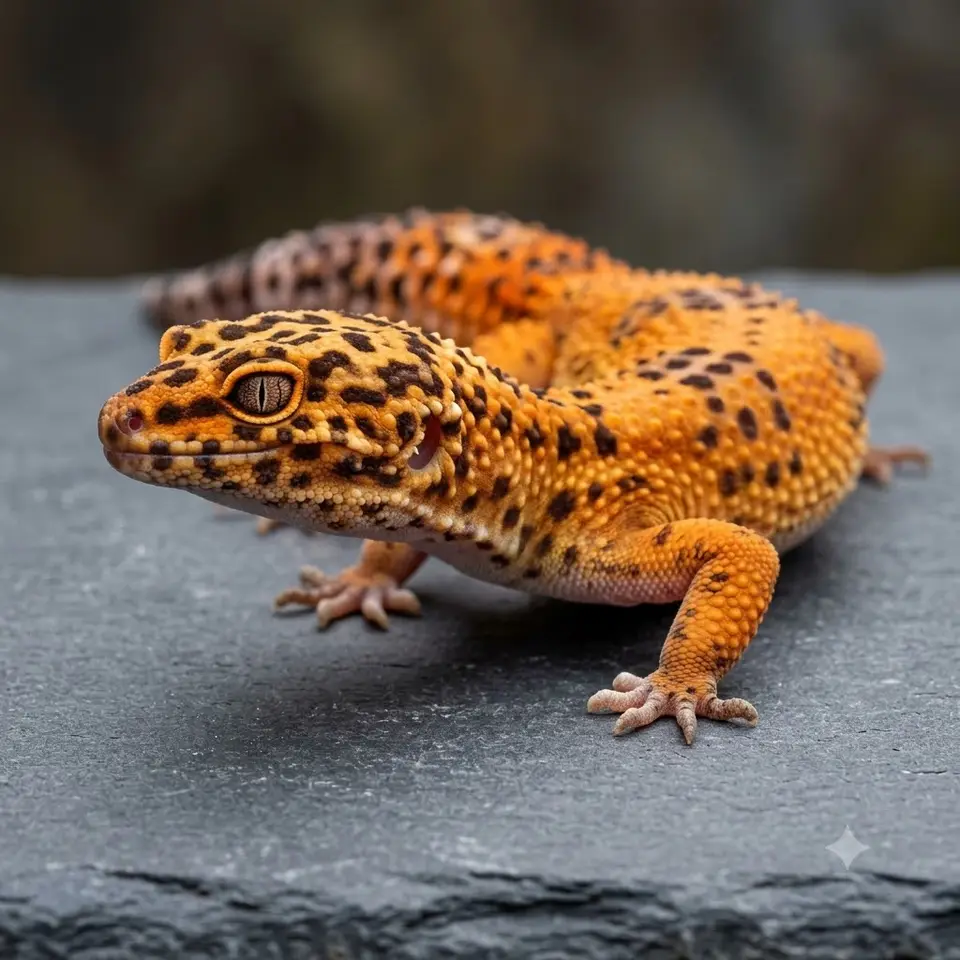 AI illustration
 Overview
The Tangerine is a leopard gecko selectively bred for warm orange colouration across the body, ranging from soft peach to deep, saturated tangerine. It is one of the most popular and widely available colour lines in the hobby, and it crosses easily into many other projects. Tangerine is a colour morph of the leopard gecko (Eublepharis macularius).
What it is
"Tangerine" describes the overall orange tone of the animal rather than a specific gene. Where a normal or wild-type leopard gecko shows a yellow base with dark brown or black spotting, a Tangerine shifts that base toward orange, often with reduced or lightened black markings. The strongest lines carry orange onto the limbs, tail and head, which normal animals typically do not show.
The genetics
Tangerine is polygenic and line-bred, not a simple recessive, dominant or co-dominant trait. This means the colour is controlled by many small-effect genes acting together, and its intensity is built up gradually by breeders choosing the most orange animals over successive generations. There is no single "Tangerine gene," no het carriers, and no super form. Because it is a colour base rather than a switch, it is frequently combined with true genetic morphs (for example carrot-tail or hypomelanistic lines) to build designer combos. Unlike incomplete-dominant "co-dom" traits in the hobby, a Tangerine does not simply express from one copy - it is an accumulation of selection.
Appearance
The base colour ranges from light peach to rich, vivid orange, usually strongest along the back and flanks. Black spotting is often reduced compared with a normal, and heavily selected lines may show orange on the legs, head and into the tail. Many Tangerines are also carrot-tail or carrot-head lines, adding orange to those areas. Eyes are the typical dark leopard gecko eye. Hatchlings usually emerge with more banding and muted colour, and the orange deepens and spreads as the animal matures over its first year or so.
How it is bred
Because Tangerine is polygenic, breeders produce it by pairing the most intensely orange animals together and selecting the brightest offspring generation after generation to concentrate the trait. There are no het pairings and no two-copy requirement as with recessives, and no single copy that "turns it on" as with dominant or co-dominant morphs. When stacked with true genetic morphs, the Tangerine colour rides along as the background while the paired gene is inherited on its own terms.
Cost and availability
Tangerines are common and generally affordable, sitting at the accessible end of the market. Basic orange animals are inexpensive and easy to find, while exceptionally intense, well-established lines or Tangerines combined with other desirable morphs command higher prices.
Health and ethics
The Tangerine line carries no special health problem beyond normal leopard gecko care - because it is a colour selection rather than a structural or neurological mutation, it is not linked to any welfare disorder. As with any animal, buy from a reputable breeder who keeps clear records, and consult a reptile (herp) veterinarian for any health concern.
Care
Care is identical to a standard leopard gecko - the Tangerine trait changes only appearance, not the animal's needs. Follow the same temperature gradient, hides, substrate, diet and supplementation you would use for any leopard gecko, and rely on reputable general leopard gecko care resources and a herp vet rather than treating this morph as a special case.
Everyday gear for reptiles
Links go to Amazon or a partner brand's own store and may earn us a commission at no extra cost to you. As an Amazon Associate we earn from qualifying purchases. An Amazon link leads to a type of gear and you choose the exact product; a card that names a store leads to that partner's own shop.
Tangerine Leopard Gecko - frequently asked questions
Is Tangerine a recessive morph?
No. It is polygenic and line-bred, meaning the orange colour comes from many genes selected over generations. There are no het carriers and no single gene to inherit.
Will my Tangerine get more orange as it grows?
Often, yes. Many hatch duller and more banded, then deepen and spread their orange over their first year, though the final intensity depends on the line.