Albino Ball Python
The Albino Ball Python is one of the most recognizable and historically important color morphs in the hobby, prized for its glowing yellow-and-white pattern and pink-red eyes.
Last reviewed: October 2026
Species guide: Ball Python · All ball python morphs
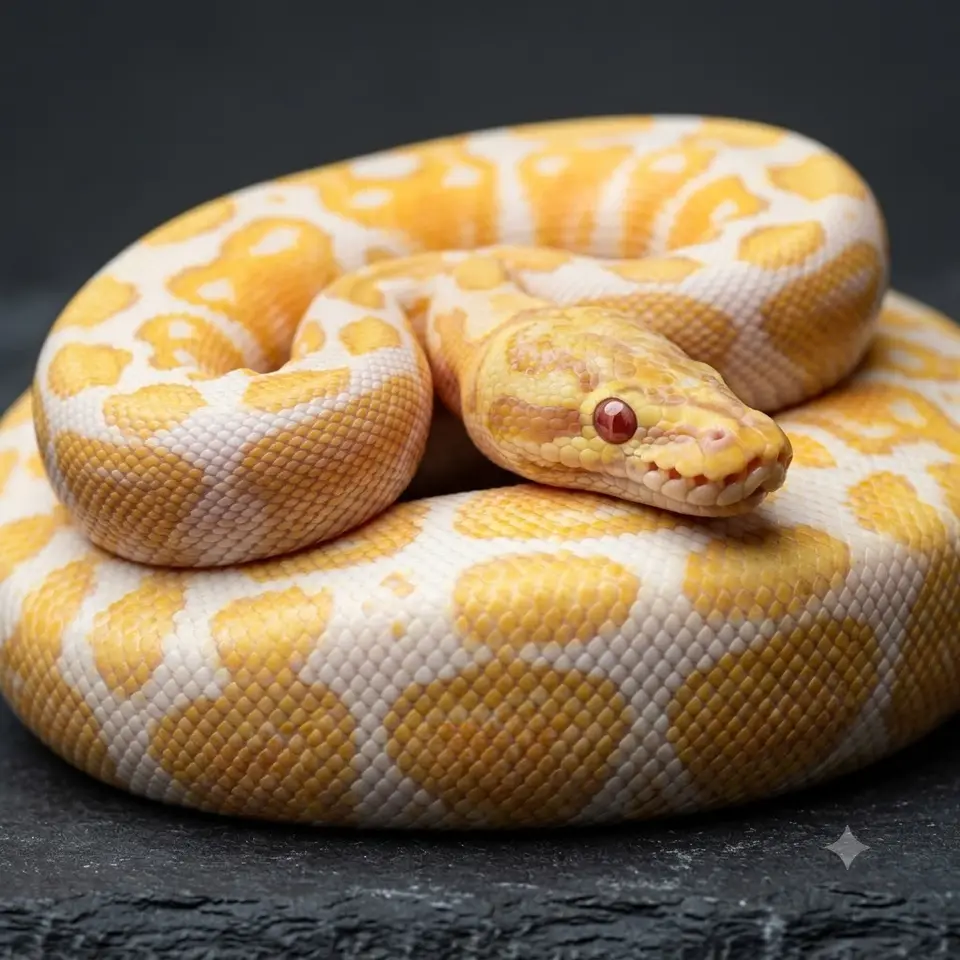 AI illustration
 Overview
The Albino Ball Python is one of the most recognizable and historically important color morphs in the hobby, prized for its glowing yellow-and-white pattern and pink-red eyes. Because it removes all dark pigment, it looks dramatically different from a wild-type snake while behaving exactly the same. It is a color morph of the ball python (Python regius).
What it is
"Albino" in this context means amelanistic - the snake cannot produce melanin, the pigment responsible for black and brown. Where a normal ball python shows a busy brown-and-black blotched pattern, the Albino keeps the same pattern shapes but renders them in warm yellow on a white background, with no dark outlines at all. The result is a bright, high-contrast animal with red or pink eyes instead of the normal dark ones.
The genetics
The Albino trait is a simple recessive mutation. Recessive means a snake must inherit two copies of the gene (one from each parent) to actually look albino. A snake with only one copy is called "het" (heterozygous) for albino - it looks completely normal but can pass the gene on. There is no "super" form here, because the trait is recessive rather than co-dominant or incomplete-dominant; two copies simply produce the visual albino. Albino is also a foundational gene in countless designer combos, where it is stacked with other traits to create new looks.
Appearance
The base is a clean white to pale cream, overlaid with the ball python's classic alien-head and blotch pattern in shades of yellow and soft orange. Newly hatched animals often show brighter, more saturated yellow that can mellow slightly with age, and some lines develop a subtle lavender or purple wash in the white areas over time. The eyes are the giveaway: clear red to pink, sometimes appearing ruby in bright light. Because there is no black pigment, the whole animal reads as bright and luminous compared to a wild-type snake.
How it is bred
Because Albino is recessive, a visual albino is only produced when a hatchling inherits the gene from both parents. Breeders reach this by pairing two visual albinos, a visual albino with a het albino, or two het albinos. Only pairings where both parents carry at least one copy can ever yield visual albino offspring; pairing a visual to a normal that carries nothing produces all het (normal-looking carrier) babies. The same gene is frequently combined with other recessive or dominant traits to build multi-gene designer morphs.
Cost and availability
Albino is one of the oldest established morphs and is widely produced, so it sits at the affordable, beginner-friendly end of the market. Single-gene Albinos are common and inexpensive relative to newer or rarer traits, while Albino combined into multi-gene designer combinations can cost considerably more depending on what else is stacked in.
Health and ethics
The Albino (amelanistic) mutation is not linked to any neurological or structural welfare problem - it changes pigment only, and these snakes live normal, healthy lives with standard species care. Albino animals can be a little more light-sensitive, so ordinary, non-glaring lighting is sensible, but this is a minor consideration rather than a defect. One combination is different: the MorphMarket community list of ball python morph issues names small eyes in Super Lessers that are also albino. As with any animal, buy from a reputable breeder who keeps good health and lineage records, and consult a reptile (herp) veterinarian for any health concern.
Care
Care is identical to a standard ball python - the morph changes only how the snake looks, not what it needs. Provide the same enclosure, temperature gradient, humidity, hides, and feeding schedule you would for any Python regius. For husbandry specifics, follow reputable ball python care resources and work with a qualified herp vet rather than treating this morph as a special case.
Everyday gear for reptiles
Links go to Amazon or a partner brand's own store and may earn us a commission at no extra cost to you. As an Amazon Associate we earn from qualifying purchases. An Amazon link leads to a type of gear and you choose the exact product; a card that names a store leads to that partner's own shop.
Albino Ball Python - frequently asked questions
Are Albino Ball Pythons blind?
No. Their red eyes lack dark pigment, so they can be a bit more sensitive to bright light, but their vision is normal and they do not need any special accommodation beyond ordinary, non-glaring lighting.
If I breed two Albinos, what do I get?
Because the trait is recessive and both parents are visual albinos, all of the offspring will be visual Albinos, since every hatchling inherits an albino copy from each parent.