Blue-Eyed Leucistic Ball Python
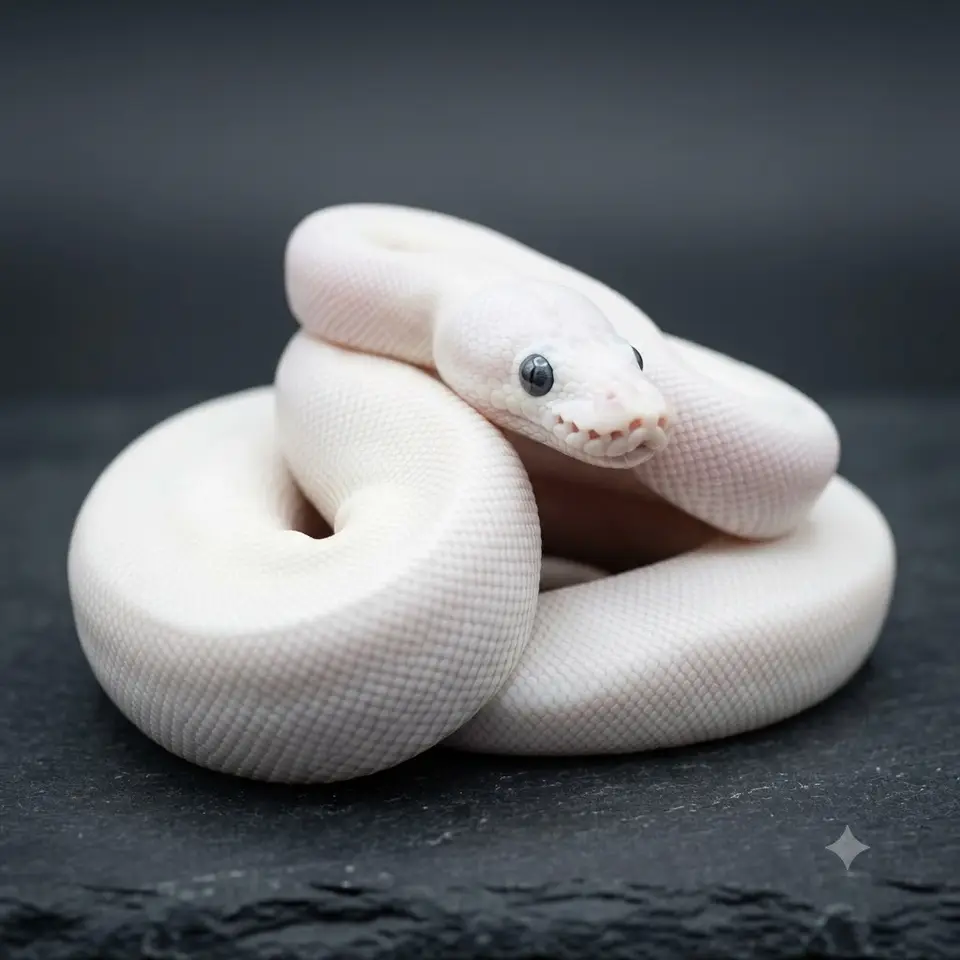
The Blue-Eyed Leucistic Ball Python, usually shortened to "BEL," is a striking near-white snake with pale, icy blue eyes and no dark pigment.
Last reviewed: October 2026
Species guide: Ball Python · All ball python morphs
 AI illustration
 Overview
The Blue-Eyed Leucistic Ball Python, usually shortened to "BEL," is a striking near-white snake with pale, icy blue eyes and no dark pigment. It is one of the classic "white snake" projects in the hobby, prized for its clean look and produced not by a single gene but by combining several complementary ones. It is a color and pattern morph of the ball python (Python regius).
What it is
A BEL is a mostly solid white to very pale cream snake with clean blue eyes, in sharp contrast to the brown-and-tan blotched pattern of a normal, wild-type ball python. The heavy dark saddles, black eyes, and busy pattern of a wild-type are essentially erased, leaving a bright, low-pattern animal. Many BELs show a faint yellow wash or a light dorsal marking, especially along the head and spine, depending on which genes were used to make them.
The genetics
The BEL look is a designer combo, not a single trait. It is created by combining two complementary genes from the "BEL complex," which includes Lesser, Mojave, Butter, Russo, Special, and a few others (related complex members such as Phantom and Mystic give dark-eyed, purple-toned combos instead). Each of these is an incomplete-dominant gene, commonly called "co-dominant" (or "co-dom") in the hobby, though technically it is incomplete-dominant: one copy produces a lightened, altered animal, and the heterozygous form looks different from both parents. A BEL results either from pairing two different BEL-producing genes together (for example Lesser plus Mojave) or from the super form of a single complex gene (such as super Lesser or super Mojave), where the animal carries two copies of the same gene. There is no separate "BEL gene" to inherit on its own.
Appearance
The base color is white to off-white, sometimes with a soft lavender, cream, or pale yellow cast. Pattern is minimal: most of the body is clean, though some animals keep a faint gray or yellow dorsal stripe or head marking, which varies by gene combination. The eyes are the signature feature, a clear pale blue rather than the dark eyes of a wild-type. Hatchlings usually emerge bright and stay largely white through life, with any faint yellowing sometimes becoming a touch more visible with age.
How it is bred
Because the underlying genes are co-dom (incomplete-dominant), a single copy already shows a visible effect, so breeders do not need hidden "het" pairings the way recessive morphs require. To make a BEL, keepers pair two animals that together can supply two complementary complex genes to the same offspring: for example a Lesser bred to a Mojave, or two copies of one gene bred to make a super. On average only a portion of a clutch inherits the right two-gene combination and shows the full white, blue-eyed result, while siblings show the single-gene "designer" looks instead. This is a general explanation, not a breeding manual.
Cost and availability
BELs are well established and widely produced, so they are among the more affordable "premium look" morphs and are easy to find from ball python breeders. Exact price depends on which genes were combined, overall whiteness, eye clarity, and whether the animal also carries extra hidden genes for future projects. Cleaner, higher-white examples and multi-gene combos command more than basic ones.
Health and ethics
The BEL complex genes (Lesser, Mojave, Butter, Russo, and similar) are not associated with the neurological "wobble," balance disorders, or lethal super forms seen in some other morphs, and BELs are viable animals. The caution is about the eyes: the MorphMarket community list of ball python morph issues names enlarged "bug eyes" for the Super Lesser, and small eyes when a BEL super form is combined with Piebald or when a Super Lesser is also albino. A small number of complex combinations can also involve genes best researched individually, so buyers should ask breeders about the exact gene makeup. As with any animal, choose a reputable breeder who is transparent about genetics, and see a reptile (herp) veterinarian for any health concern.
Care
Care is identical to a standard ball python. This morph changes only appearance, not the animal's needs, so the same enclosure, heating, humidity, hiding, and feeding requirements apply. Follow reputable ball python husbandry resources for temperatures, humidity, and feeding, and consult a herp veterinarian for medical questions. This profile is education, not veterinary or breeding advice.
Everyday gear for reptiles
Links go to Amazon or a partner brand's own store and may earn us a commission at no extra cost to you. As an Amazon Associate we earn from qualifying purchases. An Amazon link leads to a type of gear and you choose the exact product; a card that names a store leads to that partner's own shop.
Blue-Eyed Leucistic Ball Python - frequently asked questions
Is the Blue-Eyed Leucistic a single gene?
No. It is a combo look created by stacking two complementary co-dom (incomplete-dominant) genes from the BEL complex, or by the super form of one of those genes. There is no standalone "BEL gene."
Does the Blue-Eyed Leucistic have the wobble or any lethal super?
No. The BEL complex genes are not linked to the neurological wobble seen in some morphs, and these combinations are viable. The known issue is the eyes: the MorphMarket community list of ball python morph issues names enlarged "bug eyes" for the Super Lesser BEL.