Champagne Ball Python
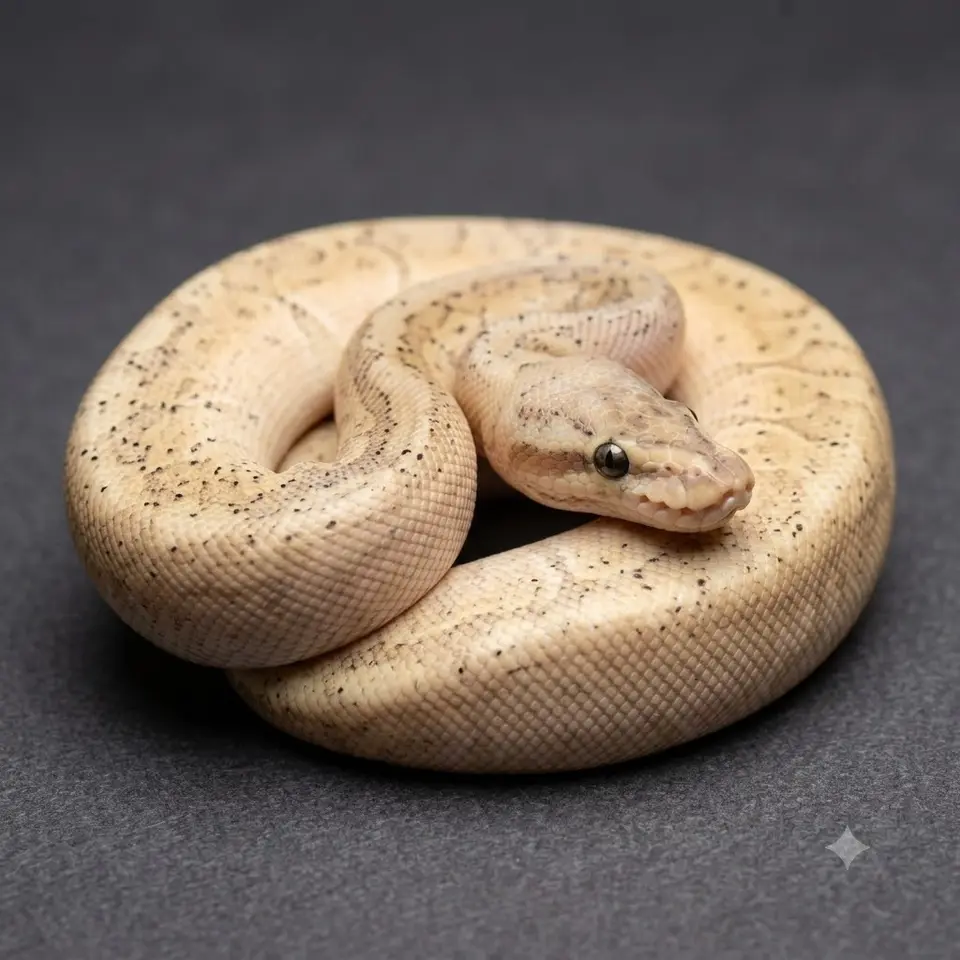
The Champagne is a warm, glowing ball python morph known for its peachy tan to orange-gold colour and a heavily reduced, faded pattern that can leave the snake looking almost clean-backed.
Last reviewed: July 2026
Species guide: Ball Python · All ball python morphs
 AI illustration
 Overview
The Champagne is a warm, glowing ball python morph known for its peachy tan to orange-gold colour and a heavily reduced, faded pattern that can leave the snake looking almost clean-backed. It is a striking and popular gene in designer combos, but it carries real welfare concerns that keepers should understand before buying. It is a colour and pattern morph of the ball python (Python regius).
What it is
The Champagne is a single-gene mutation that lightens and warms the base colour and strips down the normal pattern. Compared to a normal, wild-type ball python - which is dark brown to black with bold gold-tan blotches and "alien head" markings - a Champagne looks soft, washed-out and coppery. Much of the heavy dark pigment is reduced, the busy side pattern fades toward the belly, and many individuals show a thin, broken dorsal line down the spine rather than full blotches.
The genetics
Champagne is a dominant gene, meaning a single copy is enough to produce the visible Champagne look. In the hobby you will sometimes see it loosely called "co-dominant," but that label is misused here - a true co-dominant or incomplete-dominant gene produces a distinct, viable "super" form when an animal inherits two copies. Champagne does not. The homozygous (two-copy) super Champagne is widely reported to be lethal or non-viable, with affected embryos failing to develop normally, so a healthy super form is not something breeders can reliably produce. For that reason Champagne is best understood as a dominant gene with a lethal super. It is also a component of many well-known combos (for example designer combinations sold under blended trade names), where it is stacked with other single genes.
Appearance
The base colour ranges from light tan and peach to a richer copper or orange, often with a faint lavender or purplish cast over the head and neck. The head is usually clean and pale with dark eyes. Pattern reduction is the signature trait: the normal blotches are broken up, blushed out, or replaced by a slender, uneven dorsal stripe, and the flanks fade to a pale, near-patternless wash toward the belly. Animals can brighten or mellow slightly with age, but the overall soft, faded, warm-toned look stays consistent through life.
How it is bred
Because Champagne is a dominant gene, only one parent needs to carry it and only one copy needs to be passed on for a hatchling to show the trait, so breeders simply pair a Champagne to a normal or to another morph. Pairing two Champagnes together is avoided by responsible keepers because it risks producing the non-viable homozygous super, which does not yield a healthy animal. Champagne is also frequently combined with other single-gene morphs to create multi-gene "combo" animals, where each gene is stacked one copy at a time.
Cost and availability
Champagne is an established, widely available gene rather than a rare novelty. Single-gene Champagnes sit in the moderate, accessible range for morph ball pythons, while multi-gene combos that include Champagne can command higher prices depending on what else is stacked in. Availability is good through morph-focused breeders.
Health and ethics
Champagne carries a genuine welfare issue and this should not be downplayed. It is one of the ball python genes linked to the neurological "wobble," a movement disorder that can cause head tremors, a tilted or corkscrewing head posture, poor coordination and, in more severe cases, difficulty striking accurately at food. Severity varies between individuals and can worsen with stress, but it is an inherited trait of the gene itself, not a husbandry mistake. On top of this, the homozygous super form is lethal or non-viable. Because of both issues, many ethical keepers either avoid the gene or choose not to breed it, and those who do work with it avoid Champagne-to-Champagne pairings. If you keep one, choose a reputable breeder who is honest about wobble in their lines, and see a qualified reptile (herp) veterinarian for any neurological or health concerns. This profile is educational and is not breeding or veterinary advice.
Care
Care for a Champagne is identical to care for any standard ball python - the morph changes only how the snake looks, not what it needs. Provide the same enclosure size, temperature gradient, humidity, hides, clean water and appropriately sized prey you would give any Python regius. The one practical difference is monitoring: because of the wobble link, watch feeding response and coordination, reduce stress, and consult a herp vet if symptoms are pronounced. For full husbandry, follow reputable ball python care resources and an experienced reptile veterinarian.
Everyday gear for reptiles
Links go to Amazon or a partner brand's own store and may earn us a commission at no extra cost to you. As an Amazon Associate we earn from qualifying purchases. An Amazon link leads to a type of gear and you choose the exact product; a card that names a store leads to that partner's own shop.
Champagne Ball Python - frequently asked questions
Do all Champagne ball pythons wobble?
No. Wobble severity varies a lot between individuals - some show almost nothing, others show obvious head tremors or corkscrewing, and stress can make it worse. The genetic link is real, though, so it can appear in any Champagne.
Why can't I get a "super Champagne"?
Because the homozygous two-copy form is lethal or non-viable. Unlike true co-dominant genes, Champagne does not produce a healthy super, which is why breeders avoid pairing two Champagnes together.