Enchi Ball Python
The Enchi is one of the most popular and useful colour morphs in the ball python hobby, valued for its warm gold and orange tones, brightened flanks and a cleaner, more open pattern than a wild-type snake.
Last reviewed: July 2026
Species guide: Ball Python · All ball python morphs
 AI illustration
 Overview
The Enchi is one of the most popular and useful colour morphs in the ball python hobby, valued for its warm gold and orange tones, brightened flanks and a cleaner, more open pattern than a wild-type snake. It behaves well in combinations, so breeders reach for it constantly to add colour and pattern polish to designer projects. It is a colour and pattern morph of the ball python (Python regius).
What it is
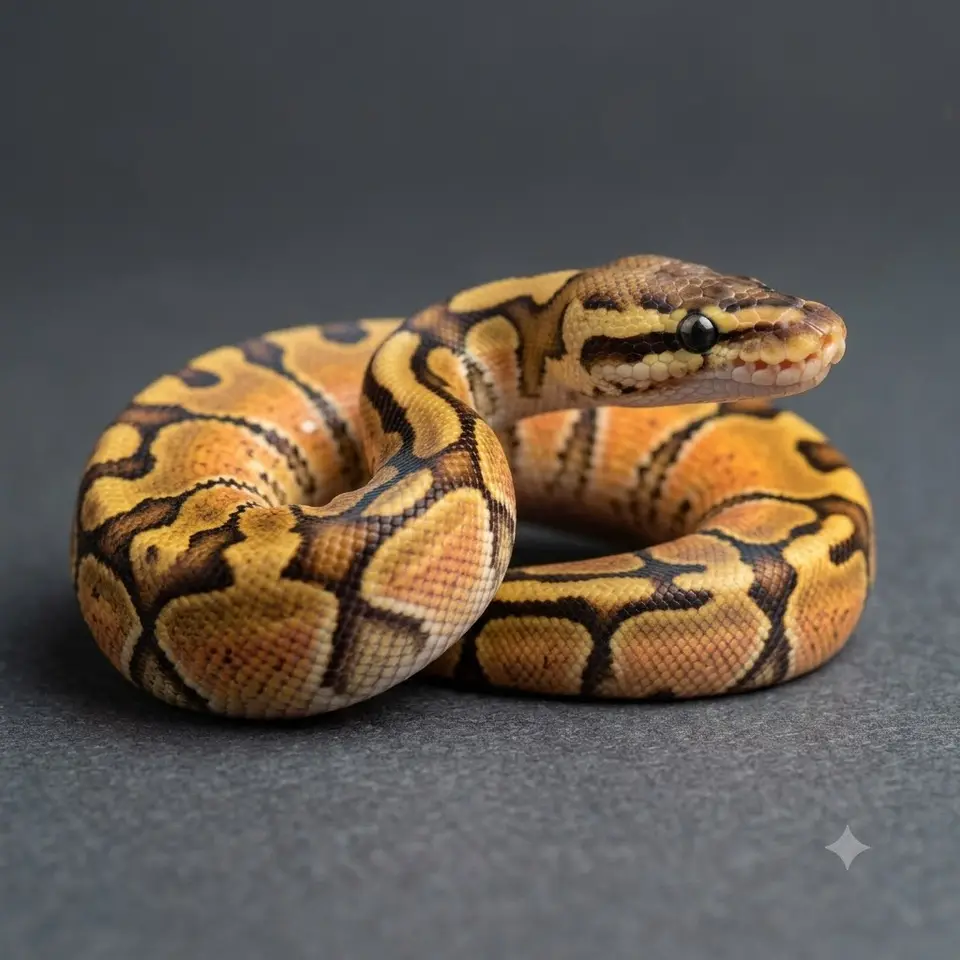
Enchi is a single-gene trait that lightens and warms the whole animal. Compared with a normal or wild-type ball python, an Enchi shows richer gold to amber blushing on the sides, cleaner belly and flank areas, and blushed or reduced dark markings so the pattern reads as more open and connected. The change is a shift in colour and pattern intensity rather than a completely new look, which is exactly why it blends so well into combos.
The genetics
Enchi is inherited in an incomplete-dominant fashion. The hobby usually calls this "co-dom," but the technically correct term is incomplete-dominant: a single copy of the gene visibly changes the snake, and two copies produce a stronger, distinct "super" form rather than just a carrier that looks normal. A single-copy Enchi is the familiar bright, warm-toned animal. The Super Enchi (two copies) tends to be lighter and higher in gold with an even more reduced pattern; it is viable and healthy, with no known lethal or neurological issues. Because one copy already shows, there are no hidden "het Enchi" animals - if a snake carries the gene, you can see it.
Appearance
The base is a warm brown-to-gold background with amber and orange blushing concentrated along the sides. Dark saddle and blotch markings are typically blushed, thinned or partly connected, giving a more flowing pattern and often a brighter dorsal look. Eyes are normal and dark; this is not a leucistic or blue-eyed trait. Colour can intensify and settle as the snake matures, and Enchi is a strong "brightener," which is a big reason it appears in so many multi-gene combos.
How it is bred
Because Enchi is incomplete-dominant, only one copy is needed to see it, so pairing an Enchi to a normal ball python produces a percentage of visible Enchi offspring in the same clutch. Pairing two Enchis can yield the Super Enchi (two-copy) form alongside single-copy Enchis and normals. To make designer animals, breeders simply stack Enchi with other single-gene morphs, letting its colour and pattern effect layer on top of other traits. No special or unusual pairing is required beyond selecting which genes to combine.
Cost and availability
Enchi is common, well established and inexpensive as morphs go. Single-gene Enchis are widely available and sit near the affordable end of the market, while Super Enchis and multi-gene combos that include Enchi cost more depending on what other genes are stacked in. Overall it is an easy morph to find from many breeders.
Health and ethics
The Enchi gene carries no known health or welfare problem beyond normal ball python care. It is not associated with the neurological "wobble" seen in some morphs, and the Super (two-copy) form is viable and healthy, so there is no lethal super to avoid. As always, choose reputable breeders who keep good records, and see a reptile (herp) veterinarian for any health concerns.
Care
Care is identical to a standard ball python - the Enchi gene changes only how the snake looks, not what it needs. Follow the same guidance on enclosure size, temperature gradient, humidity, hiding spots, clean water and appropriately sized prey that applies to any ball python, and use reputable, up-to-date care resources. For anything health-related, consult a qualified herp vet.
Everyday gear for reptiles
Links go to Amazon or a partner brand's own store and may earn us a commission at no extra cost to you. As an Amazon Associate we earn from qualifying purchases. An Amazon link leads to a type of gear and you choose the exact product; a card that names a store leads to that partner's own shop.
Enchi Ball Python - frequently asked questions
Is Enchi the same as co-dom?
The hobby often labels Enchi "co-dom," but the accurate term is incomplete-dominant. One copy shows visibly, and two copies make a distinct Super Enchi rather than a hidden carrier.
Does Enchi cause a wobble or any defect?
No. Enchi has no known link to the neurological "wobble" or any other genetic welfare issue, and the two-copy Super Enchi is healthy and viable.