Giant Leopard Gecko
The Giant leopard gecko is not a colour or pattern change but a size trait: a gecko selectively bred to grow noticeably larger and heavier than a typical leopard gecko.
Last reviewed: October 2026
Species guide: Leopard Gecko · All leopard gecko morphs
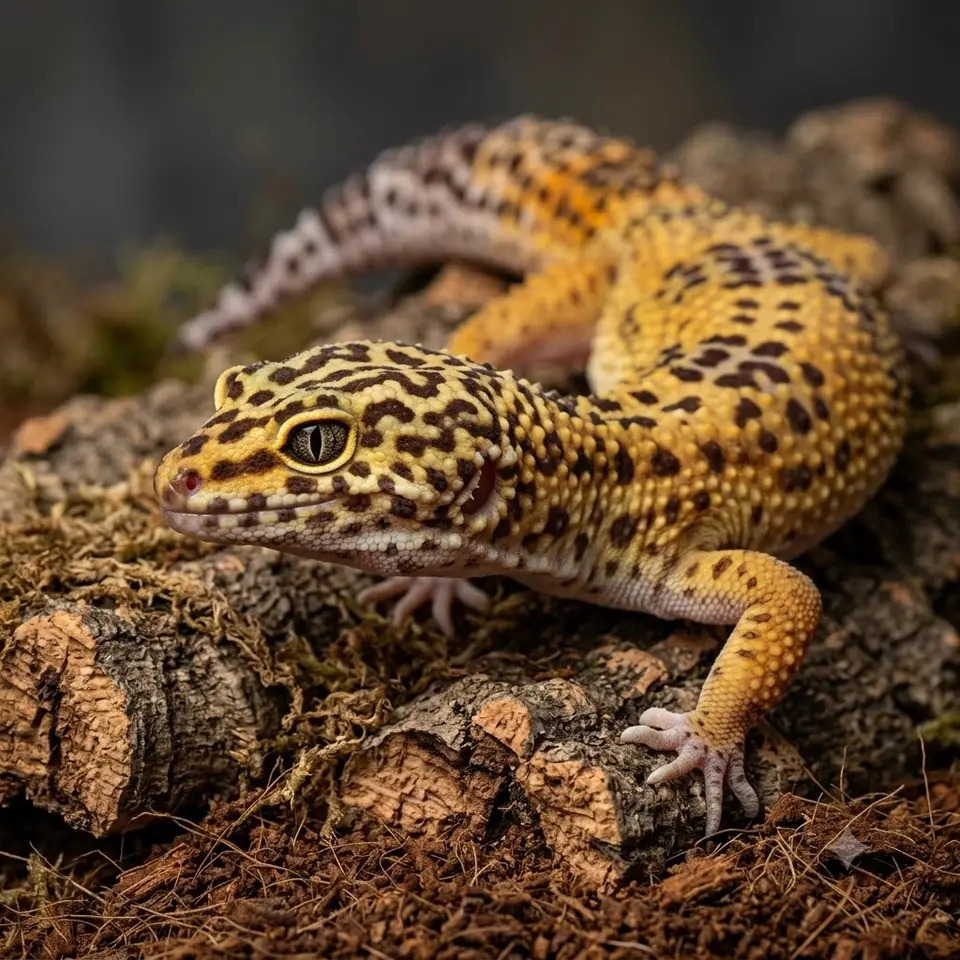 AI illustration
 Overview
The Giant leopard gecko is not a colour or pattern change but a size trait: a gecko selectively bred to grow noticeably larger and heavier than a typical leopard gecko. Giants and the even bigger Super Giants keep the normal range of colours and patterns, so the "morph" is really about mass and length rather than looks. It is a size line of the leopard gecko (Eublepharis macularius).
What it is
Where a standard adult leopard gecko usually lands somewhere around 50 to 80 grams, a Giant is bred to reach the upper end and beyond, and a Super Giant can push past 100 grams or more with a longer, chunkier body. The trait does not add any special colour or pattern of its own. A Giant can be a normal wild-type, an albino, a tangerine, a stripe, or almost any other morph combined with the extra size. Visually it looks like a familiar leopard gecko that is simply bigger and more robust.
The genetics
Size in these lines is treated as a polygenic, line-bred trait: many genes contribute a little each, and breeders build up size over generations by pairing their largest, fastest-growing animals. "Giant" and "Super Giant" are labels for how far along that size line an animal falls, with Super Giant being the larger expression. This is different from a single-gene morph. On this view it is polygenic rather than a clean recessive or dominant gene, so there is no simple "het" or guaranteed ratio, and offspring vary in how much size they inherit. Sources disagree, though: the breeder who established the line describes Super Giant as a single recessive gene with het carriers, and some guides call Giant incomplete dominant.
Appearance
Base colour, spotting, banding and eye type all follow whatever morph the Giant is combined with, so appearance ranges widely. The defining feature is scale and proportion: a heavier build, a broader head and thicker tail base, and greater overall length. Hatchlings from Giant lines often start out normal-looking and reveal the size difference as they grow, typically packing on weight faster and topping out heavier than clutchmates from standard lines. Colour and pattern change with age the same way they do in any leopard gecko, with juvenile bands breaking up into the adult spotted look.
How it is bred
Because size here is treated as polygenic, breeders produce Giants by selecting and pairing their largest, healthiest, fastest-growing animals and repeating that selection across generations, rather than by matching up copies of a single gene. Size can be stacked onto colour and pattern morphs by crossing a proven Giant line into those projects, then keeping the biggest offspring to carry the size forward. There is no fixed pairing formula that guarantees a Giant, which is why documented growth records and honest line history matter more than a punnett square here.
Cost and availability
Giants are fairly established in the hobby and widely available, though verified Giant and especially Super Giant lines with real weight records sit above plain normals in price. Cost climbs when the size trait is combined with sought-after colour or pattern morphs, or when a breeder can show a documented Super Giant lineage. In general terms it is a mid-range trait: not rare, but proven big lines command a premium.
Health and ethics
The Giant size trait itself is not linked to any known genetic welfare disorder. It does not carry the neurological "wobble" seen with some other leopard gecko and reptile morphs, and it is not associated with tumors or balance problems. The main ethical points are ordinary good husbandry ones: a larger gecko should reach its size through healthy growth, not overfeeding or "power feeding" that stresses the animal, and breeders should be honest about actual adult weights rather than overselling the label. As with any animal, buy from reputable breeders who track health and lineage, and see a reptile (herp) veterinarian for any health concern.
Care
Care is identical to a standard leopard gecko. The trait changes size only, not the animal's needs, though a bigger adult simply eats a bit more and benefits from enough floor space and secure hides sized to its body. Follow standard leopard gecko husbandry for heating, humidity, diet and supplementation from reputable care sources, and consult a herp vet for health questions. This profile is educational and is not breeding instruction or veterinary advice.
Everyday gear for reptiles
Links go to Amazon or a partner brand's own store and may earn us a commission at no extra cost to you. As an Amazon Associate we earn from qualifying purchases. An Amazon link leads to a type of gear and you choose the exact product; a card that names a store leads to that partner's own shop.
Giant Leopard Gecko - frequently asked questions
Is a Giant leopard gecko a different species?
No. It is the same species, Eublepharis macularius, just selectively bred for larger size. It is a size line, not a separate animal.
Will breeding two Giants guarantee Giant babies?
Not reliably. Size is treated as polygenic, so offspring inherit a range of the size trait rather than a guaranteed outcome, which is why breeders select the largest animals over many generations.
Does the Giant trait cause any health problems?
There is no known genetic welfare issue tied to the size trait itself. Concerns are about husbandry, such as avoiding overfeeding, rather than an inherited disorder.