Lesser Ball Python
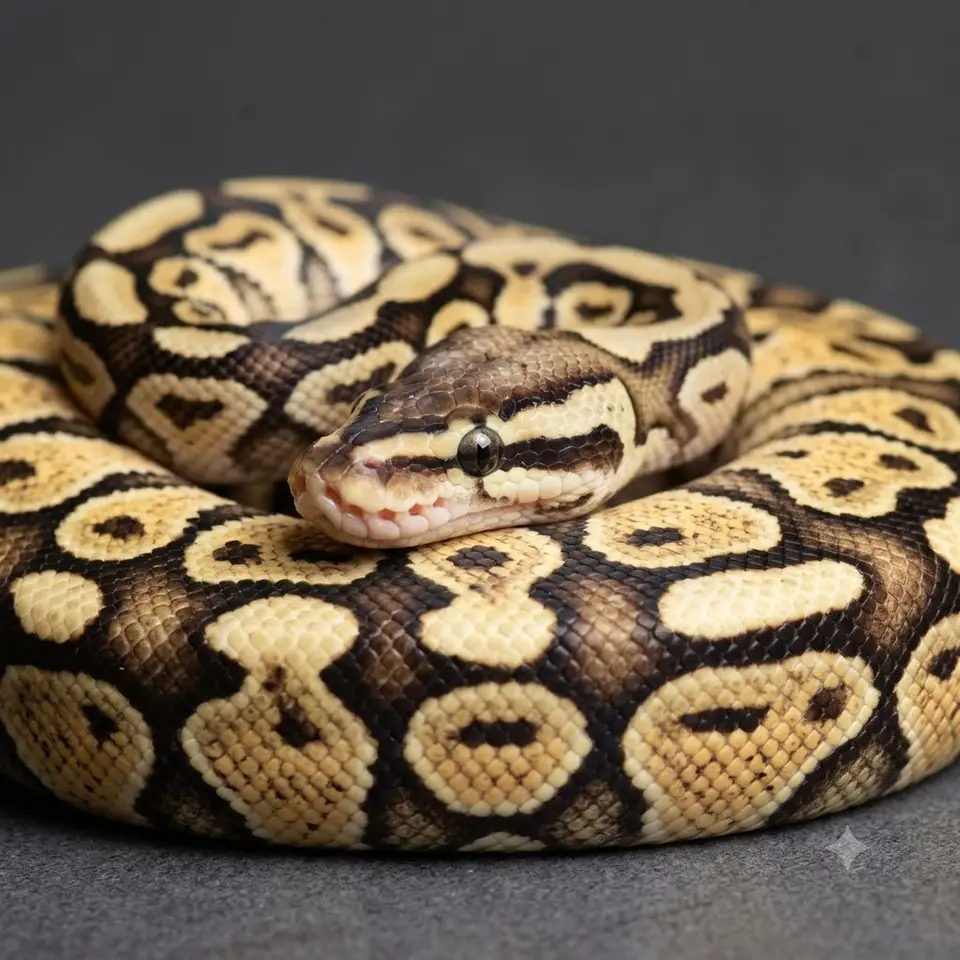
The Lesser is a light, washed-out ball python morph with faded pattern and softened, tan-to-golden tones compared with a normal.
Last reviewed: October 2026
Species guide: Ball Python · All ball python morphs
 AI illustration
Overview
The Lesser is a light, washed-out ball python morph with faded pattern and softened, tan-to-golden tones compared with a normal. In the hobby it is best known as one of the foundation genes of the blue-eyed leucistic (BEL) complex, meaning it is used both on its own and as a building block for pure white, blue-eyed snakes. It is a colour and pattern morph of the ball python (Python regius).
What it is
The Lesser is a single-gene "lightening" morph. On a normal ball python the base is dark brown to black with tan or gold blotches; a single-gene Lesser reduces that dark pigment, so the animal looks paler, cleaner and more golden or tan overall. The pattern is still recognisable as a ball python but it is reduced, blushed and less contrasting, with lighter sides and a brighter, softer dorsal look than wild-type.
The genetics
The Lesser is inherited as an incomplete-dominant trait. In plain terms, a snake needs only one copy of the gene to show the Lesser look, and when a Lesser is bred to a normal, roughly half the clutch inherits the gene and shows it. The hobby usually calls this "co-dominant," but technically it is incomplete-dominant, because one copy gives the lightened Lesser appearance and two copies give a visibly different, more extreme result.
Two copies produce a "super" form: the Super Lesser is a blue-eyed leucistic (BEL), an almost entirely white snake with pale blue eyes. This super form is viable, not lethal, though it is the form in which breeders report enlarged, bulging "bug eyes" (see Health below). The Lesser is also part of the wider BEL complex, so pairing it with other complex genes (such as Mojave, Butter, Russo and similar allelic morphs) can also produce blue-eyed leucistic animals, and it is frequently stacked into designer combos.
Appearance
A single-gene Lesser shows a light tan, caramel or golden base with reduced dark pigment, muted brown blushing and a faded, lower-contrast version of the normal ball python pattern. The head is often cleaner and lighter, and the sides can look pale and washed. Eyes are normal and dark in the single gene; the striking pale blue eyes only appear in the super/BEL form. As with many light morphs, the exact shade varies between individuals and can shift slightly as the animal matures.
How it is bred
Because Lesser is incomplete-dominant, only one copy is needed to see it, so a Lesser bred to a normal will pass the trait to about half the offspring. To make the Super Lesser (blue-eyed leucistic), two Lessers are paired so that some offspring inherit two copies. Breeders also cross Lesser with other BEL-complex genes to produce blue-eyed leucistics, or stack it into multi-gene combos to lighten and clean up other morphs. This is a general description of how the gene behaves, not a breeding manual.
Cost and availability
The Lesser is a long-established, widely available morph and sits at the affordable end of the market as a single gene. Super Lessers (BELs) and multi-gene combos that use Lesser cost more because they take extra pairings to produce, but the base gene itself is common and easy to find from breeders.
Health and ethics
A single-gene Lesser is not linked to any known neurological or structural welfare problem, and unlike the Spider or Champagne genes it carries no "wobble". The super form is a different matter: the MorphMarket community list of ball python morph issues names "bug eyes" - enlarged, bulging eyes - for the Super Lesser and for other blue-eyed leucistics made from Lesser and Butter. The Super Lesser is viable and not lethal, but no clutch data say how often the eyes are affected, so ask a breeder about the parents and look at the eyes before you buy a BEL. As with any snake, buy from reputable breeders who keep good records, and see a reptile (herp) veterinarian for any health concern.
Care
Care for a Lesser is identical to that of a standard ball python. The morph changes only how the snake looks, not what it needs in terms of enclosure, heating, humidity, feeding or handling. Follow a reputable ball python care resource for husbandry, and consult a herp vet for medical questions rather than treating a morph as a special case.
Everyday gear for reptiles
Links go to Amazon or a partner brand's own store and may earn us a commission at no extra cost to you. As an Amazon Associate we earn from qualifying purchases. An Amazon link leads to a type of gear and you choose the exact product; a card that names a store leads to that partner's own shop.
Lesser Ball Python - frequently asked questions
Does the Lesser gene cause a wobble or other defect?
Not in a single copy: Lesser is not associated with wobble or any known neurological or structural problem. The super form (Super Lesser, a BEL) is viable, but the MorphMarket community list of morph issues names enlarged "bug eyes" for it.
What do you get when you breed two Lessers together?
Some offspring will be Super Lessers, which are blue-eyed leucistic (BEL) snakes: nearly all white with pale blue eyes.
Is a single-gene Lesser white with blue eyes?
No. A single-gene Lesser is a lightened, faded tan or golden snake with normal dark eyes. The white body and blue eyes appear only in the super/BEL form.