Pewter Ball Python
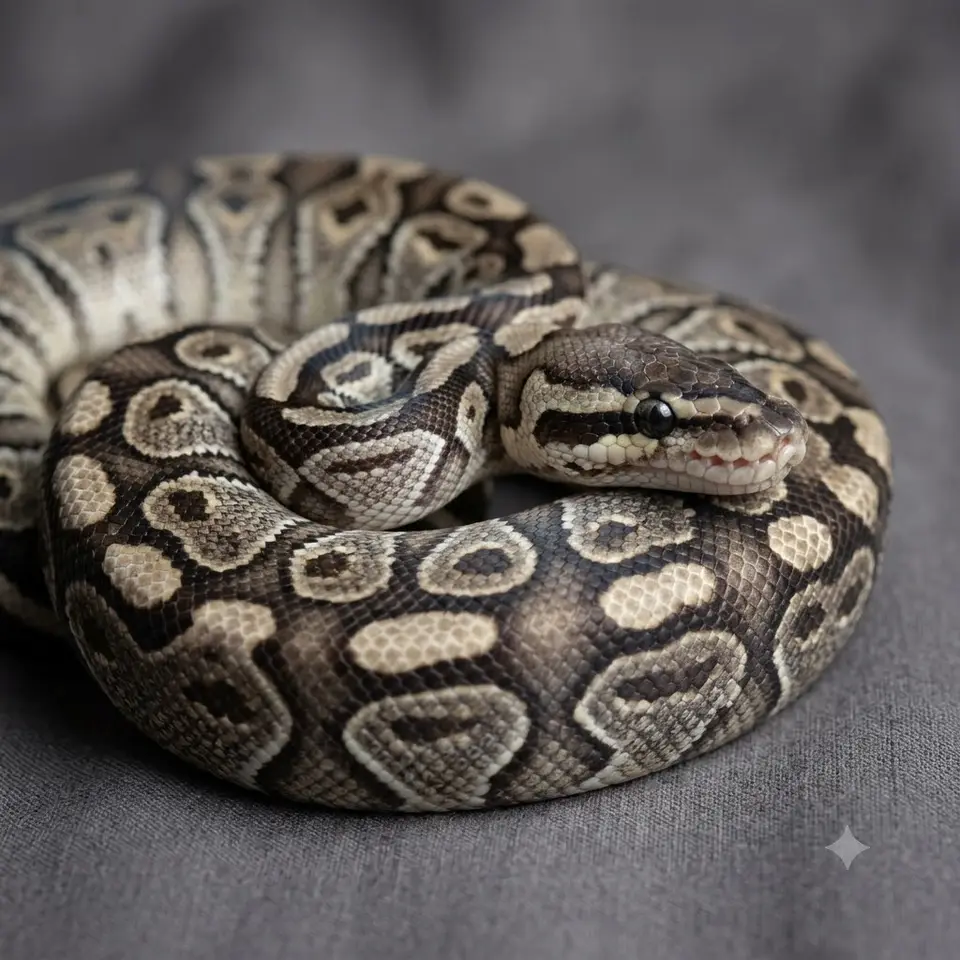
The Pewter is a warm grey-to-pewter coloured ball python with a faded, washed-out pattern and heavy "blushing" through the sides and back.
Last reviewed: October 2026
Species guide: Ball Python · All ball python morphs
 AI illustration
 Overview
The Pewter is a warm grey-to-pewter coloured ball python with a faded, washed-out pattern and heavy "blushing" through the sides and back. It is one of the classic two-gene designer combos in the hobby, valued for its clean, muted look and its usefulness as a building block in bigger projects. The Pewter is a colour and pattern morph of the ball python (Python regius).
What it is
A Pewter is not a single mutation but a combination of two morphs: Cinnamon and Pastel. Compared with a normal, wild-type ball python, the busy black-and-gold pattern is softened and greyed out. The dark base becomes a smoky brownish-grey, the pale markings warm toward tan or gold, and the whole animal takes on a muted, dusty "pewter" tone that gives the morph its name.
The genetics
The Pewter is a designer combo. Both parent genes, Cinnamon and Pastel, are inherited in an incomplete-dominant fashion, which the hobby usually calls "co-dominant" or "co-dom." Technically that hobby label is not quite right: with true co-dominance both forms would show fully and separately, whereas here a single copy produces an intermediate look and two copies produce a stronger "super" form, which is the signature of incomplete dominance. Because each gene is incomplete-dominant, only one copy of each is needed for the animal to look the part. Stacking a single copy of Cinnamon with a single copy of Pastel gives the Pewter. Note that Cinnamon does have a super form (Super Cinnamon), and combining that with Pastel produces the darker, related "Super Pewter" look, but the standard Pewter uses just one copy of each gene.
Appearance
The base colour is a soft, smoky grey that can lean brown or tan depending on the individual and its age. The normally crisp pattern is faded and blurred, with the lighter markings warming to gold or straw and the darker areas blushing out toward the spine so the back can look almost washed clean. Some Pewters show light peppering or a subtle keyhole-and-alien-head pattern remnant. Eyes and overall build are typical of the species. Like many ball python morphs, Pewters often "brown out" or darken somewhat with age, so an adult may look a little more muted than a bright hatchling.
How it is bred
Because both genes are incomplete-dominant, a Pewter is produced by pairing an animal carrying Cinnamon with an animal carrying Pastel, so that some offspring inherit one copy of each. A Cinnamon paired with a Pastel can yield Pewters in the clutch alongside single-gene and normal-looking babies. Breeders also cross existing Pewters to normals or to other single-gene animals to keep producing them, or fold Cinnamon and Pastel into larger multi-gene projects where Pewter is one of several possible outcomes. Unlike recessive morphs, no hidden "het" carriers are involved: the genes show visually whenever they are present.
Cost and availability
Pewter is an old, well-established and widely available combo, and both of its component genes are common and inexpensive. As a result single Pewters sit at the affordable end of the morph market and are easy to find from many breeders. Price rises only when Pewter is combined with rarer genes in more complex designer animals.
Health and ethics
The Pewter combo carries no special genetic health or welfare problem beyond normal ball python care. In single copies neither Cinnamon nor Pastel is associated with a neurological "wobble," a balance disorder or a lethal super form, so a standard Pewter is considered a safe, healthy combination. Two copies of Cinnamon are another matter: breeders report duckbilled faces and spinal kinks in some Super Cinnamons, and a breeder on the MorphMarket community has started collecting clutch data because how often it happens is not known. Pairing two Pewters, or Pewter to Cinnamon, can produce Super Cinnamons, so plan pairings with that in mind. As always, buy from reputable breeders who keep clear genetic records and healthy animals, and see a reptile (herp) veterinarian for any health concern.
Care
Care for a Pewter is identical to care for any standard ball python: the morph changes only how the snake looks, not what it needs. Provide the same enclosure, heating, humidity, hides, water, and appropriately sized feeders you would give a normal ball python. For husbandry specifics, follow reputable, up-to-date ball python care resources and consult a herp vet with any questions about health or setup.
Everyday gear for reptiles
Links go to Amazon or a partner brand's own store and may earn us a commission at no extra cost to you. As an Amazon Associate we earn from qualifying purchases. An Amazon link leads to a type of gear and you choose the exact product; a card that names a store leads to that partner's own shop.
Pewter Ball Python - frequently asked questions
Is the Pewter a single morph or a combo?
It is a two-gene designer combo, made by putting the Cinnamon and Pastel genes together. Each gene on its own produces a different, milder look.
Does the Pewter have any wobble or health issues?
A standard Pewter, no: one copy each of Cinnamon and Pastel is not linked to the "wobble" or other welfare disorders. The risk sits in the super form of Cinnamon - breeders report duckbilled faces and spinal kinks in some Super Cinnamons (MorphMarket community), which a Pewter x Pewter pairing can produce.
Is "co-dominant" the right word for its genetics?
The hobby calls Cinnamon and Pastel "co-dom," but they are more accurately incomplete-dominant: one copy gives the intermediate look and two copies of Cinnamon give a stronger super form.
Are Pewters expensive?
No. Because both parent genes are common and cheap, single Pewters are among the more affordable combos and are widely available.