Snow Corn Snake
The Snow Corn Snake is a colour morph of the corn snake (Pantherophis guttatus), one of the most familiar pet snake species in the hobby.
🗓️ Last reviewed: July 2026
Overview
The Snow Corn Snake is a colour morph of the corn snake (Pantherophis guttatus), one of the most familiar pet snake species in the hobby. It is a two-gene combination that strips out almost all dark and red pigment, leaving a pale white-and-pink animal. Despite the dramatic look, it is a normal corn snake in body, behaviour, and needs.
What it is
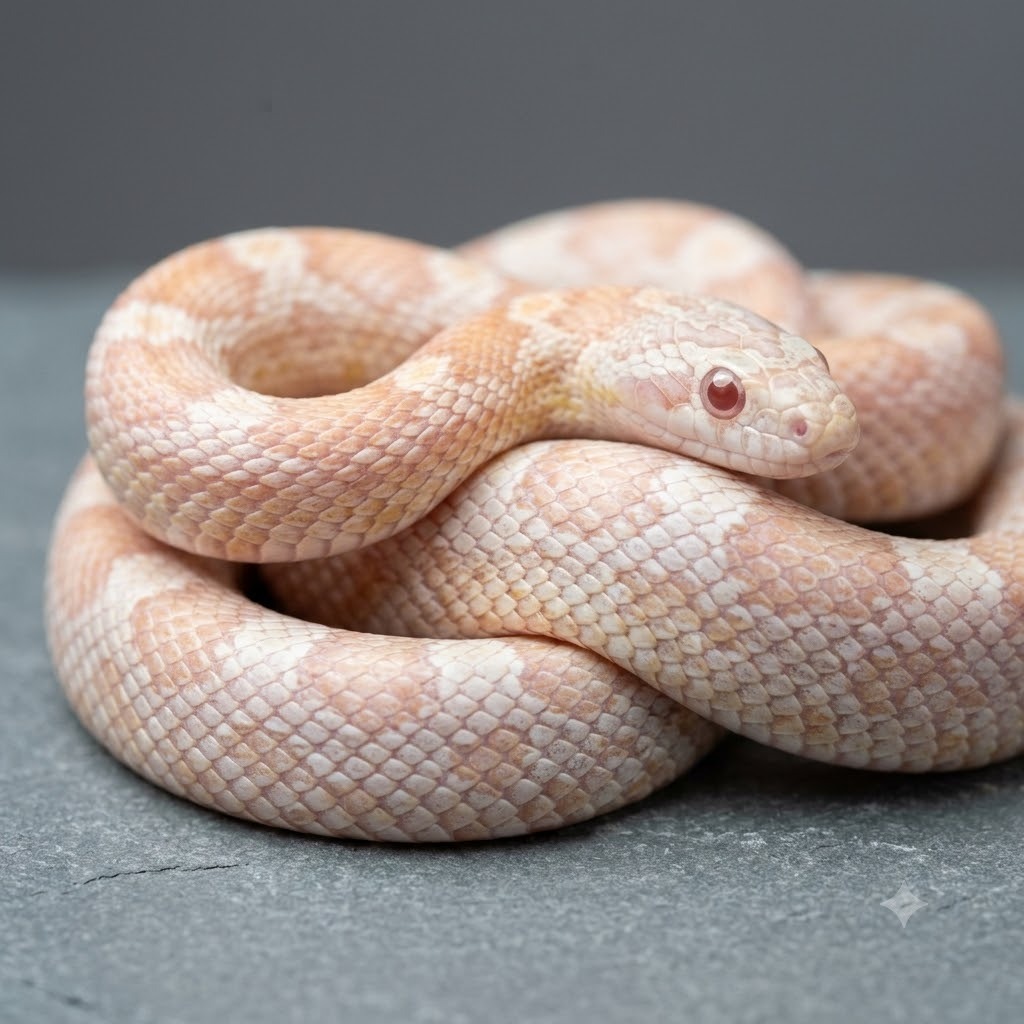
A wild-type corn snake is an orange to reddish snake with darker-bordered red or brown blotches down the back. The Snow morph removes the black and brown pigment and the red and orange pigment at the same time, so instead of a bold orange-and-red pattern you get a soft white to pinkish snake with faint, ghostly blotches and often a pale yellow wash near the head and neck.
The genetics
Snow is a recessive combination (a "combo") of two separate recessive genes: amelanistic (amel), which removes black and brown melanin, and anerythristic (anery), which removes red and orange (erythrin) pigment. Each gene is simple recessive on its own, and Snow is what appears when an animal is homozygous for both at the same time. Because both traits are recessive, a snake must carry two copies of each to show the morph; a snake with only one copy of either is a normal-looking "het" (heterozygous) carrier.
Appearance
Hatchlings are typically very pale, sometimes almost pure white with translucent pink blotches and pink eyes, because both major pigment systems are switched off. As the snake matures it often develops soft yellow, cream, or faint orange tones, most noticeably along the neck, throat, and head, so an adult Snow can look creamier than it did as a baby. The blotch pattern usually remains as pale outlines rather than the bold, high-contrast saddles of a normal corn snake. Eyes are pink to reddish.
How it is bred
Recessive genes like amel and anery only show up when an animal inherits two copies, one from each parent. To make Snow reliably, breeders pair animals that both carry both genes, for example two Snows together (which produce all Snow offspring), or normal-looking animals that are het for both amel and anery, which produce a percentage of Snow babies. Combos like this simply stack two recessive traits in the same animal. (Dominant and incomplete-dominant traits, by contrast, can show with only a single copy, and line-bred traits are built up by selecting the best-looking animals over many generations rather than by a single on/off gene - Snow is not one of those; it is a clean double-recessive.)
Cost and availability
Snow is a long-established, widely available morph and sits at the affordable end of the corn snake market. Because both parent genes are common and the combo has been bred for decades, Snows and related lines are easy to find and modestly priced, usually costing only a little more than a normal corn snake.
Health and ethics
Snow carries no special health defect - it is purely a pigment combination, and these animals are as robust as any normal corn snake. There is no lethal super form or welfare concern tied to the morph itself. As with any reptile, choose a reputable, health-focused breeder who keeps clear lineage records, and take a new or unwell animal to a qualified reptile (herp) veterinarian.
Care
Care is identical to a standard corn snake - the morph changes appearance only, not the animal's needs. Housing, temperature, humidity, and feeding are the same as for any corn snake. For a full husbandry setup, follow a reputable corn snake care source and consult a herp vet with any health questions.
Snow Corn Snake - frequently asked questions
Is a Snow Corn Snake albino?
Partly. It carries the amelanistic (albino) gene, which removes black and brown pigment, but Snow also adds the anerythristic gene, which removes red and orange. So it is more than a plain albino - it is an albino that also lacks red pigment, which is why it looks white and pink rather than bright orange.
Why does my Snow look more yellow as an adult?
That is normal. Many Snows hatch nearly white and then develop soft yellow, cream, or faint orange tones with age, especially around the neck and head. It is a natural part of maturing and not a sign of a problem.