Yellow Belly Ball Python
The Yellow Belly is a subtle single-gene morph best known for the small pattern quirks on its lower sides and belly rather than for dramatic color.
Last reviewed: September 2026
Species guide: Ball Python · All ball python morphs
 AI illustration
 Overview
The Yellow Belly is a subtle single-gene morph best known for the small pattern quirks on its lower sides and belly rather than for dramatic color. On its own it is easy to overlook, but it is prized as a building block: two copies produce a strikingly pale animal, and it anchors its own allelic complex with genes such as Specter, Gravel and Asphalt. It is a color and pattern morph of the ball python (Python regius).
What it is
Yellow Belly is a co-dominant (technically incomplete-dominant) trait that changes a normal ball python only slightly. Single-gene animals look close to a wild-type "normal" but with cleaner, brighter coloring, often a faint golden or yellow wash along the lower flanks, and telltale markings on the belly and the first row or two of side scales. Many keepers identify it by these lower-side "flame" or vertical dashes and by a generally crisper, higher-contrast look than an ordinary normal.
The genetics
Yellow Belly follows an incomplete-dominant inheritance pattern. In the hobby this is almost always called "co-dominant" or "co-dom," but strictly speaking it is incomplete-dominant: one copy of the gene produces a visibly changed but intermediate animal (the Yellow Belly itself), and two copies produce a distinct, more extreme super form rather than simply masking or blending. The super form of Yellow Belly is the Ivory, a pale, patternless or near-patternless cream to white snake, usually with a dorsal stripe and dark eyes. Because it is dominant-acting, there are no "hidden carriers" the way there are with recessive morphs. Yellow Belly is not part of the Blue-Eyed Leucistic (BEL) complex; it anchors its own allelic group with genes such as Specter, Gravel and Asphalt, which can pair with it to make other pale, reduced-pattern super-type animals.
Appearance
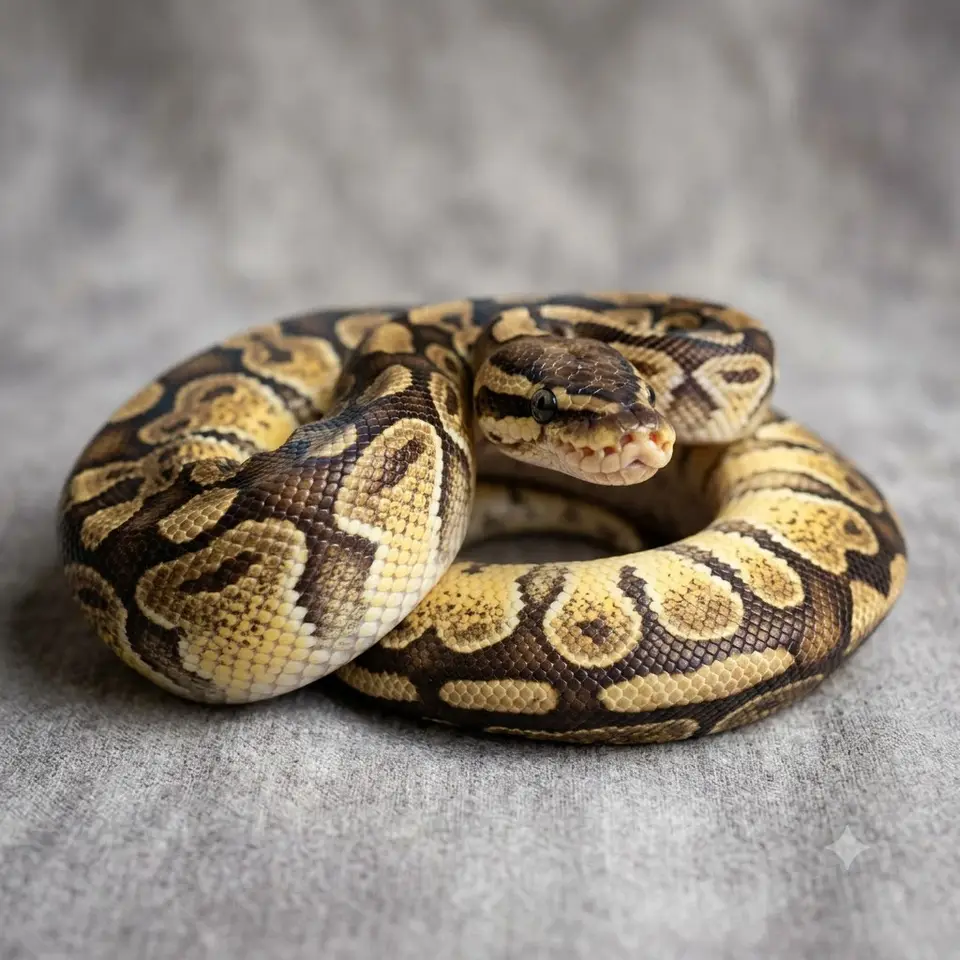
A single-gene Yellow Belly resembles a normal ball python's brown-and-gold blotched pattern but is typically brighter and cleaner, with reduced or "faded" head striping in some lines and a warm yellow or golden tone low on the sides. The defining tells are on the belly and the lowest rows of lateral scales: unusual dark flecks, dashes or keyhole markings, and small vertical bars where a normal is plain. Eyes are normal (dark) in the single-gene form. The super form, Ivory, looks completely different: an almost solid pale cream to off-white snake with a faint yellow dorsal stripe and dark eyes, and it holds that clean look throughout life.
How it is bred
Because Yellow Belly is dominant-acting, only one copy is needed to see it, so pairing a Yellow Belly to a normal yields roughly half Yellow Belly and half normal-looking offspring. Breeding two Yellow Bellies together can produce the Ivory super form, which needs two copies of the gene. Yellow Belly is also stacked into designer combos and paired with its allelic partners such as Specter, Gravel and Asphalt. There are no het (hidden carrier) pairings to track, since the trait shows whenever it is present.
Cost and availability
Yellow Belly is one of the more common and affordable single-gene morphs, widely available from hobbyist and professional breeders. Plain single-gene Yellow Bellies sit at the low end of the market. Ivory supers and combinations with its allelic partners cost somewhat more, and price rises further as additional genes are stacked, but none of these are considered rare or premium in the current market.
Health and ethics
Yellow Belly carries no known genetic health or welfare problem. Its super form, Ivory, is a healthy, viable animal (unlike some ball python super forms that are non-viable), and Yellow Belly is not associated with the neurological "wobble" or other defects seen in certain other morphs. As with any snake, buy from a reputable breeder who keeps clean records and prioritizes healthy, well-started animals, and consult a qualified reptile (herp) veterinarian for any health concern. This profile is educational and is not breeding instruction or veterinary advice.
Care
Care is identical to that of a standard ball python: the morph changes only appearance, not the animal's needs. Provide the same enclosure, warmth and thermal gradient, humidity, hides, clean water and appropriately sized prey you would give any ball python. For setup and husbandry details, follow reputable, up-to-date ball python care resources and a herp veterinarian rather than relying on a morph's looks.
Everyday gear for reptiles
Links go to Amazon or a partner brand's own store and may earn us a commission at no extra cost to you. As an Amazon Associate we earn from qualifying purchases. An Amazon link leads to a type of gear and you choose the exact product; a card that names a store leads to that partner's own shop.
Yellow Belly Ball Python - frequently asked questions
Is Yellow Belly really "co-dominant"?
That is the common hobby term, but it is technically incomplete-dominant: one copy gives the visible Yellow Belly, and two copies give a distinct super form (Ivory) rather than just a stronger or blended version.
What is the super form of Yellow Belly?
The Ivory: a pale cream to near-white, mostly patternless snake with a faint dorsal stripe and dark eyes, produced when an animal inherits two copies of the Yellow Belly gene.
Does Yellow Belly have any wobble or health issues?
No. Yellow Belly is not linked to the neurological "wobble" or other known defects, and its Ivory super form is healthy and viable.
Why do breeders like Yellow Belly if it looks almost normal?
Its value is as a genetic building block: it makes Ivories and, paired with allelic partners such as Specter, Gravel and Asphalt, other clean, pale super-type animals.