Amelanistic Corn Snake
The Amelanistic Corn Snake is a colour morph of the corn snake (Pantherophis guttatus), one of the most popular pet snakes in the world.
🗓️ Last reviewed: July 2026
Overview
The Amelanistic Corn Snake is a colour morph of the corn snake (Pantherophis guttatus), one of the most popular pet snakes in the world. "Amelanistic" means it cannot produce melanin, the pigment responsible for black and brown. The result is a snake in bright reds, oranges, and whites, often marketed under names like "Amel" or "red albino."
What it is
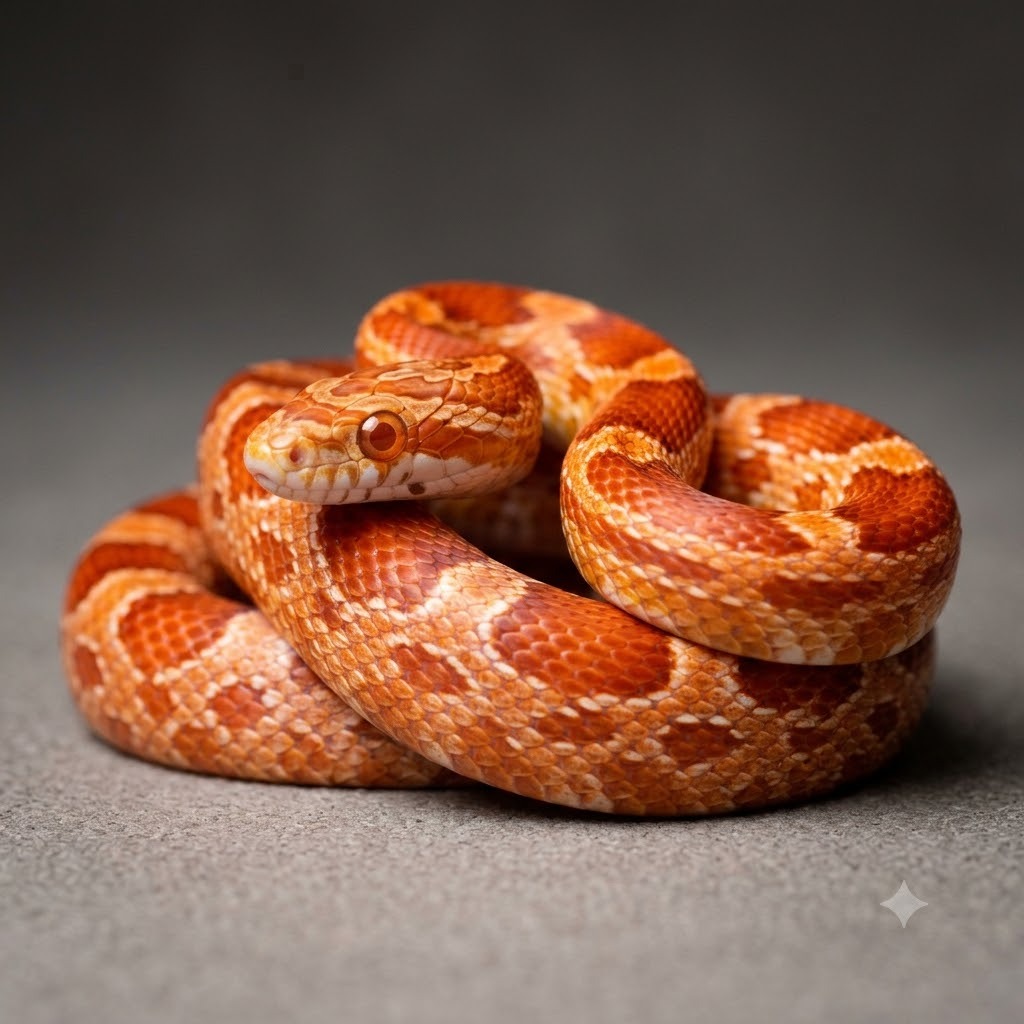
A normal, wild-type corn snake shows orange-to-brown body colour with red saddle blotches outlined in black, plus a black-and-white checkered belly. The Amelanistic morph removes every trace of black and brown from that pattern. The saddles and background remain, but their dark outlines and any brown tones disappear, so the animal reads as red and orange on a pale or white ground with red or pink eyes.
The genetics
Amelanism in corn snakes is a simple recessive trait. A snake needs two copies of the amelanistic gene (one from each parent) to actually look amel. An animal carrying just one copy looks normal but is a "het" (heterozygous) carrier that can pass the trait on. Because it is a clean on/off recessive gene, breeding outcomes are highly predictable using basic Punnett-square math.
Appearance
Amel corn snakes display red to orange saddle blotches, an orange, yellow, or cream background, and white borders where a normal snake would have black. Eyes are red or pink because there is no melanin in the iris. Hatchlings often start paler and somewhat washed out, then deepen and brighten over the first year or two as they mature. Adults commonly show strong orange and red tones, though exact intensity varies between bloodlines. The lack of black is the defining, lifelong feature.
How it is bred
Because amelanism is recessive, a visible amel results only when a snake inherits the gene from both parents. Two amel parents produce all amel babies. An amel bred to a het produces a mix of amels and hets. Two hets, on average, yield some visible amels alongside normal-looking carriers. Amel is also a favourite building block for combo morphs (for example Snow, Butter, and Fire) where it is stacked with other recessive genes; each added recessive simply requires two copies to show.
Cost and availability
The Amelanistic Corn Snake is one of the oldest and most widely available morphs, so it is inexpensive and easy to find. Single-gene amels typically sit at the low end of the corn snake price range. Combo morphs that include amel cost more depending on the other genes involved and the quality of the line.
Health and ethics
Amelanism is a colour-only trait and carries no known health or welfare problems beyond those of any normal corn snake. Red or pink eyes may make some individuals mildly more light-sensitive, but this is not a disability and needs no special accommodation. As with any reptile, choose reputable breeders who keep clear genetic and health records, and consult a qualified reptile (herp) veterinarian for any health concerns.
Care
Care is identical to a standard corn snake - the morph changes appearance only, not the animal's needs. Corn snakes need an appropriately sized secure enclosure, a temperature gradient, fresh water, a hide, and correctly sized frozen-thawed rodents. For full husbandry details, rely on reputable breeders and a herp vet rather than a morph description.
Amelanistic Corn Snake - frequently asked questions
Is an Amelanistic Corn Snake the same as an albino?
Effectively yes. In the corn snake hobby "amelanistic," "amel," and "albino" all refer to the same recessive trait that removes black and brown pigment, leaving red, orange, white, and red or pink eyes.
Do Amelanistic Corn Snakes have vision or health problems?
No. Aside from possible mild light sensitivity from the red eyes, they are as healthy and hardy as any normal corn snake and need the same care.