Bloodred Corn Snake
The Bloodred is a popular colour-and-pattern morph of the common corn snake (Pantherophis guttatus).
🗓️ Last reviewed: September 2026
Overview
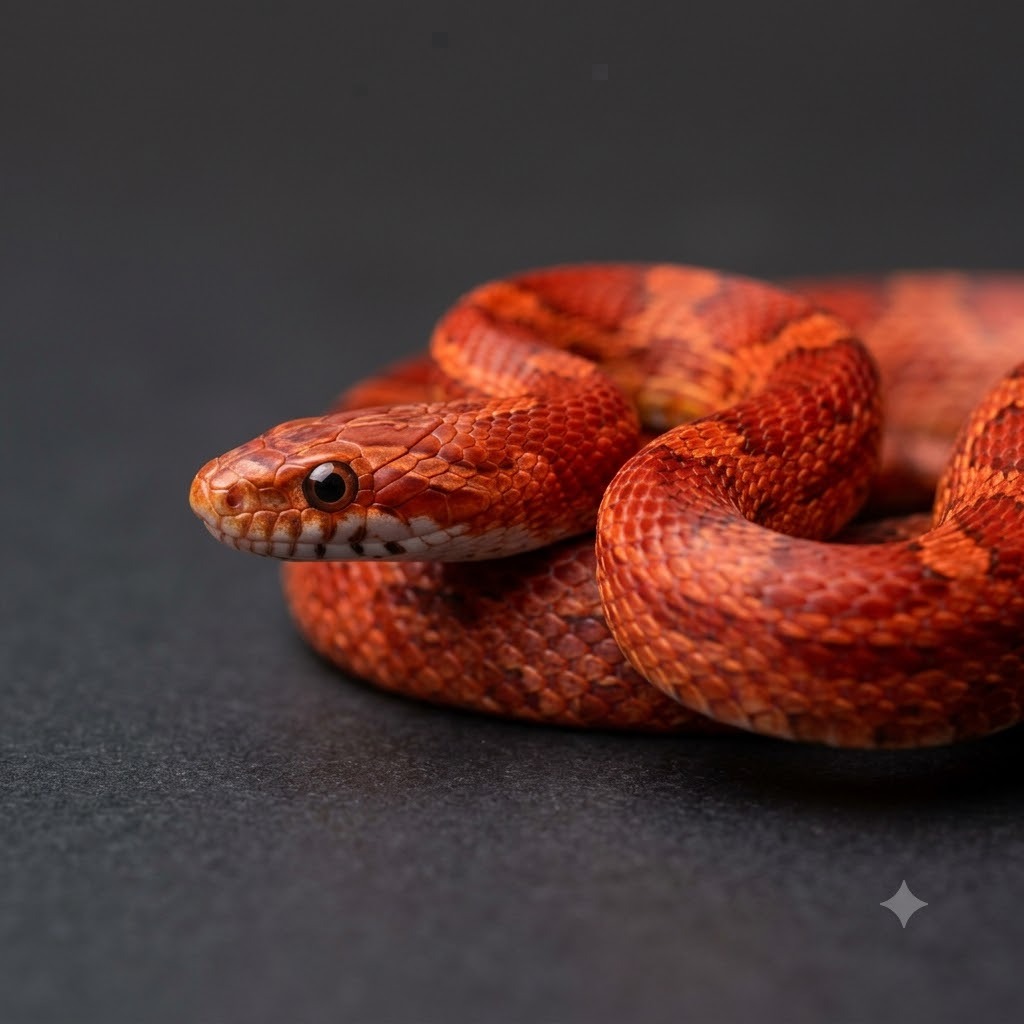
The Bloodred is a popular colour-and-pattern morph of the common corn snake (Pantherophis guttatus). It is best known for the way adults lose most of their markings and settle into a rich, uniform red. The look is produced by a recessive trait rather than by any change to how the snake lives or behaves.
What it is
A normal (wild-type) corn snake has bold orange-to-red saddle blotches edged in black, a lighter background, and a bright black-and-white checkerboard belly. The Bloodred replaces that busy contrast with a diffused, near-patternless deep red. The signature detail is the belly: instead of a checkerboard, a true Bloodred shows a plain, unmarked underside.
The genetics
Bloodred is a simple recessive trait, historically called "diffused." Because it is recessive, a snake needs two copies of the gene to actually look Bloodred. An animal carrying just one copy appears normal but is a "het" (heterozygous) carrier that can pass the trait on. The strong, even red seen in many Bloodreds is partly the base recessive gene and partly generations of selective breeding stacked on top of it to deepen and clean up the colour.
Appearance
Hatchlings can be misleading. Young Bloodreds often show more visible saddle pattern and a duller, grey-to-brown wash, so a baby may not look impressively red at all. With each shed through the first year or two the pattern diffuses and the background and blotches blend together, and the animal deepens toward the solid red the morph is prized for. Adults typically read as a smooth red-on-red snake with soft, faded edges and a clean belly. Exact tone varies a lot from line to line, from brick and rust to a brighter cherry.
How it is bred
Recessive traits like Bloodred follow a straightforward rule: to see the morph, a snake must inherit one copy from each parent. Pairing two visual Bloodreds yields all Bloodred babies. Pairing a Bloodred to a het produces roughly half visual, half het. Pairing two hets produces about one in four visual, with most of the rest carrying the trait unseen. On top of that basic on/off inheritance, breeders line-breed the best-coloured animals over several generations to intensify the red and reduce leftover pattern. Bloodred also combines readily with other corn snake genes to create stacked combos.
Cost and availability
Bloodred is a long-established, widely available morph, so single-gene examples sit at the affordable end of the corn snake market. Price rises with quality of colour, with adult animals that show off the finished red, and with combos that pair Bloodred with other traits.
Health and ethics
Bloodred carries no known welfare problem tied to the trait itself; it changes colour and pattern only, and these snakes are as robust as any corn snake. Some keepers do report that hatchlings from heavily line-bred Bloodred lines can be slower to start feeding, so it is worth asking a breeder whether babies are already eating well. As with any reptile purchase, choose a reputable breeder who keeps clear lineage records, and take a new or unwell animal to a qualified reptile (herp) veterinarian.
Care
Care is identical to a standard corn snake; the morph affects appearance only, not the animal's needs. Corn snakes are hardy, beginner-friendly colubrids. For full husbandry, follow a dedicated corn snake care guide and a herp vet rather than treating this morph as a special case.
Bloodred Corn Snake - frequently asked questions
Why does my baby Bloodred not look very red?
That is normal. Bloodreds often hatch duller and more patterned, then intensify and diffuse over the first year or two of sheds. The full red usually arrives with maturity.
Is the Bloodred a healthy morph?
Yes. It is a simple recessive colour-and-pattern trait with no associated health defect, so a Bloodred needs the same care and lives as well as any corn snake.