Dalmatian Crested Gecko
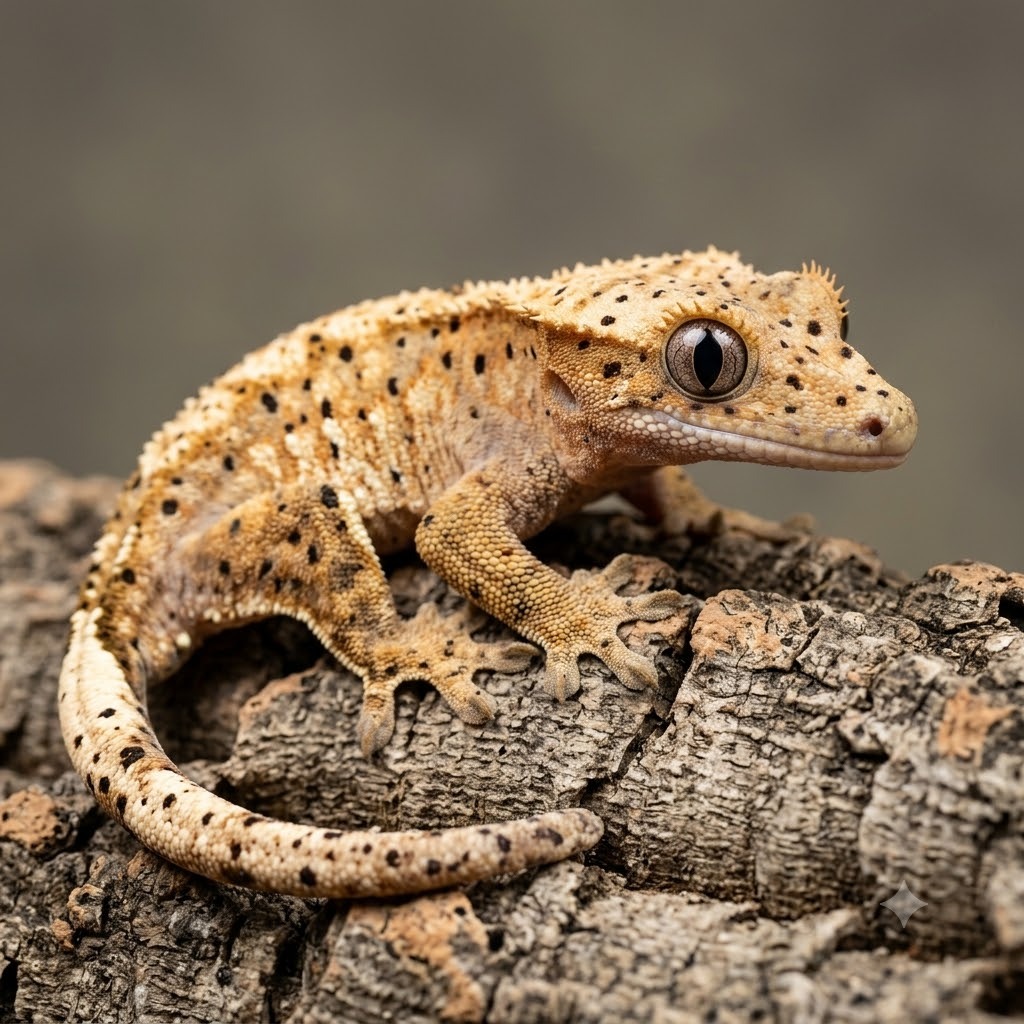
The Dalmatian is a trait of the crested gecko (Correlophus ciliatus), named for the scattered dark spots that dot the skin much like the coat of a Dalmatian dog.
🗓️ Last reviewed: July 2026
Overview
The Dalmatian is a trait of the crested gecko (Correlophus ciliatus), named for the scattered dark spots that dot the skin much like the coat of a Dalmatian dog. It is not a species or a base colour of its own but a pattern trait that can appear on top of almost any crested gecko morph. Spot count and boldness vary widely, and heavily spotted animals are prized by keepers who enjoy the look.
What it is
A normal or wild-type crested gecko shows colour and pattern (cream, fire, harlequin, pinstripe and so on) without the peppering of round dark dots. A Dalmatian carries those dots - small to large, black or sometimes red - sprinkled across the body, limbs and tail. The spots are the defining feature; the rest of the animal still reads as whatever base morph lies underneath.
The genetics
Dalmatian is a polygenic, line-bred trait, not a simple on/off gene. That means there is no single recessive or dominant gene to inherit and no het to track. Instead the spotting is controlled by many genes acting together, and breeders increase it by selecting the most heavily spotted animals over successive generations. Because it is polygenic, offspring show a spectrum of spotting rather than a clean "has it / does not have it" result, and the trait can layer onto any base morph.
Appearance
The signature look is round, well-defined dark spots scattered over the skin. Some geckos carry only a handful; the most striking show hundreds, occasionally described as "super Dalmatian." Spots are usually black, though red Dalmatian spotting also occurs. The base can be any colour, so a Dalmatian may be cream, buckskin, orange, red or nearly any tone with dots on top. Spotting often develops and intensifies as a gecko matures, so a lightly spotted hatchling can become far more heavily marked as an adult. Like all crested geckos, day-to-day "firing up" and "firing down" also shifts how bold the animal and its spots appear.
How it is bred
Simple recessive traits need two copies to show, so both parents must carry the gene (as visual animals or hidden hets). Dominant and incomplete-dominant traits show with just one copy. Dalmatian is neither of those - being line-bred, it is built by choosing the best-spotted parents generation after generation, gradually concentrating the many genes that drive spotting. Traits can also be stacked: a Dalmatian can be combined with base morphs such as harlequin or with structural traits, so a single gecko may be a "Dalmatian" plus several other trait names at once.
Cost and availability
Crested geckos are among the most widely available pet reptiles, and lightly spotted Dalmatians are common and affordable. Price climbs with spot density and with the base morph underneath, so a clean, heavily spotted animal - especially a red Dalmatian or one combined with other desirable traits - sits toward the higher end of the market. Overall it is an accessible trait rather than a rare or premium one.
Health and ethics
Dalmatian spotting is a cosmetic pattern trait and carries no known welfare problem - there is no lethal super form and no structural defect tied to it, unlike some other crested gecko traits. Health considerations are simply those of the species. As with any reptile, choose reputable breeders who keep clear lineage records and healthy stock, and see a qualified reptile (herp) veterinarian for health questions.
Care
Care is identical to a standard crested gecko - the Dalmatian trait changes appearance only, not the animal's needs. Housing, temperature, humidity, diet and handling are the same as for any Correlophus ciliatus. For specifics, follow current crested gecko husbandry from reputable breeders and a herp vet rather than treating this morph as special.
Dalmatian Crested Gecko - frequently asked questions
Is Dalmatian a recessive gene?
No. It is a polygenic, line-bred trait, so there is no single recessive gene and no het to carry. Breeders build it by selecting the most heavily spotted animals over many generations.
Will a Dalmatian's spots change over time?
Often yes. Spotting commonly increases and darkens as the gecko matures, so an adult may look far more spotted than it did as a hatchling. Firing up and down also changes how bold the spots appear day to day.