Enigma Leopard Gecko
The Enigma is a striking pattern morph known for its speckled, blotchy markings and bright, often patchy coloration that breaks up the normal banded look.
Last reviewed: July 2026
Species guide: Leopard Gecko · All leopard gecko morphs
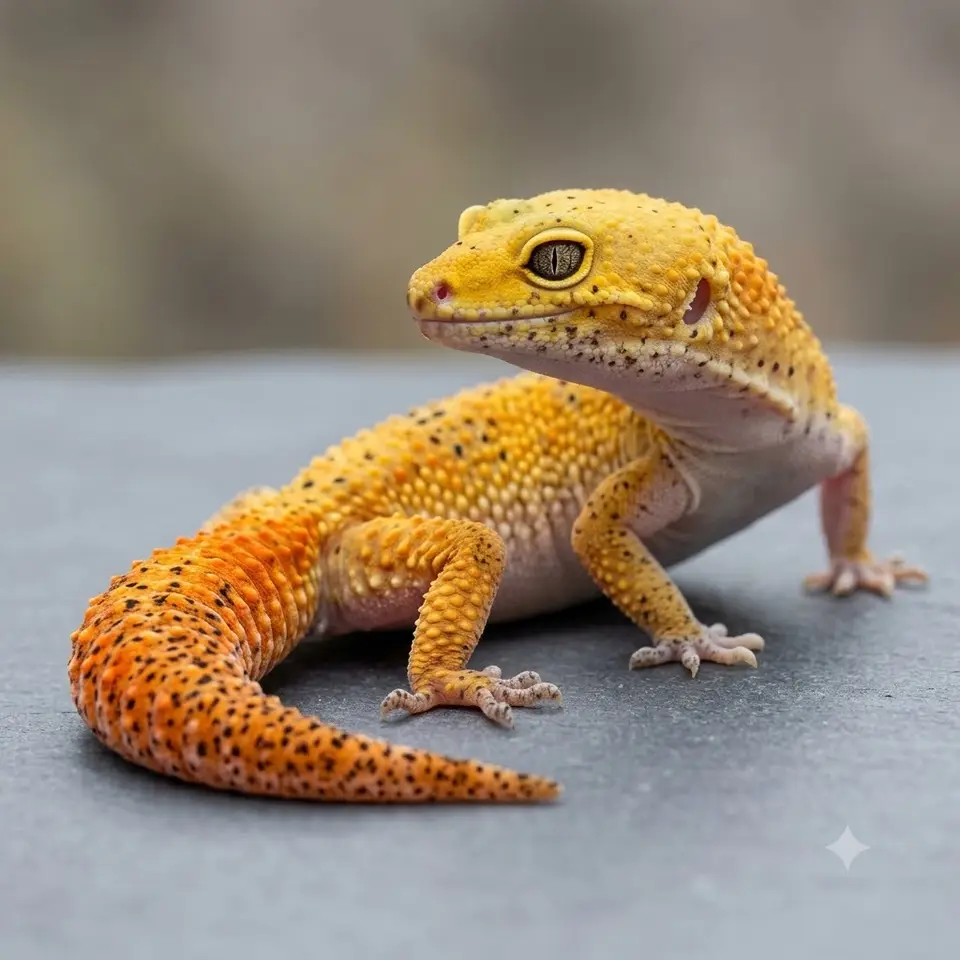 AI illustration
 Overview
The Enigma is a striking pattern morph known for its speckled, blotchy markings and bright, often patchy coloration that breaks up the normal banded look. It is also one of the most controversial morphs in the hobby because it is inseparably tied to a neurological welfare problem. Enigma is a color and pattern morph of the leopard gecko (Eublepharis macularius).
What it is
Enigma is a dominant pattern mutation that scrambles the normal wild-type banding into random spots, speckles, and irregular blotches. Instead of the clean dark bands of a normal leopard gecko, an Enigma shows a busy, "static" pattern, frequently with clean white or pale patches and a brighter yellow to orange wash. The look is distinctive enough that most Enigmas can be picked out by pattern alone.
The genetics
Enigma is inherited as a dominant trait, which means a single copy of the gene is enough to produce the visible morph - an animal does not need two copies to look Enigma. Because it is dominant rather than recessive, there are no hidden "het" carriers: if a gecko carries Enigma, it shows Enigma. It is widely combined with other morphs to make designer combos (for example paired with snow, albino, or other lines), where the Enigma pattern layers on top of the other genes. The existence of a viable, distinct "super" (double-copy) form is debated and not reliably demonstrated, and some keepers report that stacking copies worsens the linked neurological issues. Critically, the neurological disorder described below is linked to the Enigma gene itself and cannot be bred out while keeping the morph.
Appearance
Enigmas typically hatch with a spotted or speckled pattern in place of the normal bands, often with bold white or cream patches on the body and tail. The base color leans yellow to orange, and as the animal matures the pattern usually becomes more broken and speckled, with spots scattering randomly across the back and sides. Eyes are normal in structure for the morph, though tail regrowth and pattern intensity vary from animal to animal. No two Enigmas look quite alike, which is part of their appeal.
How it is bred
Because Enigma is dominant, breeders only need one Enigma parent to pass the trait to a portion of the offspring - roughly half of the clutch from a single-copy Enigma paired with a non-Enigma will show the morph. To create designer combinations, breeders pair Enigma animals with other morphs so the resulting geckos carry Enigma plus the second gene. There is no het-carrier pairing to plan for, since the gene always shows when present. This is a general description, not breeding guidance, and the welfare concerns below weigh heavily on whether this morph should be bred at all.
Cost and availability
Enigmas and Enigma-based combos are widely available and generally sit in the low to mid price range, though flashier designer combinations and cleaner examples command more. Availability is not the limiting factor here - the ethical questions around the morph are.
Health and ethics
Enigma is linked to Enigma Syndrome (ES), a genetic neurological disorder affecting balance and coordination. Affected geckos can show head tilting, circling or spinning, "stargazing" (looking upward), rolling, disorientation, and difficulty tracking and catching food; severity ranges from barely noticeable to severe and can worsen with stress. ES is tied to the Enigma gene itself, so every Enigma carries the risk and it cannot be separated out while keeping the morph. Because of this, many experienced and ethical keepers choose not to breed Enigma, or avoid the morph entirely, and stacking copies is generally discouraged. If you keep one, choose a reputable breeder who is honest about ES, watch for symptoms, and see a reptile (herp) veterinarian for any health concerns. This is education, not veterinary or breeding advice.
Care
Day-to-day care for an Enigma is identical to a standard leopard gecko - the morph changes only how the animal looks, not its basic needs for heat, diet, and housing. The one exception is that ES-affected animals may need practical accommodations, such as shallow food and water dishes, assistance during feeding, and a low-stress setup, and any severe symptoms warrant a herp vet visit. For full husbandry, follow reputable leopard gecko care resources rather than a morph-specific routine.
Everyday gear for reptiles
Links go to Amazon or a partner brand's own store and may earn us a commission at no extra cost to you. As an Amazon Associate we earn from qualifying purchases. An Amazon link leads to a type of gear and you choose the exact product; a card that names a store leads to that partner's own shop.
Enigma Leopard Gecko - frequently asked questions
Does every Enigma leopard gecko have Enigma Syndrome?
Every Enigma carries the genetic link to Enigma Syndrome, but the severity varies widely. Some show obvious circling or balance problems, while others appear nearly normal - and symptoms can appear or worsen with age or stress.
Can Enigma Syndrome be bred out of the morph?
No. The syndrome is tied to the Enigma gene itself, so it cannot be separated from the morph. This is why many ethical keepers avoid breeding Enigma altogether.