Hypomelanistic Corn Snake
The Hypomelanistic Corn Snake, usually shortened to "Hypo", is a colour morph of the corn snake (Pantherophis guttatus).
🗓️ Last reviewed: September 2026
Overview
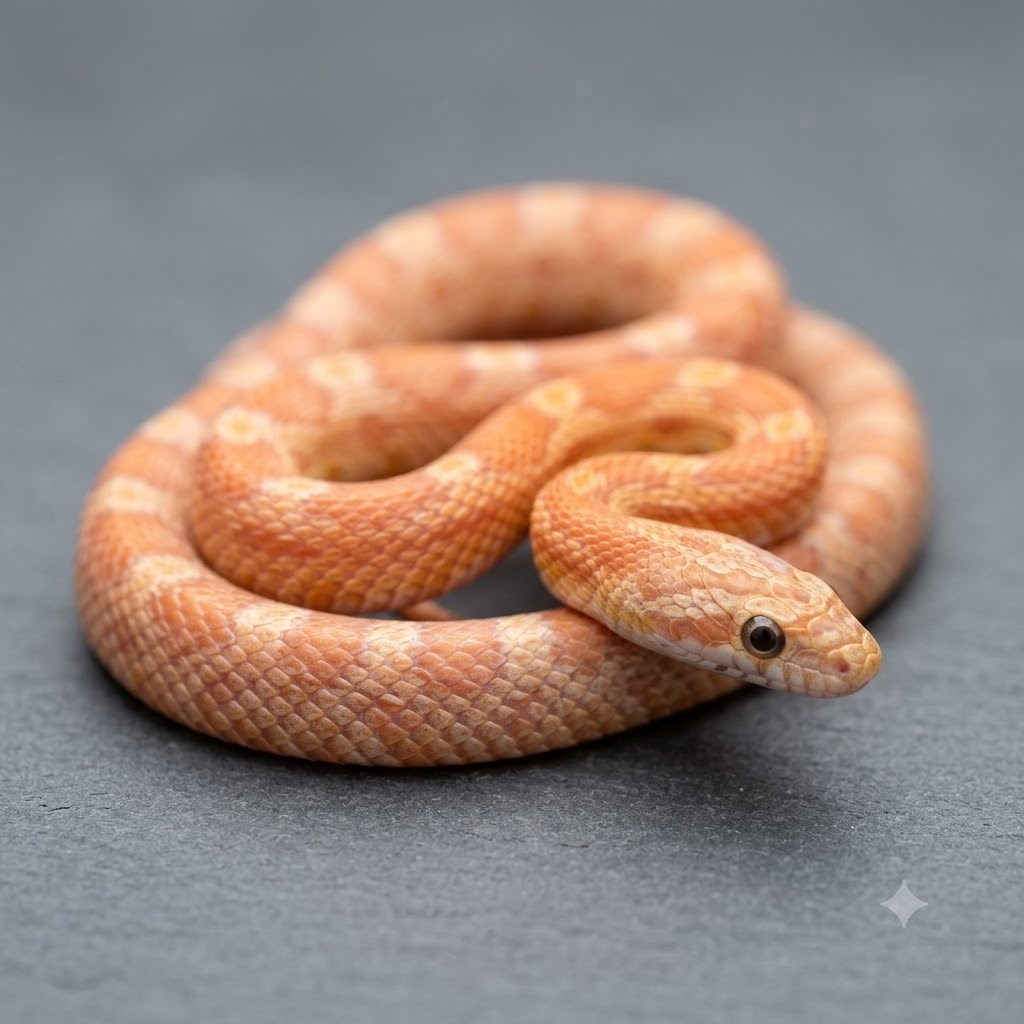
The Hypomelanistic Corn Snake, usually shortened to "Hypo", is a colour morph of the corn snake (Pantherophis guttatus). It is defined by reduced black pigment, which gives the animal a lighter, cleaner and more vivid appearance than a wild-type. It is one of the foundation morphs in corn snake keeping and appears in countless combinations.
What it is
"Hypomelanistic" means reduced (hypo) black pigment (melanin). A normal or wild-type corn snake shows crisp black borders around its dorsal saddles and a heavily speckled black-and-white belly. In a Hypo, that black is thinned out rather than removed, so the dark outlines become soft grey or faded and the underlying reds, oranges and browns look brighter and warmer. It is a reduction, not a full loss, which sets it apart from amelanistic ("amel") snakes that have no black at all.
The genetics
Hypomelanism in corn snakes is a simple recessive trait. A snake must inherit two copies of the hypo gene (one from each parent) to actually look hypo. A snake with only one copy appears normal but is a "het" (heterozygous) carrier that can pass the gene on. Because it is recessive, the trait can hide invisibly in a line for generations until two carriers are paired. Note that "hypo" is used loosely in the hobby: there are several distinct genes that all reduce melanin (for example hypo, sunkissed, lava and others), and they are not all the same mutation even though they look similar.
Appearance
Hypos keep the classic corn snake saddle pattern, but the whole animal reads as softer and brighter. The black borders that frame each blotch are reduced to pale grey, tan or ghost-like outlines, and the belly checkerboard is much lighter than a normal's bold black-and-white. Ground colour ranges from warm orange to red, and because the darkening black is pulled back, those colours often look more saturated. Hatchlings can appear a little duller or greyer, and many Hypos intensify in colour as they mature over their first year or two.
How it is bred
Because hypo is recessive, a snake needs two copies to display it. Pairing two visual Hypos produces all visual Hypo babies. Pairing a visual Hypo to a normal het (a carrier) produces a mix of visual Hypos and hets, while pairing two hets averages about one visual Hypo in four. Dominant and incomplete-dominant traits, by contrast, only need a single copy to show. Hypo is also a favourite building block: breeders "stack" it with other recessives (such as anerythrism to make the Ghost, or other colour genes for pastel combos) by first making animals that are het for several genes, then combining them over generations.
Cost and availability
Hypomelanistic corn snakes are common, widely available and inexpensive as morphs go. A single-gene Hypo is one of the more affordable options, while multi-gene combinations that include hypo cost more depending on how many traits are stacked and how clean the example is. Availability is strongest during the northern-hemisphere breeding and hatching season.
Health and ethics
Hypomelanism is a colour trait only and carries no known health or welfare problems. Hypos are as robust as any normal corn snake and have the same lifespan and needs. There is no "super" form to worry about and no structural change to the animal. As with any snake, choose a reputable breeder who keeps clear lineage records, and take a new or unwell animal to a qualified reptile (herp) veterinarian.
Care
Care is identical to a standard corn snake - the morph changes appearance only, not requirements. Corn snakes are hardy, beginner-friendly colubrids that need a secure enclosure, a temperature gradient, fresh water and appropriately sized rodent prey. For husbandry specifics, follow guidance from a reputable breeder and a herp vet rather than caring for a Hypo any differently.
Hypomelanistic Corn Snake - frequently asked questions
Is a Hypo the same as an amel (amelanistic) corn snake?
No. Amelanistic snakes have no black pigment at all, while a Hypo only reduces it. A Hypo still shows faint grey or tan outlines where an amel would show none.
If I breed two normal-looking corn snakes, can I get Hypos?
Yes, if both parents are hidden carriers (het for hypo). Because the trait is recessive, two normal-looking hets can produce visual Hypo babies, on average about one in four.