Lavender Corn Snake
The Lavender is a colour morph of the corn snake (Pantherophis guttatus), a hardy North American rat snake kept widely in the reptile hobby.
🗓️ Last reviewed: July 2026
Overview
The Lavender is a colour morph of the corn snake (Pantherophis guttatus), a hardy North American rat snake kept widely in the reptile hobby. It replaces the usual orange-and-red look with a soft, dusty palette of pale grey and pinkish mauve. Like all corn snake morphs it is simply a colour variant of the same species, not a different kind of snake.
What it is
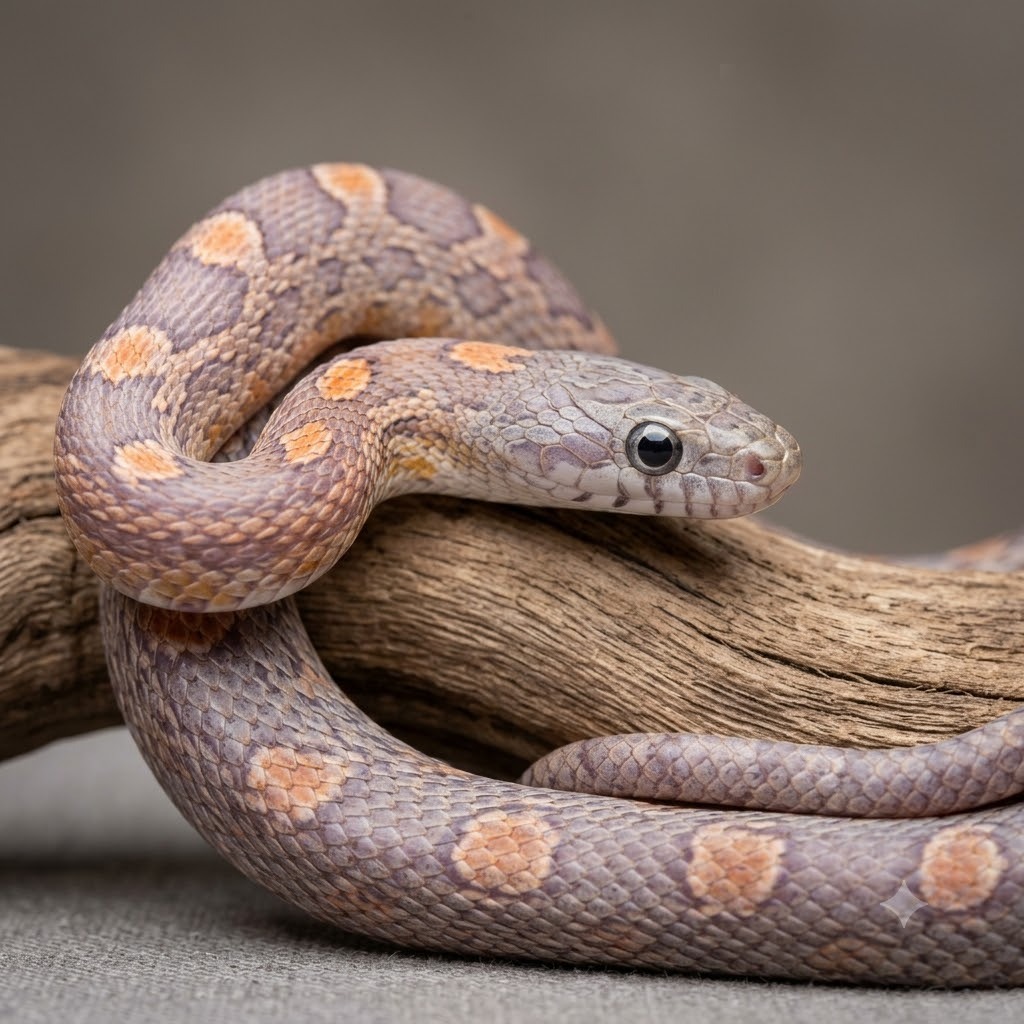
A normal or wild-type corn snake is orange to reddish with bold red-orange saddles outlined in black, and a checkered black-and-white belly. The Lavender morph strips out much of that warm pigment, leaving a pale lavender-grey background with soft mauve to purplish-grey saddles and, often, a lighter belly with reduced or faded checkering.
The genetics
Lavender is a simple recessive trait. A snake only looks Lavender when it carries two copies of the Lavender gene, one from each parent. A snake with a single copy shows normal colour but is a "het" (heterozygous) carrier that can pass the trait on. Two visual Lavenders bred together produce all Lavender offspring.
Appearance
The overall impression is a gentle, washed-out snake in grey, mauve and pale pink tones, with saddles that can range from purplish-grey to a warmer dove or tan-mauve depending on the line. Eyes are typically dark ruby to burgundy rather than black. Hatchlings often look greyer and can carry a slight peach or pinkish cast; as the snake matures the lavender and mauve tones usually deepen and become more defined, though exact shade varies between bloodlines and individuals.
How it is bred
Because Lavender is recessive, a snake needs two copies of the gene to show it. Breeders pair two visual Lavenders (all babies visual), a visual to a het (about half visual), or two hets (about a quarter visual, the rest normal-looking carriers). This differs from dominant or incomplete-dominant morphs, where a single copy already changes the look. Lavender is also commonly stacked with other recessive and pattern genes to create combination morphs such as lavender-based motleys, stripes and pastel blends.
Cost and availability
Lavender is a long-established and widely available corn snake morph. Single-gene Lavender hatchlings are generally affordable and sit in the low-to-mid range of corn snake pricing, while multi-gene combinations built on Lavender cost more depending on how many traits are stacked and how clean the line is.
Health and ethics
Lavender carries no known welfare problem. It is a pure colour trait with no linked defect, no lethal super form, and no impact on scale quality or vision beyond the ordinary. Lavender corn snakes have the same lifespan, hardiness and needs as any normal corn snake. As with any reptile, buy from a reputable breeder who keeps clear genetic records, and consult a qualified reptile (herp) veterinarian for any health concerns.
Care
Care is identical to a standard corn snake; the morph changes appearance only and nothing about husbandry. Corn snakes are famously beginner-friendly. For specific enclosure, temperature, humidity and feeding guidance, follow care sheets from reputable breeders and a herp vet rather than treating a colour morph as special.
Lavender Corn Snake - frequently asked questions
Is a Lavender corn snake harder to keep than a normal one?
No. It has exactly the same care needs, hardiness and lifespan as any corn snake. Only the colour is different.
Will two Lavender corn snakes always produce Lavender babies?
Yes. Because the trait is recessive, pairing two visual Lavenders gives an entire clutch of visual Lavender offspring.
Do the colours change as the snake grows?
Usually yes. Hatchlings tend to look greyer, and the lavender and mauve tones often deepen and become clearer as the snake matures.