Piebald Ball Python
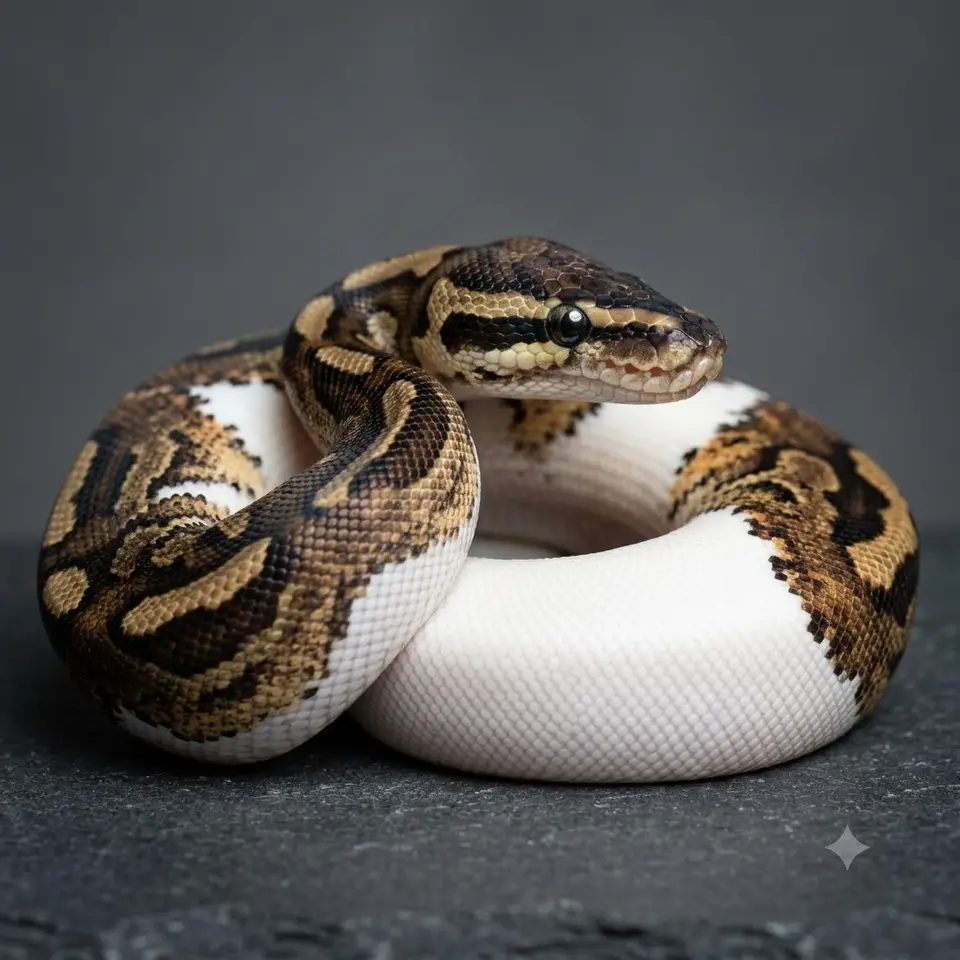
The Piebald Ball Python, often shortened to "pied," is one of the most recognizable and beloved morphs in the hobby, showing large areas of unmarked white skin interrupted by islands of normal ball python coloring.
Last reviewed: October 2026
Species guide: Ball Python · All ball python morphs
 AI illustration
 Overview
The Piebald Ball Python, often shortened to "pied," is one of the most recognizable and beloved morphs in the hobby, showing large areas of unmarked white skin interrupted by islands of normal ball python coloring. The size, placement, and amount of white varies from animal to animal, so no two pieds look exactly alike. It is a recessive color and pattern morph of the ball python (Python regius).
What it is
A Piebald is a ball python whose skin carries broad, sharply defined patches of pure white with little or no pattern, set against retained "islands" of normal brown-and-tan blotching. In a wild-type (normal) ball python, the entire body is covered in the usual dark brown base with lighter alien-head blotches. In a Piebald, portions of that normal pattern are simply replaced by clean white, and the boundary between white and patterned areas is usually crisp rather than blended.
The genetics
Piebald is a simple recessive trait. That means a snake needs two copies of the piebald gene (one from each parent) to actually show the white patches. A snake with a single copy is a "het" (heterozygous) - it looks like a normal ball python but carries the gene invisibly. Because it is recessive, there is no "super" form: two copies produce the visible pied, and that is the full expression. This is different from the incomplete-dominant traits the hobby loosely calls "co-dom," where one copy already changes the look and two copies make a distinct super form. Piebald does not work that way - one copy shows nothing outwardly.
Appearance
The hallmark is contrast: crisp, unpatterned white against retained patches of natural brown, tan, and gold ball python markings. The amount of white ranges widely, from animals that are mostly patterned with small white sections to "high white" individuals that are almost entirely white with only a few colored islands. The eyes are normal and dark, and the white areas are true unpigmented skin rather than a faded version of the pattern. The look is essentially set from hatching and stays stable as the snake grows, though colored areas can deepen slightly with age. Piebald is also commonly combined with other morphs, which changes the color of the patterned islands while keeping the white.
How it is bred
Because Piebald is recessive, a visible pied only appears when a hatchling inherits the gene from both parents. Breeders typically pair two visible pieds, or pair a visible pied with a het pied, or pair two hets together. Two hets can produce some visible pied offspring even though neither parent shows it, along with normal-looking siblings that may or may not carry the gene. Pied is also frequently stacked with other morphs to create designer combos, which involves pairing pied lines with animals carrying additional recessive or dominant genes over more than one generation.
Cost and availability
Piebald is a well-established, widely available morph. Basic single-gene pieds are moderately priced and easy to find from breeders, having come down a great deal from their early rarity. High-white examples, clean-patterned "designer" pieds, and multi-gene combos that include pied command higher prices depending on how striking and how complex they are.
Health and ethics
On its own, piebald carries no known genetic welfare problem: unlike some morphs linked to neurological or other health issues, it changes pigment and pattern, so a pied has the same needs and lifespan as any normal ball python. One kind of combination is the exception - the MorphMarket community list of ball python morph issues names small eyes in pieds that also carry a super form from the blue-eyed leucistic complex (Lesser, Mojave, Butter and their relatives), so ask about the full genetics of any pied combo. As with any snake, choose a reputable breeder who keeps healthy, well-started animals, and see a qualified reptile (herp) veterinarian for any health concern.
Care
Care is identical to a standard ball python - this morph changes only how the snake looks, not what it needs. Provide the same enclosure, temperatures, humidity, hides, and feeding as any ball python. Follow reputable, up-to-date ball python care resources for husbandry specifics, and consult a reptile (herp) veterinarian for health questions.
Everyday gear for reptiles
Links go to Amazon or a partner brand's own store and may earn us a commission at no extra cost to you. As an Amazon Associate we earn from qualifying purchases. An Amazon link leads to a type of gear and you choose the exact product; a card that names a store leads to that partner's own shop.
Piebald Ball Python - frequently asked questions
Are Piebald Ball Pythons healthy?
A plain pied, yes: the piebald gene changes color and pattern and is not linked to any neurological or physical defect. The exception is a pied combined with a blue-eyed leucistic super form, where the MorphMarket community list of ball python morph issues names small eyes. A pied needs the same care as a normal ball python and can live just as long.
Why do two normal-looking parents sometimes produce a Piebald?
Piebald is recessive, so a normal-looking snake can carry one hidden copy of the gene (a "het"). When two hets are paired, some hatchlings can inherit the gene from both parents and show the pied pattern, even though neither parent looks pied.