Scaleless Corn Snake
The Scaleless Corn Snake is a morph of the corn snake (Pantherophis guttatus) in which the animal develops with most of its body scales missing.
🗓️ Last reviewed: September 2026
Overview
The Scaleless Corn Snake is a morph of the corn snake (Pantherophis guttatus) in which the animal develops with most of its body scales missing. It is not a colour morph but a structural one, affecting the skin itself rather than the pattern. Because it is a recessive trait, it can be combined with almost any colour or pattern morph.
What it is
A normal, wild-type corn snake is covered in overlapping keeled or smooth scales, including a row of wide belly scales (ventral scutes) used for grip and locomotion. A Scaleless Corn Snake instead shows largely bare, soft-looking skin, so the colours and pattern sit on an exposed surface. Most individuals still keep their belly scales, while the amount of remaining body and head scaling varies by breeding line.
The genetics
Scalelessness in corn snakes is inherited as a simple recessive trait. A snake needs two copies of the gene to actually look scaleless. A snake with one copy is a normal-looking carrier, called a het (heterozygous), and shows no visible sign of the trait. This is a true on/off gene, unlike the selectively bred looks seen in some other reptiles.
Appearance
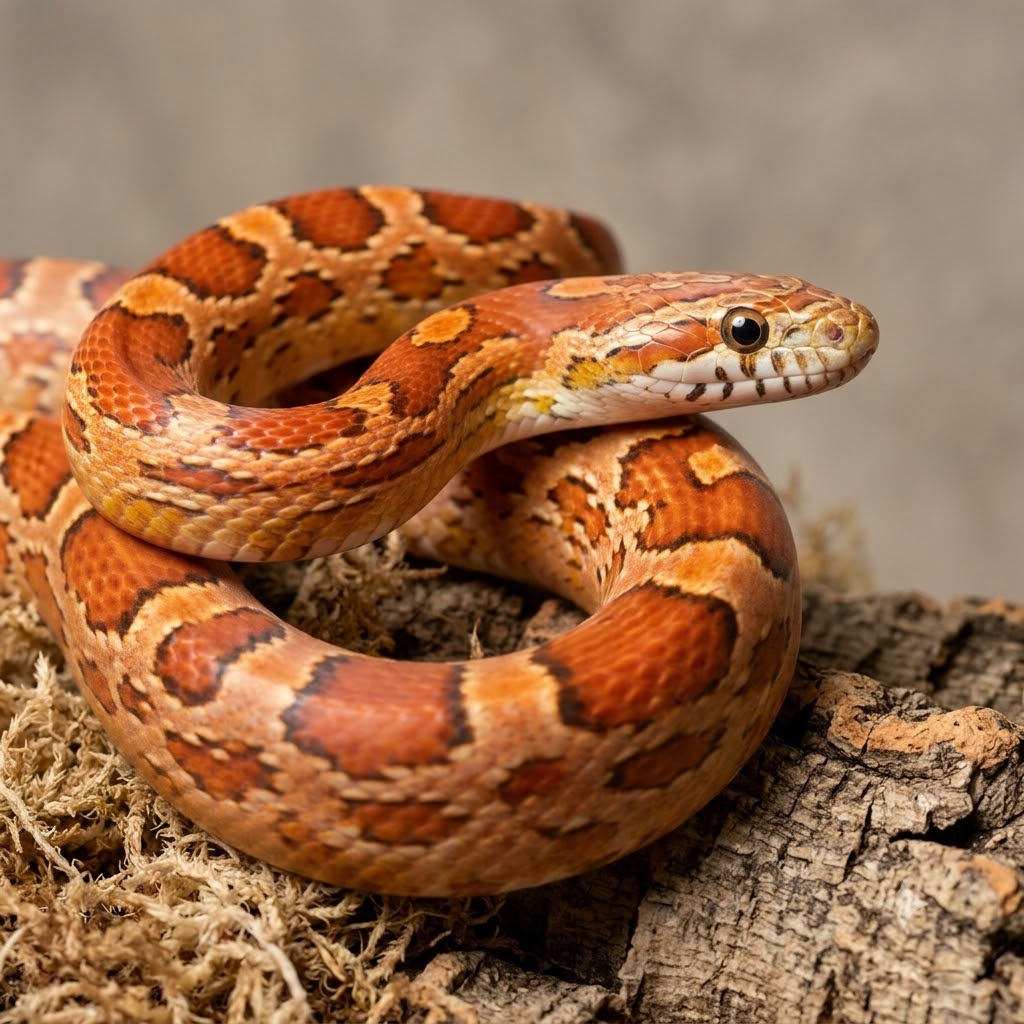
The most striking feature is the smooth, almost naked skin, which can make the underlying colour and pattern look unusually soft or matte. Head scales are often reduced too, and the eyes can appear more prominent against the bare skin. Hatchlings already show the trait, and as the snake grows the colours tend to deepen and settle much like any corn snake, just without the texture and shine that scales normally add.
How it is bred
Because the trait is recessive, a visibly scaleless snake carries two copies of the gene. Breeding two scaleless snakes produces scaleless offspring; pairing a scaleless snake with a het produces a mix of scaleless and het babies; and two hets produce a mix that includes some scaleless young. Colour and pattern morphs are stacked on top by combining scaleless lines with other recessive or dominant morphs over successive generations.
Cost and availability
Scaleless corns are an established but still specialist morph, so they usually cost more than a standard normal or a common single-gene morph. Price rises further when scalelessness is combined with popular colour or pattern morphs. Availability is steady from breeders who work with the line, though less common than everyday morphs.
Health and ethics
This is a morph with a genuine, openly discussed welfare talking point. The missing body scales remove much of the physical protection that scales normally give the skin, and ethical keepers honestly debate whether that is fair to the animal. Most animals do keep their ventral scales, which still help with grip and movement. Anyone considering one should choose a reputable, welfare-minded breeder, ask exactly how much scaling the line retains, and have a herp vet involved for any skin or handling questions.
Care
Care is the same as for any standard corn snake - the morph changes appearance, not the animal's basic needs. Follow normal corn snake husbandry for enclosure, heat, humidity and feeding, take extra care with rough surfaces or handling given the exposed skin, and rely on reputable breeders and a herp vet for guidance rather than experimenting.
Scaleless Corn Snake - frequently asked questions
Is the Scaleless Corn Snake completely without scales?
Not completely. Scaleless corns lose most of their body scales but usually keep their belly scales and some head scales. The exact amount depends on the breeding line, so ask the breeder what a given animal actually retains.
Is scalelessness dominant or recessive?
It is recessive. A snake needs two copies of the gene to look scaleless, and a snake with one copy is a normal-looking carrier (het) that shows no visible sign of the trait.