Tessera Corn Snake
Tessera is a pattern morph of the corn snake (Pantherophis guttatus), one of the most widely kept pet snakes.
🗓️ Last reviewed: July 2026
Overview
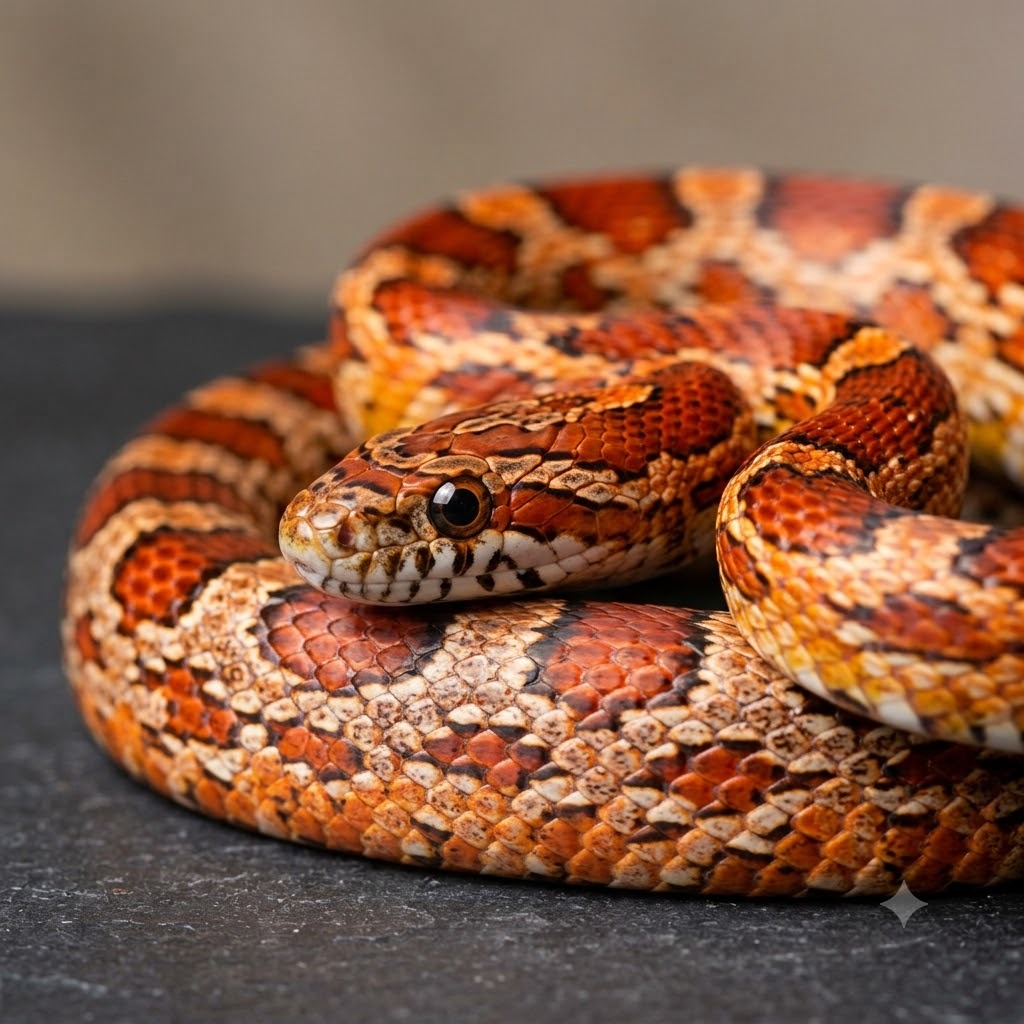
Tessera is a pattern morph of the corn snake (Pantherophis guttatus), one of the most widely kept pet snakes. Instead of the usual chain of dorsal saddles, a Tessera shows a clean stripe running down the spine with a busier, connected side pattern. It is a pattern change only, so it can be combined with almost any colour morph.
What it is
A normal or wild-type corn snake has a row of separate saddle blotches down its back, edged in black, over an orange to brownish base, with a checkerboard belly. A Tessera replaces that saddle chain with a bold vertebral (spine) stripe and lateral markings that connect into a more geometric, mosaic-like arrangement along the sides. The underlying colours stay whatever the snake's other genes dictate; only the shape of the pattern changes.
The genetics
Tessera is inherited as a dominant pattern trait. That means a single copy of the Tessera gene is enough to produce the striped, connected look - the animal does not need two copies. Breed a Tessera to a normal-patterned corn snake and, on average, about half the clutch will show the Tessera pattern. Because it is dominant rather than recessive, there is no hidden "het" carrier: a corn snake either visibly shows Tessera or does not carry it. Some lines are reported to produce a homozygous (two-copy) form, but a keeper looking at the animal cannot tell one copy from two by pattern alone.
Appearance
The signature feature is a straight, unbroken stripe down the centre of the back, flanked by side markings that link up rather than sitting as isolated blotches. Depending on the colour genes stacked with it, the stripe and sides can read as deep red, orange, brown, or - on amel and other lines - much paler. Hatchlings usually show the striped pattern clearly from day one, and the pattern generally stays stable through life, though colours often intensify and the contrast between stripe and background can sharpen as the snake matures.
How it is bred
The rules follow the type of gene. Recessive morphs (such as amel or anery) need two copies to show, so they are carried invisibly as "hets" until paired up. Dominant and incomplete-dominant morphs - Tessera among them - need only one copy to show, so a single Tessera parent can pass the look to roughly half its offspring. Line-bred traits, by contrast, are not simple on/off genes; they are strengthened by selecting the best-looking animals over many generations. Combos are made by stacking traits, for example putting the dominant Tessera pattern together with recessive colour morphs to create striped, colourful animals.
Cost and availability
Tessera is well established in the corn snake hobby and widely available. A basic single-gene Tessera is usually modestly priced, while Tesseras combined with sought-after colour morphs (multi-gene combos) command more. Overall it sits in the affordable-to-mid range rather than being a rarity.
Health and ethics
Tessera is a pattern trait with no known health or welfare problem tied to it - it does not carry a lethal super form or any structural defect, so these snakes have the same needs and lifespan as any other corn snake. As with any purchase, choose a reputable, health-focused breeder who can show clean, well-started animals, and see a reptile (herp) vet for any health concerns.
Care
Care is identical to a standard corn snake - the morph changes appearance only, not the animal's needs. Corn snakes want a secure enclosure with a warm and cool side, a hide on each end, fresh water, and appropriately sized rodent prey. For full husbandry details, follow guidance from reputable breeders and a herp vet.
Tessera Corn Snake - frequently asked questions
Is Tessera dominant or recessive?
It is dominant. A single copy of the gene produces the striped, connected pattern, so a Tessera corn snake always shows the trait - there are no invisible carriers.
Does Tessera affect the snake's colour?
Not directly. Tessera only reshapes the pattern into a spine stripe with connected sides. The colours come from whatever other morphs the snake carries, which is why Tessera is so often combined with colour morphs.