Tiger Crested Gecko
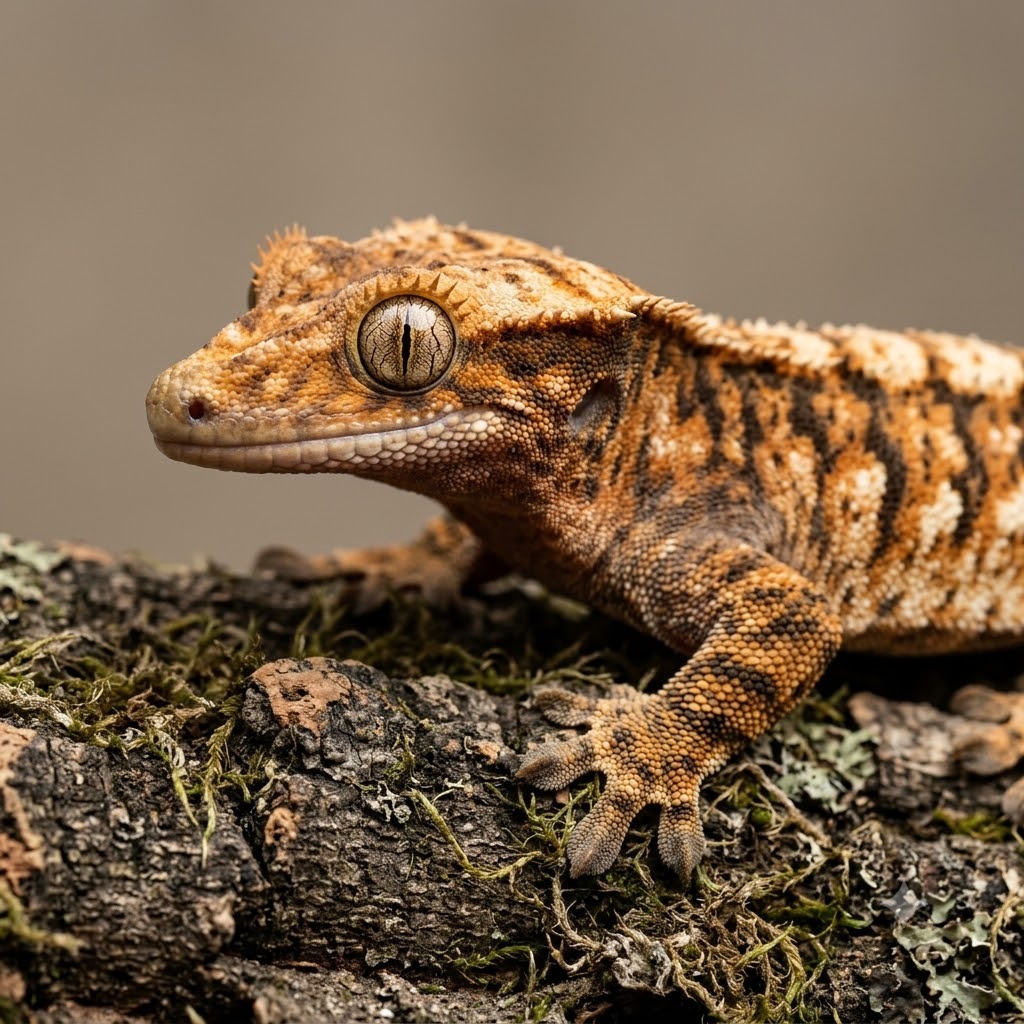
The Tiger is a pattern trait of the crested gecko (Correlophus ciliatus), named for the vertical bands that run down the animal's sides like a tiger's stripes.
🗓️ Last reviewed: July 2026
Overview
The Tiger is a pattern trait of the crested gecko (Correlophus ciliatus), named for the vertical bands that run down the animal's sides like a tiger's stripes. It is one of the most recognisable pattern styles in the hobby and can be combined with almost any base colour. Tiger is a look, not a species or a single gene.
What it is
A normal or wild-type crested gecko shows a fairly even base colour with only soft, irregular markings. A Tiger shows distinct darker vertical bars stepping down each flank from the spine toward the belly. The stronger and more even the banding, the more prized the "Tiger" label; when the bands become broken, jagged, or chaotic, keepers usually call the animal a Brindle instead.
The genetics
Tiger is a polygenic, line-bred trait, not a simple recessive or dominant gene. There is no single on/off "Tiger gene" that an animal either carries or does not - the banding is the combined result of many small genetic influences plus selective breeding. Because of this you cannot describe an animal as "het Tiger," and pairing two strong Tigers does not guarantee a whole clutch of strong Tigers. Instead, breeders improve the trait gradually by choosing the best-banded parents generation after generation.
Appearance
The signature feature is a series of dark vertical bands running down both sides of the body, often extending onto the limbs and tail. The base colour underneath can be nearly anything - buckskin, olive, red, orange, yellow, or grey - and the contrast between band and base is what makes a Tiger stand out. Like all crested geckos, a Tiger "fires up" and down: colours and banding look boldest and darkest when the animal is fired up (often at night or when active) and can fade to a paler, washed-out version when fired down. Hatchlings frequently show only faint banding that becomes clearer as the gecko matures, so the adult look can be much stronger than the baby suggested.
How it is bred
It helps to compare the trait types. Recessive traits need two copies to show, so hidden carriers ("hets") can pass them on invisibly. Dominant and incomplete-dominant traits show with just one copy from one parent. Tiger belongs to neither group - as a line-bred, polygenic trait it is built up by selection: a breeder keeps the most strongly and evenly banded animals, pairs them together, then repeats over several generations to concentrate the look. Tiger is also frequently stacked with other traits (for example on a Dalmatian-spotted or red base) to create combination animals, but each of those traits still follows its own mode of inheritance.
Cost and availability
Tigers are common and widely available. Lightly or unevenly banded animals sit near the lower end of crested gecko pricing, while clean, high-contrast Tigers - especially on a bright or unusual base colour, or combined with other desirable traits - command more. Overall this is an accessible, beginner-friendly pattern rather than a rare, premium one.
Health and ethics
Tiger carries no special health or welfare problem. It is purely a pattern trait and does not affect the gecko's body, scales, or viability, so it is not linked to any lethal or structural issue. Standard crested gecko care fully applies. As with any reptile, choose a reputable breeder who keeps clean records, and see a qualified reptile (herp) vet for any health concerns.
Care
Care is exactly the same as for any standard crested gecko - the Tiger trait changes appearance only, not needs. Provide the usual arboreal setup, appropriate temperatures and humidity, and a complete crested gecko diet. For specifics, follow a reputable crested gecko care source and consult a herp vet.
Tiger Crested Gecko - frequently asked questions
Is Tiger a recessive or dominant gene?
Neither. Tiger is a polygenic, line-bred trait, so there is no single dominant or recessive gene and no such thing as a "het Tiger." It is produced by selecting well-banded animals over generations.
Will breeding two Tigers give me all Tiger babies?
Not guaranteed. Because the trait is polygenic, pairing two strong Tigers improves the odds of good banding but still produces a range, from faint to bold. Consistent results come from continued selective breeding, not a single pairing.
What is the difference between a Tiger and a Brindle?
They are the same underlying banding trait on a spectrum. Clean, even vertical bars are called Tiger; when the bands become broken, jagged, or chaotic, keepers call the animal Brindle.
Does the Tiger need special care?
No. Care is identical to any crested gecko. The trait affects looks only.