GHI Ball Python
The GHI is a dark, richly patterned ball python morph known for the way it deepens the base colour and adds a coppery, dusky wash across the body.
Last reviewed: October 2026
Species guide: Ball Python · All ball python morphs
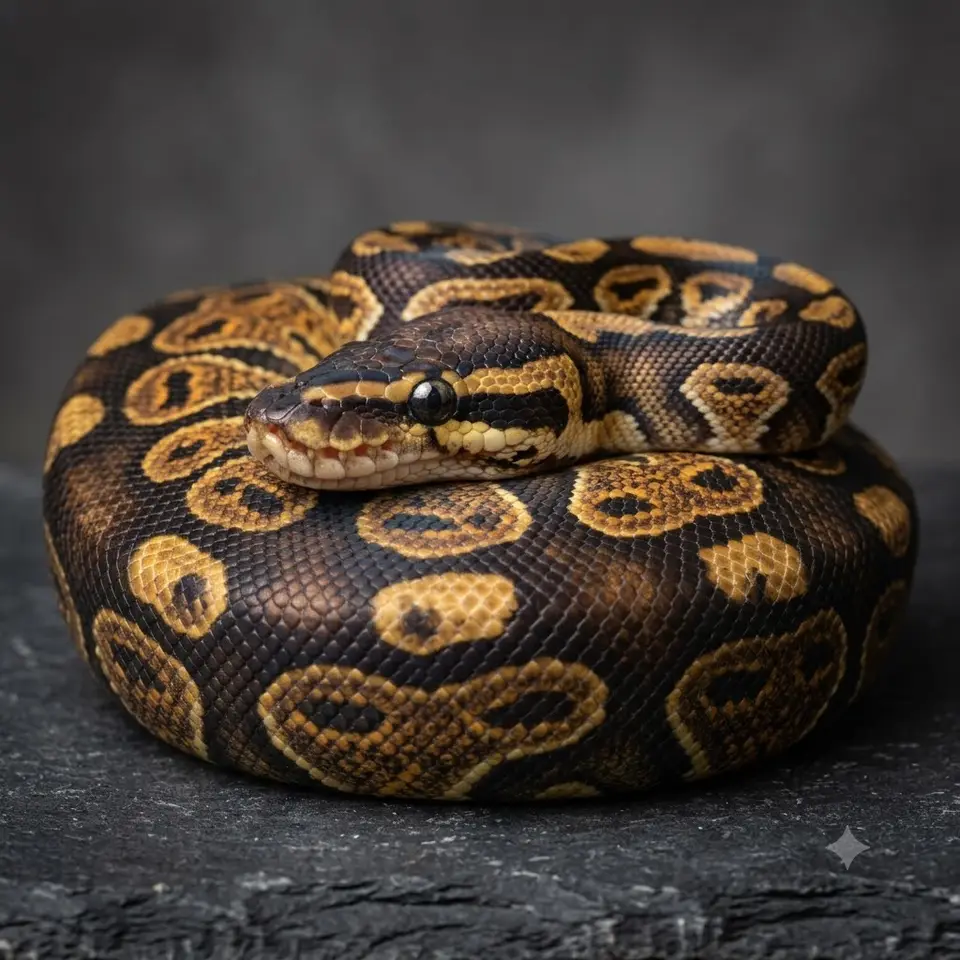 AI illustration
 Overview
The GHI is a dark, richly patterned ball python morph known for the way it deepens the base colour and adds a coppery, dusky wash across the body. It is popular both on its own and as a "booster" gene that intensifies other morphs in combos. GHI is a single-gene colour and pattern morph of the ball python (Python regius).
What it is
GHI (the hobby name stands for "Gotta Have It") is a visual morph that darkens and enriches a normal ball python's appearance. Compared with a wild-type animal, a GHI shows deeper browns and blacks, a coppery or greenish-bronze cast to the lighter markings, and a somewhat blurred, connected pattern. The overall impression is a darker, higher-contrast snake rather than a radically new pattern shape.
The genetics
GHI is inherited as an incomplete-dominant trait. In the hobby this is usually called "co-dominant" or "co-dom," but technically it is incomplete-dominant: a single copy of the gene produces the visible GHI look, and two copies produce a distinct, more extreme "super" form. The Super GHI is generally darker and more washed-out in pattern; it is viable rather than lethal, though breeders report wrinkly-skinned Super GHI hatchlings (see Health below). GHI is also widely used in designer combos, where it stacks with other genes to deepen and enrich the result.
Appearance
A single-gene GHI has a dark chocolate-to-black background with lighter markings that take on a coppery, bronze, or faintly greenish tone. The pattern often looks slightly connected or "muddled" compared with a clean normal, and the sides can show a dusky, speckled wash. Eyes are normal and dark. Many GHIs darken and deepen further as they mature, so adults often look richer than hatchlings. The Super GHI pushes all of this further into a very dark, low-contrast, almost patternless look in some individuals.
How it is bred
Because GHI is incomplete-dominant, a snake only needs one copy of the gene to look like a GHI, so pairing a single GHI to a normal produces a percentage of visual GHI offspring. Pairing two GHIs together can also produce the double-gene Super GHI. In combo projects, breeders pair GHI animals with other morphs so the GHI gene stacks with those genes to intensify the colour. Unlike recessive morphs, GHI does not hide as an invisible "het," so any animal carrying it shows it.
Cost and availability
GHI is a well-established, widely available morph. Single-gene GHIs are relatively affordable and easy to find, sitting in the moderate range rather than the rare or premium tier. Super GHIs and multi-gene GHI combos cost more, depending on which other morphs are stacked in.
Health and ethics
The GHI gene itself carries no known genetic health or welfare problem. It is not linked to any neurological "wobble," balance disorder, tumour issue or lethal super form. The Super GHI is viable, but the MorphMarket community list of ball python morph issues names "wrinkly hatchlings" for it and gives no figures for how often this happens, so ask the breeder about any Super GHI before you buy. As with any ball python, buy from a reputable breeder who keeps clear genetic and health records, and see a reptile (herp) veterinarian for any health concerns. This profile is educational and is not breeding instruction or veterinary advice.
Care
Care for a GHI is identical to that of a standard ball python. The morph changes only how the snake looks, not what it needs in terms of enclosure size, heating, humidity, feeding, or handling. Follow reputable, up-to-date ball python husbandry sources for setup and daily care, and consult a herp vet for medical questions.
Everyday gear for reptiles
Links go to Amazon or a partner brand's own store and may earn us a commission at no extra cost to you. As an Amazon Associate we earn from qualifying purchases. An Amazon link leads to a type of gear and you choose the exact product; a card that names a store leads to that partner's own shop.
GHI Ball Python - frequently asked questions
Is GHI the same as co-dominant?
In everyday hobby talk GHI is called "co-dom," but it is technically incomplete-dominant. One copy gives the GHI look and two copies give the distinct Super GHI form, which is what separates incomplete-dominant traits from true dominants.
Is the Super GHI unhealthy or lethal?
It is not lethal: the Super GHI is viable and looks darker and lower in contrast than a single-gene GHI. It is not entirely problem-free, though - the MorphMarket community list of ball python morph issues names "wrinkly hatchlings" for the Super GHI.