Extreme Harlequin Crested Gecko
The Extreme Harlequin is a patterning morph of the crested gecko (Correlophus ciliatus), a small arboreal lizard native to New Caledonia.
🗓️ Last reviewed: September 2026
Overview
The Extreme Harlequin is a patterning morph of the crested gecko (Correlophus ciliatus), a small arboreal lizard native to New Caledonia. It sits at the high end of the harlequin line, where the harlequin markings spread unusually far down the sides and across the body. It is a look, not a separate species or a single "gene."
What it is
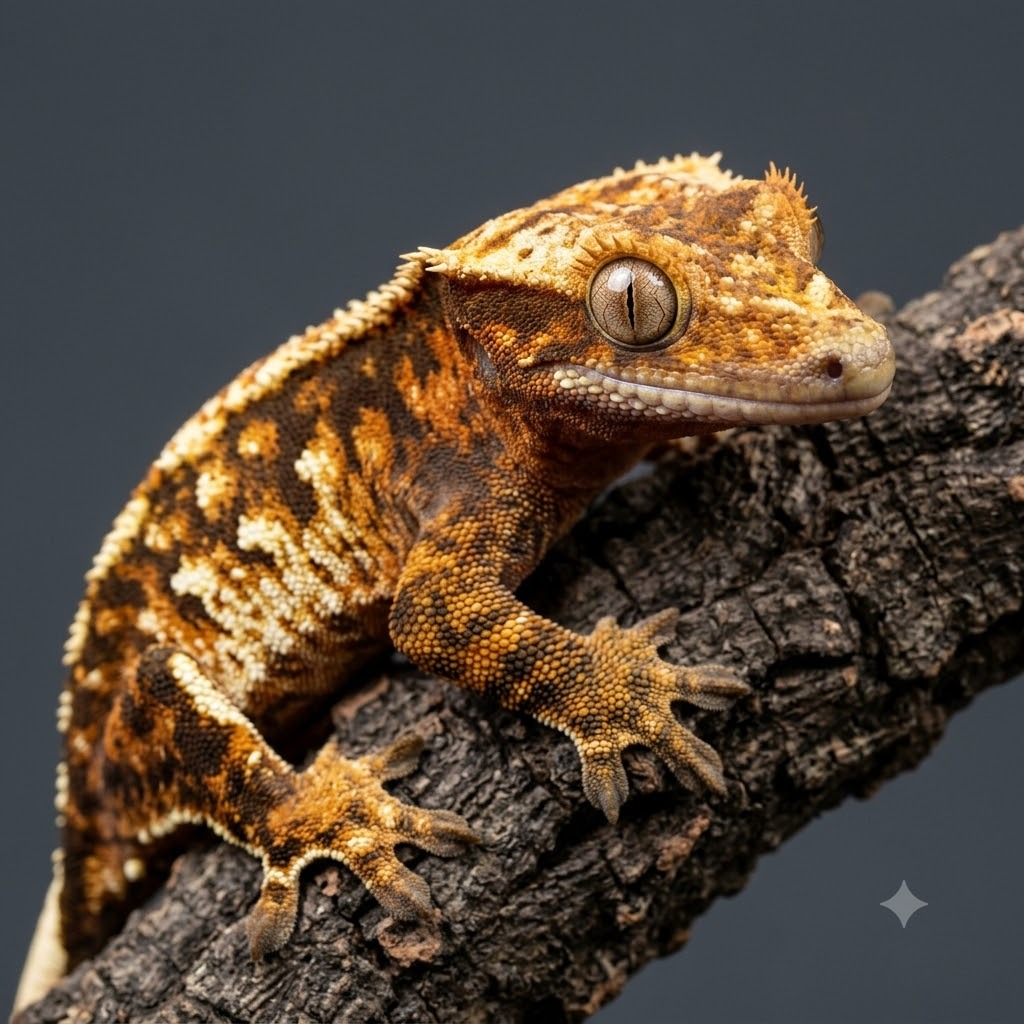
A wild-type crested gecko typically shows pattern concentrated along the dorsal (back) region, with plainer flanks. A harlequin has bolder patches of contrasting colour spreading down the sides and often onto the legs. In an Extreme Harlequin, that patterning is pushed further still, with lots of pattern covering the flanks and legs as well as the back, so the animal reads as busy and high-contrast over most of its body.
The genetics
Extreme Harlequin is a polygenic, line-bred trait, not a simple recessive or dominant gene. That means there is no single on/off switch to inherit and no "het" carriers. The amount of pattern is controlled by many small genetic factors plus how the animal develops, so offspring fall on a spectrum. Breeders reach the "extreme" end by selecting the highest-pattern animals over generations, but even two extreme parents can produce babies with less pattern. Because it is a degree of pattern rather than a discrete gene, where "harlequin" ends and "extreme harlequin" begins is a matter of judgement, not a genetic test.
Appearance
Expect strong, contrasting patches - creams, oranges, reds, yellows or near-white against a darker base - covering the flanks and extending high onto the back and often the limbs. Pattern edges may be crisp or feathered, and many carry the base cream/tan dorsal broken up by colour. Crested geckos change with age and mood: hatchlings often look plainer, with the full extent of the pattern only becoming clear as they grow. They also "fire up" (darken and intensify) when active or at night and "fire down" (pale out) when calm or in daylight, so the same gecko can look quite different hour to hour.
How it is bred
Simple recessive traits need two copies to show and can hide in unaffected "het" carriers; dominant and incomplete-dominant traits show with a single copy. Extreme Harlequin is none of these - it is line-bred, meaning breeders keep pairing the highest-pattern individuals generation after generation to concentrate the trait, with results always on a sliding scale. It also combines freely with colour and structural traits (for example harlequin patterning layered onto a particular base colour, or stacked with traits like dalmatian spotting), since stacking independent looks is how most crested gecko combos are made.
Cost and availability
Crested geckos are one of the most widely kept and bred reptiles, so they are generally easy to find. A clean, high-pattern Extreme Harlequin usually costs more than a plain or lower-pattern gecko, and price climbs further when the harlequin is paired with sought-after colour or structural traits. As a common, well-established look rather than a rare gene, it stays affordable relative to premium combo animals.
Health and ethics
There is no welfare problem specific to the Extreme Harlequin trait - it changes pattern only, and it carries no lethal gene or structural defect. It needs the same care as any crested gecko. As with any purchase, choose a reputable breeder who keeps clean records and healthy stock, ask about the animal's history, and see a qualified reptile (herp) vet for any health concerns.
Care
Care is identical to a standard crested gecko - the morph affects appearance only, not the animal's needs. In brief: a suitably sized, well-ventilated vertical arboreal setup with cover to climb, appropriate room-temperature range and humidity, and a complete crested gecko diet. For full husbandry, follow guidance from reputable breeders and a herp vet rather than a pattern label.
Extreme Harlequin Crested Gecko - frequently asked questions
Is Extreme Harlequin a recessive gene?
No. It is a polygenic, line-bred trait, so there is no single gene, no "super" form and no het carriers. Pattern amount falls on a spectrum shaped by many factors and by selective breeding.
Will two Extreme Harlequin parents always produce Extreme Harlequin babies?
Not always. Because the trait is line-bred, offspring vary, and some may show less pattern than their parents. High-pattern parents improve the odds but guarantee nothing.
Does the "extreme" pattern need special care?
No. It needs exactly the same care as any crested gecko. The trait only changes how the gecko looks.
Why does my Extreme Harlequin look different at night?
Crested geckos "fire up" when active or at night and "fire down" when calm or in daylight, so colour and contrast shift with mood, temperature and time of day.