Carrot Tail Leopard Gecko
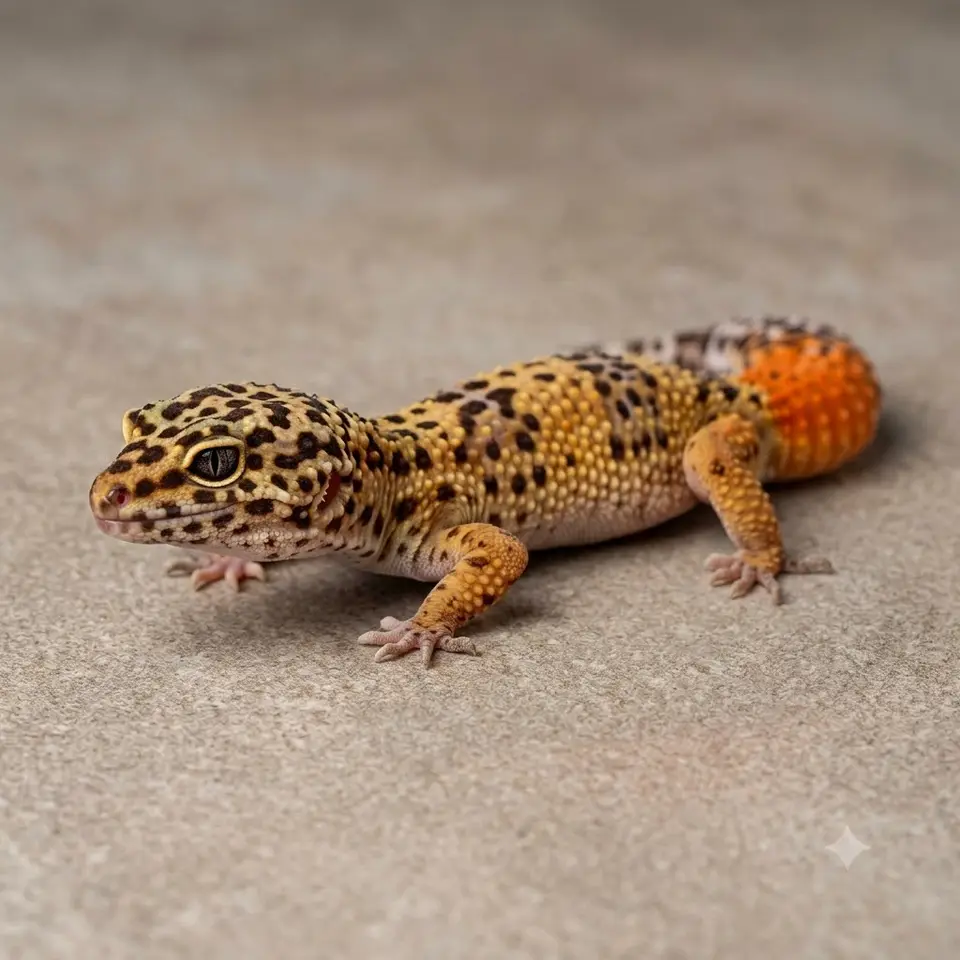
The Carrot Tail is a leopard gecko selected for a distinctive band of bright orange on its tail, ranging from a light wash to a deep, almost neon "carrot" tone.
Last reviewed: July 2026
Species guide: Leopard Gecko · All leopard gecko morphs
 AI illustration
 Overview
The Carrot Tail is a leopard gecko selected for a distinctive band of bright orange on its tail, ranging from a light wash to a deep, almost neon "carrot" tone. It is not a single gene but a line-bred trait that breeders concentrate over generations, and it is frequently paired with other morphs to add warmth and color. It is a color trait of the leopard gecko (Eublepharis macularius).
What it is
Carrot Tail describes orange pigment spread across the tail rather than a full-body color change. A gecko is generally called a Carrot Tail once a meaningful portion of the tail (in the hobby, often cited as roughly 15 percent or more) shows clear orange. Compared with a normal or wild-type leopard gecko, whose tail is typically banded in black, cream and yellow, a Carrot Tail replaces much of that with vivid orange, sometimes covering most or all of the tail in the strongest examples.
The genetics
Carrot Tail is polygenic and line-bred, not a simple recessive, dominant or incomplete-dominant gene. That means the orange is controlled by many small genetic contributions acting together, and its intensity is built up by selecting and breeding the most strongly colored animals over successive generations. Because it is not a single Mendelian gene, there is no "het," no "super" form, and no clean pairing that guarantees a set result - offspring show a spectrum. It is often stacked onto established morphs such as Tangerine, Bell Albino, Tremper Albino, RAPTOR and others, where the orange complements the base trait. In these combinations the Carrot Tail portion still behaves as a line-bred trait, while the co-inherited morph follows its own inheritance rules.
Appearance
The defining feature is orange on the tail, which can appear as a soft peach band near the body or as a saturated orange running along most of the tail's length. The rest of the body follows whatever base morph the animal carries - it might be a tangerine-oriented orange body, a pale albino, or a more typical yellow leopard gecko. Eyes are usually the normal dark leopard gecko eye unless the animal also carries an eye-affecting morph. Hatchlings often show muted color that intensifies as they mature, and the orange typically deepens over the first months of life. If a gecko drops and regrows its tail, the regenerated tail is usually shorter, differently shaped and often does not reproduce the original carrot coloring.
How it is bred
Because the trait is polygenic, breeders produce Carrot Tails by pairing animals that already show strong orange tails and selecting the most vivid offspring to carry the line forward. There are no het pairings to track and no two-copy "super" to make, so progress comes from patient selection over multiple generations rather than a single planned cross. Breeders often combine Carrot Tail lines with color morphs like Tangerine to reinforce orange, or with albino and designer morphs to create striking combinations. Results vary from clutch to clutch, and not every hatchling from strong parents will express the same level of orange.
Cost and availability
Carrot Tail is common and widely available, and a basic Carrot Tail is usually inexpensive. Price rises with the intensity and coverage of the orange and with the value of any morphs it is combined with - a deeply saturated tail on a premium designer animal costs considerably more than a light wash on a standard gecko. Overall it remains one of the more accessible and affordable traits in the hobby.
Health and ethics
Carrot Tail is a color trait with no known genetic health or welfare problem. It is not linked to the neurological or balance disorders seen in some other morphs, and it carries no lethal or non-viable form. A Carrot Tail gecko needs the same attention to health as any leopard gecko. As with any animal, buy from a reputable breeder who keeps clean records, and see a reptile (herp) veterinarian for any health concern.
Care
Care is identical to a standard leopard gecko - this trait changes only how the tail looks, not what the animal needs. Follow standard leopard gecko husbandry for enclosure size, heat, humidity, diet, supplementation and handling, and consult reputable general leopard gecko care resources and a herp veterinarian rather than treating this morph as a special case.
Everyday gear for reptiles
Links go to Amazon or a partner brand's own store and may earn us a commission at no extra cost to you. As an Amazon Associate we earn from qualifying purchases. An Amazon link leads to a type of gear and you choose the exact product; a card that names a store leads to that partner's own shop.
Carrot Tail Leopard Gecko - frequently asked questions
Is a carrot tail a genetic morph or just line-breeding?
It is a line-bred, polygenic trait. The orange is built up by selecting strongly colored animals over generations rather than passed on by a single gene, so results vary between offspring.
Will the orange color get brighter as the gecko grows?
Often yes. Many Carrot Tails hatch with muted color that intensifies over the first several months. If the gecko loses and regrows its tail, though, the new tail usually does not match the original carrot coloring.