Clown Ball Python
The Clown is a recessive ball python morph prized for its reduced, connected dorsal pattern and clean, warm colouring.
Last reviewed: July 2026
Species guide: Ball Python · All ball python morphs
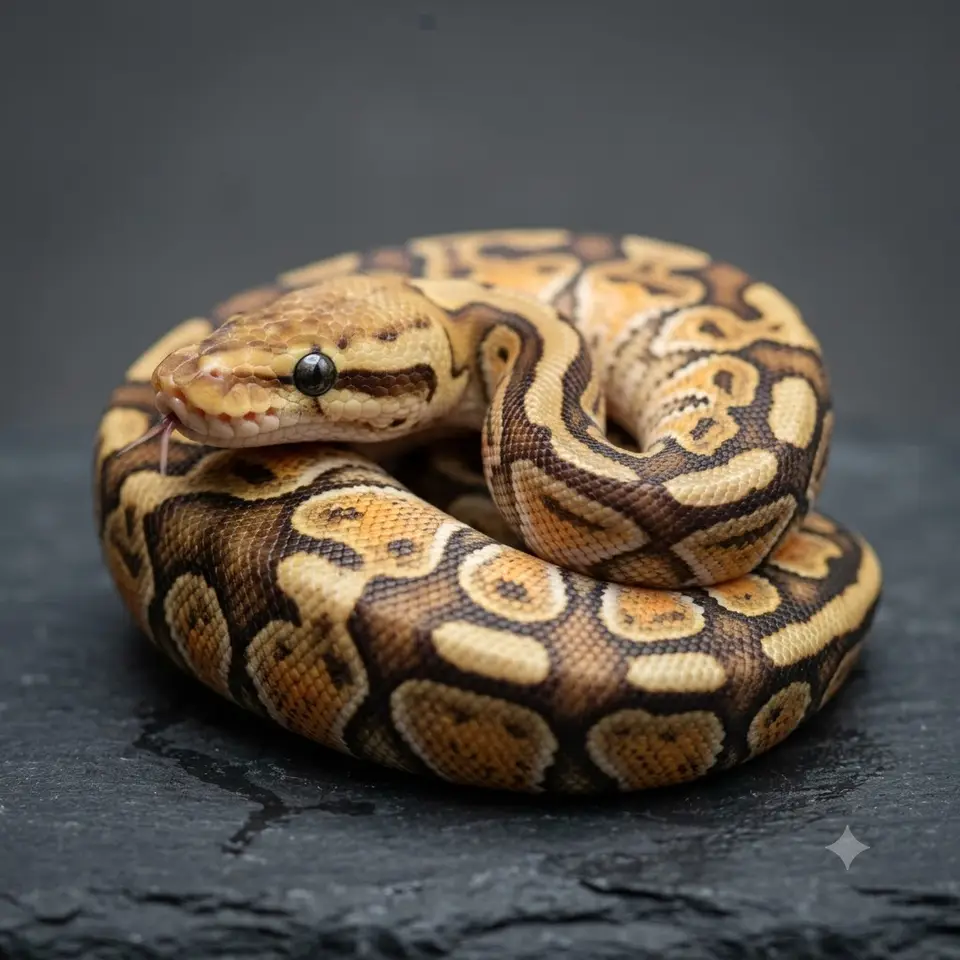 AI illustration
 Overview
The Clown is a recessive ball python morph prized for its reduced, connected dorsal pattern and clean, warm colouring. It gets its name from the distinctive "teardrop" or "clown mask" markings around the head and the smooth striping down the spine. It is a colour and pattern morph of the ball python (Python regius).
What it is
Clown alters both the pattern and the colour of a normal ball python. Instead of the busy "alien head" blotches and dark peppering of a wild-type animal, a Clown shows a cleaner body with a bold, often connected dorsal stripe, reduced side pattern, and a paler, more golden or caramel tone. The head carries the signature dark teardrop markings that give the morph its name.
The genetics
Clown is inherited as a simple recessive trait. A snake needs two copies of the Clown gene - one from each parent - to actually look like a Clown (to be "visual"). An animal with only one copy is a "het" (heterozygous) Clown: it looks completely normal but can pass the gene on. Because it is recessive, Clown does not have a "super" form the way incomplete-dominant (hobby "co-dom") morphs do, and it is not dominant. It is, however, extremely popular in combos, where the Clown gene is stacked with other genes to create designer morphs.
Appearance
The base colour is typically a warm caramel, gold, or light brown, often noticeably brighter than a normal ball python. The dorsal region tends to form a bold, connected stripe or a series of joined markings running down the back, while the sides are much cleaner than wild-type. The head shows the characteristic dark teardrop lines and a distinctive pattern that hobbyists call the "clown mask." Eyes are normal and dark. Colour and contrast can intensify somewhat as the animal matures, and exact look varies from line to line and combo to combo.
How it is bred
Because Clown is recessive, producing visual Clowns requires both parents to carry the gene. Common approaches are pairing two visual Clowns, pairing a visual Clown with a het Clown, or pairing two het Clowns. Only pairings where both parents carry at least one copy can yield visual Clown offspring. Breeders also cross Clown into other morphs over generations to create het combos and, eventually, multi-gene "designer" Clowns. There is no super form to chase, since Clown is recessive rather than co-dominant.
Cost and availability
Clown is a well-established, widely available morph. Single-gene visual Clowns sit in the moderate, mid-range price bracket - more than a normal ball python but far from rare. Het Clowns are cheaper, while multi-gene Clown combos and newer designer projects command higher prices depending on how many genes are stacked and how sought-after the look is.
Health and ethics
The Clown gene itself is not linked to any known neurological or structural welfare problem. Unlike Spider or Champagne (which carry a "wobble"), Enigma (balance disorder), or certain lethal super forms, a standard Clown carries no special health issue beyond normal ball python care. The main ethical point is that Clown is frequently combined with other genes, so buyers should check the full genetic makeup of a combo animal and avoid pairings that introduce a known welfare-linked gene. As always, choose reputable breeders who are transparent about genetics, and see a reptile (herp) veterinarian for any health concerns.
Care
Care is identical to a standard ball python. The morph changes only how the snake looks, not what it needs - the same enclosure, temperatures, humidity, hiding spots, and feeding schedule apply. Follow a trusted ball python care resource for husbandry specifics, and consult a herp vet for health questions rather than treating a morph as needing anything special.
Everyday gear for reptiles
Links go to Amazon or a partner brand's own store and may earn us a commission at no extra cost to you. As an Amazon Associate we earn from qualifying purchases. An Amazon link leads to a type of gear and you choose the exact product; a card that names a store leads to that partner's own shop.
Clown Ball Python - frequently asked questions
Is the Clown ball python healthy?
Yes. The Clown gene on its own is not associated with any neurological or structural defect, so a single-gene Clown is as healthy as any normal ball python. Just verify the genetics of any combo animal and buy from a reputable breeder.
Why is it called a "Clown"?
The name comes from the distinctive dark teardrop and mask-like markings around the head, plus the reduced, tidy pattern, which reminded early breeders of clown face paint. It has nothing to do with behaviour.