Mudpuppy
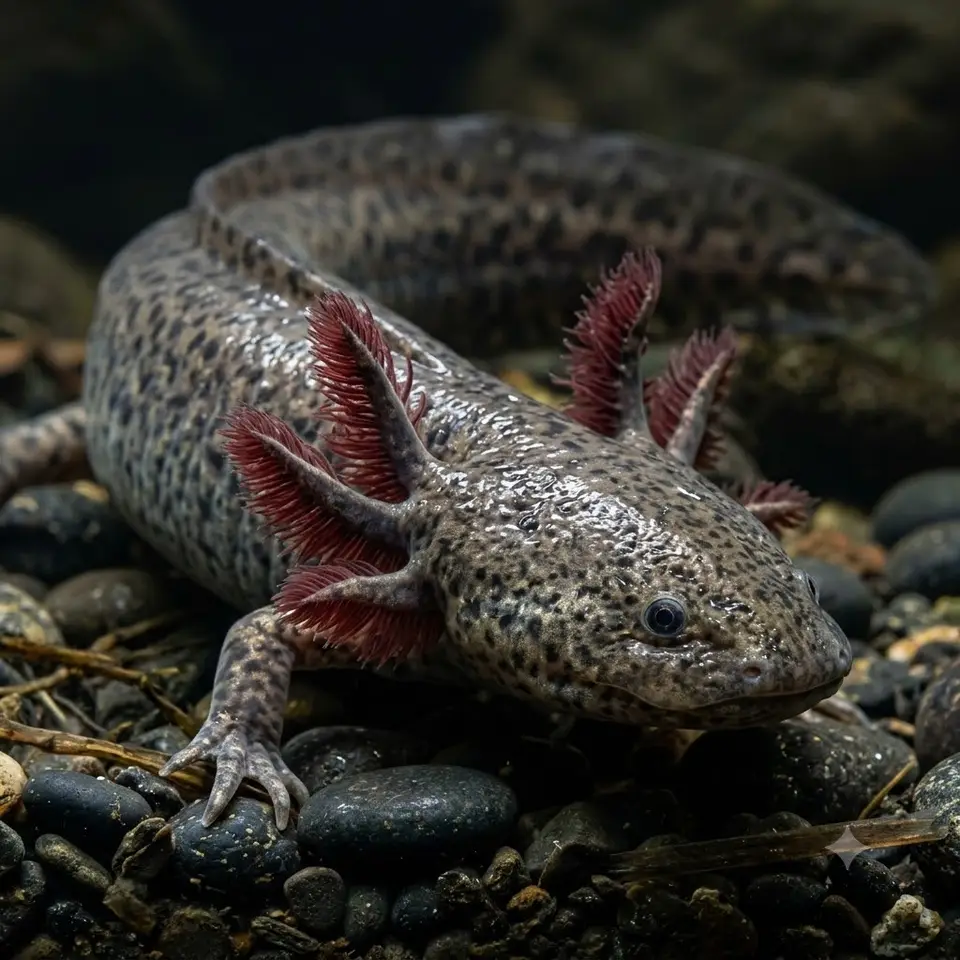
The Mudpuppy (Necturus maculosus) is a large, fully aquatic salamander from eastern North America that keeps its feathery external gills for life and never leaves the water.
Updated: July 2026
 AI illustration
 Wash your hands after handling. The FDA notes that reptiles and amphibians can carry Salmonella and show no signs of illness, so the animal, its enclosure and everything in it can spread the germs: wash your hands with soap and water straight after touching any of them. The agency says children younger than 5, pregnant women, the elderly and people with weakened immune systems should not handle reptiles or amphibians. Source: FDA, Salmonella and pet reptiles and amphibians.
Overview
The Mudpuppy (Necturus maculosus) is a large, fully aquatic salamander from eastern North America that keeps its feathery external gills for life and never leaves the water. It is a cool-water specialist, nocturnal and secretive, and honestly a specialist's animal rather than a beginner pet. Most that reach the pet trade are wild-caught, which raises real sourcing concerns, and its temperature needs make it harder to keep than a typical tropical amphibian.
Natural History
Mudpuppies live in lakes, rivers, and streams across the eastern and central United States and parts of Canada. They are paedomorphic, meaning they never metamorphose the way most salamanders do - they retain their bushy red external gills and stay aquatic their whole lives. In the wild they favor cool, well-oxygenated water and hide under rocks and debris by day, foraging at night. Gill size shifts with water quality: bigger, redder gills appear in warmer or lower-oxygen water.
Appearance
Adults typically reach 8-13 inches (20-33 cm), with large individuals approaching 16 inches (40 cm). The body is stout and slippery, usually gray to rusty brown with dark blotches, and a flattened, paddle-like tail for swimming. The standout feature is the pair of maroon external gills behind the head, which fan out in the water. Four short legs, each with four toes, and small lidless eyes complete the look.
Temperament & Handling
This is a look-don't-touch animal. Mudpuppies have delicate, permeable skin and fragile gills, and handling stresses them and can transfer oils, soaps, or lotions into their system. Only move one when necessary, using wet, clean hands or a soft net, and never dry-handle. They are not aggressive, but a large one can deliver a surprising nip at feeding time, so keep fingers away from the mouth.
Enclosure
Mudpuppies need a spacious aquatic setup. Plan on at least a 29-gallon (110 L) aquarium for one adult, and larger is better - a 40-breeder or bigger suits a full-grown animal and gives room to spread out. They are strictly aquatic, so the tank stays fully flooded with a secure lid. Use fine sand or bare bottom, or smooth stones too large to swallow, to avoid impaction. Provide plenty of caves, slate, PVC pipe, or rock hides, since a mudpuppy with nowhere to shelter will be chronically stressed.
Heating, Lighting, Humidity
The biggest challenge is temperature. Mudpuppies are cold-water animals and do best around 50-65°F (10-18°C); sustained temperatures above roughly 70°F (21°C) cause stress, poor gill function, and death over time. In most US homes this means an aquarium chiller or a cool basement, not a heater. Use strong biological filtration with gentle flow, always dechlorinate the water, and keep it clean and well-oxygenated. Lighting should be dim - no UVB is required for this nocturnal, fully aquatic species, and bright light only stresses them.
Diet
Mudpuppies are carnivores that hunt by smell. Offer earthworms, nightcrawlers, blackworms, bloodworms, small feeder fish, shrimp, crayfish, and insect larvae. Earthworms are an excellent staple. Feed juveniles a few times a week and adults every 3-5 days, adjusting to body condition. Feed after dark when they are active, and remove uneaten food to protect water quality. A light calcium dusting on softer prey does no harm.
Health & Lifespan
15-20 years.
With good cool water they are long-lived, and many exceed 20 years. Most health problems trace back to warm water: heat stress, gill deterioration, and secondary skin or bacterial infections. Poor water quality causes fungal patches and gill damage, so filtration and dechlorination are non-negotiable. Impaction from swallowed gravel is a preventable killer. Wild-caught animals often arrive carrying parasites and stress, another reason to weigh sourcing carefully. Find an exotics or aquatic-focused vet before you need one.
Pros & Cons
Pros:
- Fascinating, fully aquatic salamander with striking external gills.
- Long-lived, often 15-20+ years.
- Not toxic to keep, and hardy once water is cool and clean.
- Simple carnivore diet built around earthworms.
Cons:
- Needs cool water year-round, usually requiring a chiller.
- Most are wild-caught; captive-bred stock is scarce.
- Protected or regulated in some states - check local law first.
- Not for handling, and shy by nature.
Everyday gear for aquatic amphibians
Links go to Amazon or a partner brand's own store and may earn us a commission at no extra cost to you. As an Amazon Associate we earn from qualifying purchases. An Amazon link leads to a type of gear and you choose the exact product; a card that names a store leads to that partner's own shop.
Mudpuppy - frequently asked questions
Are mudpuppies poisonous or dangerous?
No. Mudpuppies are not venomous or toxic, and the old myth that they are poisonous is false. They can nip at feeding time, but they pose no real danger. Their skin is sensitive, so the risk runs the other way - protect them from you.
Can I keep a mudpuppy at room temperature?
Usually not. Typical US room temperatures are too warm and will slowly kill a mudpuppy. You need water in the 50-65°F (10-18°C) range, which almost always means an aquarium chiller or a naturally cool room.
Should I buy wild-caught or captive-bred?
Captive-bred is far better for the animal and the wild population, but it is rare. If only wild-caught animals are available, consider whether you can meet their needs at all, and always confirm your state allows possession, since mudpuppies are protected in some areas.
Do they need a land area or UVB light?
No. Mudpuppies are fully aquatic and never leave the water, so no land section is needed. They also do not require UVB, and dim lighting suits this nocturnal species best.
Test yourself: guess the amphibian
Three clues from our quiz bank, each about another of our amphibians. Can you name them?
Clue 1.This plump, placid green tree frog from Australia has loose folds of skin and a famously calm, docile temperament for a pet amphibian.
It's the White's Tree Frog - read the full profile →
Clue 2.This rotund South American amphibian is named for a video-game character because its enormous gaping mouth spans nearly half its body.
It's the Pacman Frog (Horned Frog) - read the full profile →
Clue 3.A common aquarium amphibian only a couple of inches long, it has four webbed feet and is often kept underwater rather than in a terrarium.
It's the African Dwarf Frog - read the full profile →