Tiger Salamander
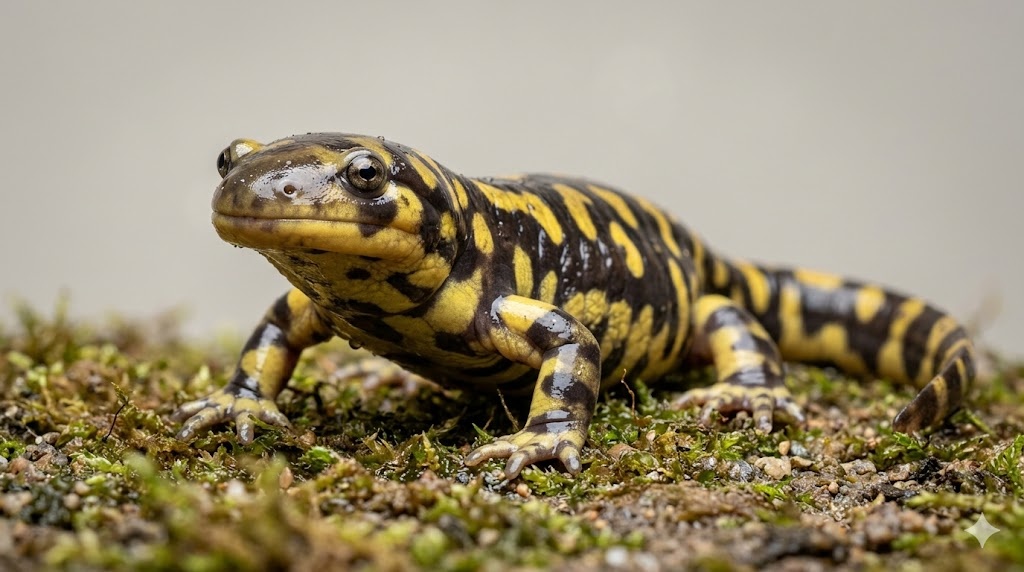
The Tiger Salamander (Ambystoma tigrinum and related) is one of the largest terrestrial salamanders - a striking yellow-banded amphibian sometimes called "the puppy of the salamander world" for its expressive face and food-driven personality.
🗓️ Last reviewed: June 2026
Overview
The Tiger Salamander (Ambystoma tigrinum and related) is one of the largest terrestrial salamanders - a striking yellow-banded amphibian sometimes called "the puppy of the salamander world" for its expressive face and food-driven personality. Long-lived, hardy, and impressively patterned.
Natural History
Native across North America. Terrestrial adult lives in burrows; aquatic larval stage.
Appearance
Adults 15-25 cm length. Stocky body. Dark base with yellow, olive, or pale bars and spots.
Temperament & Handling
Calm. Better tolerates careful handling than many amphibians, but skin sensitivity remains. Brief, gloved or wet-hand handling only.
Enclosure
Minimum: 75 L (20 gallon) for one adult.
Provide:
- Deep moist substrate (15+ cm) for burrowing.
- Hides.
- Shallow water dish.
- Cool dark environment.
Heating, Lighting, Humidity
- Temperature: 16-22°C. Cool - heat is dangerous.
- Dim lighting.
- Humidity: 70-80%.
Diet
Insects: nightcrawlers (gold standard), crickets, dubia roaches, occasional pinky mice (treats, fatty). Feed adults every 3-5 days.
Health & Lifespan
10-25 years.
Common concerns:
- Heat stress - major killer.
- Impaction from substrate.
- Chytrid fungus.
- Bacterial infections.
Pros & Cons
Pros: long-lived, hardy, striking appearance, food-driven personality. Cons: cool temperatures required; observation pet primarily.
🐾 Everyday gear for amphibians
Links go to Amazon or a partner brand's own store and may earn us a commission at no extra cost to you. As an Amazon Associate we earn from qualifying purchases. We link gear types, not sponsors' picks: you choose the exact product.
Tiger Salamander - frequently asked questions
How long do they live?
10-25 years. Some over 25.
Are they good for kids?
For observation, yes. Older children only.
Can I keep two together?
Adults can fight; safer alone.
Why "Tiger"?
The yellow banded pattern on a dark background resembles tiger stripes.
🧠 Test yourself: guess the amphibian
Three clues from our quiz bank, each about another of our amphibians. Can you name them?
Clue 1.Named after a naturalist, this chubby green climber has sticky toe pads and can change shade from green to brownish.
It's the White's Tree Frog - read the full profile →
Clue 2.This stout amphibian of the genus Ceratophrys will try to swallow prey nearly its own size and may wait days for a meal.
It's the Pacman Frog (Horned Frog) - read the full profile →
Clue 3.Native to the rivers of central Africa, this little webbed-footed swimmer lacks a tongue and tiny teeth, sweeping food into its mouth with its hands.
It's the African Dwarf Frog - read the full profile →